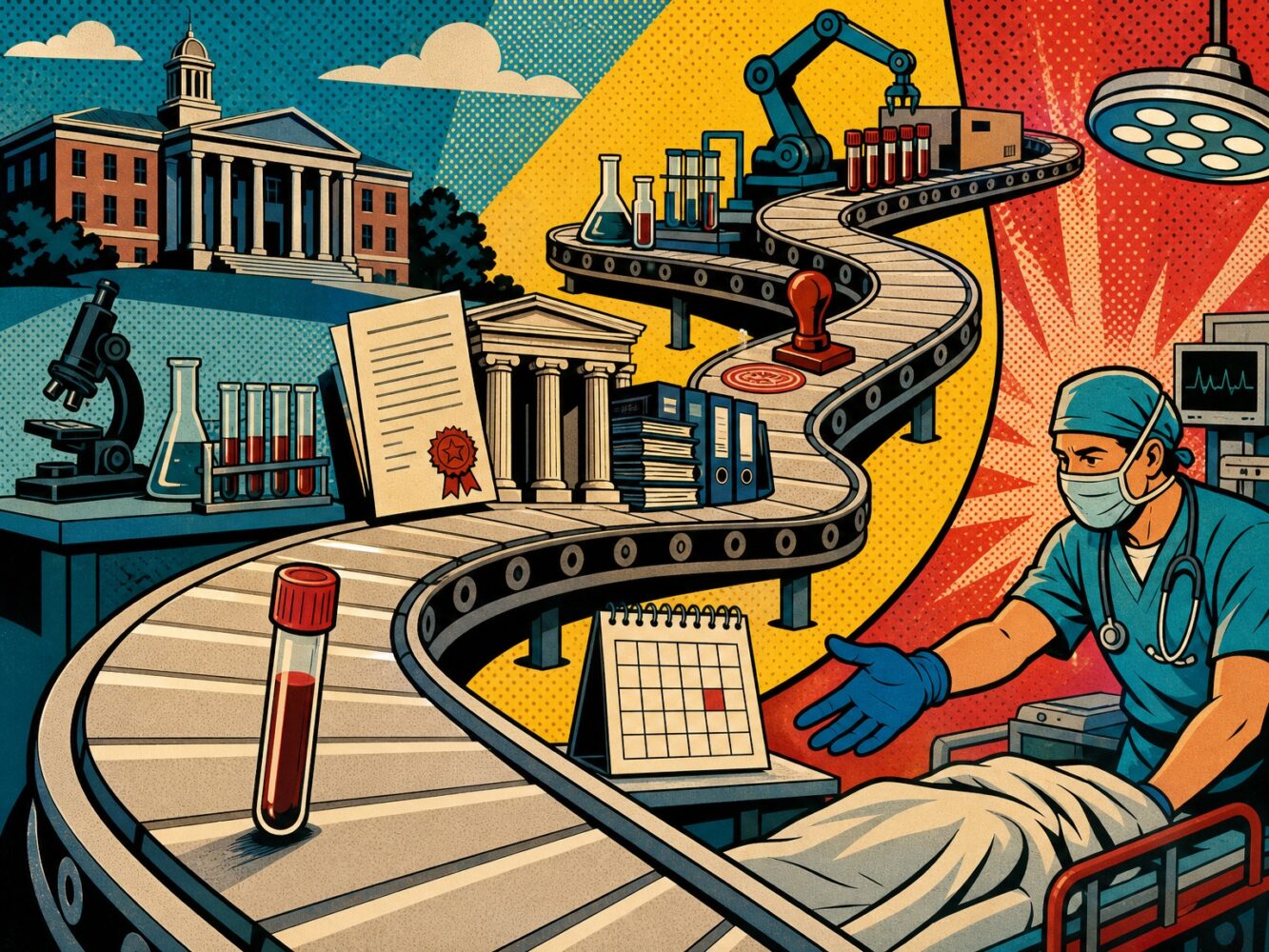
A blood test now helps doctors decide, in about 15 minutes, whether a patient with a suspected brain injury needs a CT scan. It took about 20 years to get there.
That gap between scientific promise and clinical use tells us more about American innovation policy than most congressional hearings ever will.
At one such hearing earlier this week, members of the Senate Judiciary Committee returned to one of the most consequential and least understood questions in innovation policy. Which inventions qualify for patent protection? The hearing focused on S. 1546, the Patent Eligibility Restoration Act (PERA), Congress’ latest attempt to resolve more than a decade of confusion over Section 101 of the Patent Act.
The debate turned on statutory text, Supreme Court precedent, and competing theories of patent policy. Senators heard about abstract ideas, laws of nature, diagnostic methods, and judicial exceptions to patent eligibility. Those questions matter, but they can quickly drift away from the inventions and patients affected by them.
To see the stakes, the committee need look no further than a trauma bay at UPMC Presbyterian Hospital in Pittsburgh.
Physicians there can now use a blood test to help determine whether an adult with a suspected traumatic brain injury needs a CT scan. Instead of relying only on visible symptoms or sending every patient for costly imaging, doctors can measure two proteins released into the bloodstream after brain injury. Those proteins are glial fibrillary acidic protein (GFAP) and ubiquitin carboxyl-terminal hydrolase L1 (UCH-L1).
The test gives physicians objective biological evidence in one of emergency medicine’s most difficult diagnostic settings. Until recently, it remained a scientific aspiration.
Its 20-year path to patients captures both the strengths of the American life-sciences system and the institutional burdens that can slow it down. Abbott’s i-STAT TBI test emerged through university research, federal funding, patents, startups, venture capital, technology transfer, clinical trials, strategic acquisitions, Food and Drug Administration (FDA) review, and entrepreneurial judgment. It also encountered the uncertainty created by judicial decisions that narrowed patent eligibility for diagnostic inventions.
The history of the test reaches well beyond diagnostics. It shows how people and institutions make costly decisions under profound uncertainty to create knowledge that did not exist before. It also shows why innovation policy should be judged by whether it helps today’s discoveries become tomorrow’s treatments.
The Long Road Out of the Lab
The story begins in a university laboratory.
More than two decades ago, neuroscientist Kevin Wang and his colleagues at the University of Florida began studying whether proteins released after a traumatic brain injury could help physicians detect damage that clinical observation often missed. The National Institutes of Health (NIH) and the Department of Defense (DOD) funded much of the work, reflecting the importance of brain injuries to civilian medicine and to military personnel returning from combat.
At that point, there was no commercial product, no FDA-cleared test, and no global distribution plan. There was a scientific hypothesis that Wang and his colleagues believed might someday improve patient care.
Most promising discoveries never get much further. Many disappear into the “valley of death,” the long, expensive, and uncertain period between laboratory research and commercial use. A technology must survive further study, product development, clinical validation, regulatory review, manufacturing, distribution, and repeated rounds of financing before it reaches a patient.
Money is only part of the problem. The process also depends on entrepreneurial judgment under genuine uncertainty. Scientists cannot know whether early findings will survive later experiments. Investors cannot know whether years of research will yield a viable product. Entrepreneurs must commit scarce resources without knowing whether regulators will approve the technology, physicians will adopt it, or competitors will produce something better first.
Ludwig von Mises described this kind of decision-making as purposeful human action directed toward an uncertain future. As I have argued, innovation does not emerge predictably from a machine-like process. It depends on people who interpret incomplete information, imagine possible futures, and act before the outcome is known.
That view differs sharply from policy accounts that treat innovation as the automatic result of greater research spending, industrial policy, or government planning. Those accounts assume that more inputs will produce more outputs. They leave little room for judgment, error, adaptation, or discovery.
The Austrian tradition begins with human choice. People form expectations, weigh risks, and commit resources today in hopes of creating something valuable tomorrow. Entrepreneurship is therefore central to innovation because every meaningful advance requires someone to act before success can be measured.
The traumatic-brain-injury (TBI) blood test illustrates that process at every stage of its development.
Patents Make Strange Bedfellows
Wang and his colleagues knew that academic research alone would not bring the test to patients. In 2002, they helped establish Banyan Biomarkers to turn the university’s discoveries into a commercial diagnostic.
That move from laboratory to startup reflects a familiar division of labor in American innovation. Universities specialize in basic research. Startups test, refine, and develop new technologies. Large firms bring manufacturing capacity, regulatory expertise, and global distribution. Each does something different, and none does everything equally well.
This specialization matters most in knowledge-intensive industries, where scientific discovery and mass production demand very different skills. Jonathan Barnett calls research-focused organizations “idea factories.” They concentrate on developing technology, then use intellectual property rights and contracts to work with firms that possess the capabilities needed for commercialization.
Banyan fits that model closely. It lacked Abbott’s manufacturing and distribution network. Abbott could not recreate two decades of specialized biomarker research on demand. Each possessed knowledge and capabilities the other lacked. Patents allowed them to combine those assets rather than duplicate them.
That role complicates the familiar claim that patents mainly confer monopoly privileges and suppress competition. In biotechnology and the life sciences, patents often make cooperation possible. They give researchers enough legal protection to disclose discoveries, negotiate licenses, attract investment, and work with commercial partners without surrendering the invention the moment they reveal it.
Kenneth Arrow identified the underlying problem decades ago. A prospective buyer often must learn an idea before deciding what it is worth. Once the buyer knows the idea, though, the seller may have little left to sell. Intellectual property partly resolves that paradox by allowing innovators to share information while retaining enforceable rights.
Barnett carries the argument further. Strong intellectual property rights allow researchers and manufacturers to specialize according to comparative advantage. Research organizations need not build factories and distribution networks. Manufacturers need not reproduce every scientific discovery themselves. Licensing and collaboration let each side contribute what it does best, reducing both development costs and time to market.
Abbott’s 2019 acquisition of Banyan therefore marked more than the closing of a corporate deal. It capped a decadeslong process in which universities, startups, investors, clinicians, and established firms supplied knowledge, capital, and organizational capabilities that no single institution possessed.
Friedrich Hayek argued that economic knowledge exists in dispersed fragments rather than in one mind or institution. Markets coordinate those fragments by allowing people with partial knowledge to cooperate through exchange. The TBI test offers a vivid example.
No central planner designed its path. No agency coordinated every stage. Researchers, entrepreneurs, investors, clinicians, patent lawyers, technology-transfer professionals, regulators, manufacturers, physicians, and patients each contributed specialized knowledge. Institutions that support property rights, contracts, investment, and exchange allowed those contributions to become a usable diagnostic.
The result is a scientific achievement made possible by entrepreneurial coordination.
The Government’s Patent Attic
The TBI blood test also depended on one of the most consequential innovation laws Congress has enacted: the Bayh-Dole Act of 1980.
Bayh-Dole allowed universities to retain ownership of inventions developed through federally funded research. That familiar description is accurate, but it understates both the problem Congress faced and the importance of the remedy.
Before Bayh-Dole, ownership of federally funded inventions usually followed the funding rather than the inventor. Universities often agreed that discoveries produced with federal support would belong to the government. The arrangement may have looked tidy on paper. In practice, tens of thousands of government-owned patents accumulated, while relatively few were licensed or commercialized.
Promising discoveries stalled because the institutions best positioned to develop them neither owned them nor had strong incentives to invest in them. The defect lay in the structure itself.
The American patent system traditionally linked invention, ownership, and voluntary exchange. Inventors created new knowledge, property rights allowed them to control and transfer it, and markets helped move it into wider use. The Framers reflected that understanding in the Constitution, which empowers Congress to secure authors and inventors exclusive rights for limited periods to promote science and the useful arts.
Bayh-Dole restored that link for federally funded university research. Universities could retain title to faculty inventions, negotiate licenses, form startups, attract private investment, and partner with firms that possessed the manufacturing, regulatory, and distribution capabilities needed to reach patients.
Its success came largely from removing a government-created barrier to commercialization. Though Bayh-Dole is a federal statute, it worked by giving universities and inventors greater control over how discoveries moved into private development.
That distinction matters. Effective reform often requires clearing away rules that block productive exchange. Contemporary innovation policy too often moves in the opposite direction, layering new interventions atop the unintended consequences of older ones.
The TBI test’s subsequent history shows how costly that habit can become.
The Cost of Taking Our Time
The successful commercialization of the TBI blood test deserves celebration. Its 20-year journey does not.
Some of that delay reflects the difficulty of medical innovation. Clinical testing takes time. Regulators must protect patients. Manufacturing sophisticated diagnostics at commercial scale is demanding. None of that resolves the central question. Should a test that can improve traumatic-brain-injury diagnosis really take two decades to reach routine clinical use?
Innovation policy rarely asks. Regulators and lawmakers focus far more on the dangers of moving too quickly than on the costs of moving too slowly. Agencies are judged for visible failures, such as approving an unsafe product. They receive little credit for benefits that arrive sooner because a needless delay was avoided.
Yet delay carries real costs. Patients continue to receive less effective care. Physicians make decisions with poorer information. Researchers and entrepreneurs spend time and money answering regulatory concerns instead of advancing the technology. Investors keep funding facilities, equipment, and personnel without knowing when, or whether, a return will come.
Many discoveries never survive the process.
Those losses rarely appear in regulatory accounting because they consist mostly of opportunities forgone. A regulator cannot identify the patient who might have benefited five years earlier. An agency cannot count the startup that was never formed because commercialization looked too uncertain. A policymaker cannot see the investor who shifted capital to a safer project after watching another technology stall.
Hayek’s account of dispersed knowledge applies with particular force. The information needed to assess innovation is spread among scientists, entrepreneurs, physicians, investors, manufacturers, and patients. Each knows something the others do not. No regulator can collect all of it, especially when the missing knowledge concerns futures that delay prevents from ever occurring.
That is why the TBI test’s 20-year path should inspire concern alongside admiration. If this is one of the success stories, the more troubling question concerns the inventions that never made it out.
Whose Risk Is It, Anyway?
These concerns lead to one of innovation policy’s hardest questions. Who should decide when a new technology is safe and effective enough for broader use?
The conventional answer is expert regulators. The Austrian answer begins with a caveat. Expertise matters, but it is always incomplete. Even the most capable regulator possesses only part of the knowledge needed to make decisions for millions of patients with different conditions, values, and tolerances for risk.
Medicine makes that limitation plain. Safety and efficacy are not absolute measures. Both require judgments about tradeoffs under uncertainty, and those tradeoffs vary across patients.
A healthy college athlete with a suspected concussion may tolerate less diagnostic uncertainty than a 75-year-old patient with several serious conditions. A patient with terminal pancreatic cancer may accept risks that someone seeking treatment for a minor illness would reject. Those choices reflect life expectancy, quality of life, family circumstances, personal values, and appetite for risk.
No formula can fully capture those differences. Patients possess that knowledge, often with help from physicians who understand both the evidence and the individual case. A centralized regulator, however skilled or well intentioned, cannot know every patient’s preferences.
Former Sen. Ben Sasse’s diagnosis with metastatic pancreatic cancer illustrates the point. After doctors reportedly told him that he might have only months to live, Sasse gained access to daraxonrasib through the FDA’s expanded-access program. The drug had shown promise in clinical trials and had already received Breakthrough Therapy and Orphan Drug designations, though it had not yet won full approval.
Sasse reportedly experienced a sharp reduction in tumor volume. His case does not prove that every experimental therapy should become immediately available, or that regulatory oversight serves no purpose. It shows that patients facing radically different circumstances can rationally value uncertainty in radically different ways.
Someone facing probable death within months may accept risks that a healthy regulator or lawmaker would refuse. That judgment is not irrational. It reflects consumer sovereignty.
Mises argued that market economies ultimately answer to consumers rather than producers or planners. In medicine, those consumers are patients working with physicians who understand the science and the patient’s circumstances.
The current FDA model asks regulators to choose the proper balance among safety, efficacy, speed, uncertainty, and opportunity cost for millions of different patients. The knowledge needed to make that choice does not exist in one place.
Policymakers should therefore consider making accelerated pathways more broadly available to patients facing the gravest risks and fewest alternatives. Earlier access could reduce development costs, shorten the path to market, and allow adoption to proceed gradually among patients with the strongest reasons to accept uncertainty.
That approach could also improve safety monitoring. Rare risks often emerge only after a treatment reaches real-world patients, including those excluded from clinical trials. Gradual uptake among patients with high expected benefits could reveal those risks before widespread use, rather than concentrating adoption during a heavily marketed launch.
How to Patent Around a Court
If Bayh-Dole shows how removing a legal distortion can encourage entrepreneurial discovery, the Supreme Court’s recent patent-eligibility decisions show how creating one can impede it.
The shift began with Mayo Collaborative Services v. Prometheus Laboratories in 2012, followed by Association for Molecular Pathology v. Myriad Genetics and Alice Corp. v. CLS Bank. Together, those decisions transformed the law governing which inventions qualify for patents.
Section 101 of the Patent Act had long served as a “coarse filter,” reflecting Congress’ broad definition of patentable subject matter. The Court instead made eligibility turn increasingly on judge-made exceptions for laws of nature, natural phenomena, and abstract ideas.
The result has been years of uncertainty for inventors, patent examiners, investors, district courts, and even the U.S. Court of Appeals for the Federal Circuit, which hears patent appeals. PERA’s congressional findings acknowledge the confusion and inconsistency that followed.
The TBI blood test shows why that uncertainty carries practical consequences. A patent claiming only the discovery that elevated levels of GFAP and UCH-L1 correlate with traumatic brain injury might face rejection as an attempt to patent a law of nature. Patent prosecutors responded as people usually do when the rules change. They adapted.
The resulting patent portfolio claims far more than the biomarkers themselves. It covers assays, antibodies, cartridges, point-of-care systems, patient-management methods, imaging decisions, and integrated diagnostic processes.
Earlier diagnostic patents often stated the invention directly. Later patents increasingly resemble elaborate commercialization blueprints constructed to survive a doctrine that may not protect the underlying scientific discovery.
Patent lawyers did not suddenly become more inventive, nor did scientists become more acquisitive. Courts changed the rules, and innovators changed their behavior in response. Much of contemporary innovation policy misses that simple point.
The Court Changes the Rules, Everyone Else Adapts
One of Mises’ most durable points is that people do not passively submit to institutional design. They adjust their behavior when incentives change. The point sounds obvious until policymakers forget it.
The Supreme Court likely believed it was addressing a genuine problem in Mayo. Whether one agrees with the decision or not, the justices’ concern was clear. Broad patents on natural laws might impede scientific progress rather than promote it.
The difficulty lay in the consequences the Court could not predict. It could change legal doctrine, but it could not know how inventors, entrepreneurs, universities, venture capitalists, technology-transfer offices, patent lawyers, and established firms would respond once the new incentives spread through the patent system.
That knowledge did not yet exist.
Hayek’s “The Use of Knowledge in Society” is often described as an argument about dispersed information. Its deeper point concerns knowledge that emerges only through action. The information needed for economic coordination exists in fragments, scattered among people whose plans and expectations change as circumstances change.
No central decision-maker can collect all of that knowledge because much of it appears only after people begin adapting.
The Supreme Court therefore took on a task no court could complete. It might predict how judges would apply a new patent-eligibility test. It could not predict how inventors and firms would redesign claims, alter investment decisions, abandon research, or build new legal strategies around “laws of nature,” “natural phenomena,” and “abstract ideas.”
That is no indictment of the Court’s intelligence. It is a limit on what any institution can know.
The Thicket Thickens
Contemporary patent policy contains a sizable irony. Critics now argue that pharmaceutical “patent thickets,” portfolios of overlapping patents covering a single product, impede competition. The recently introduced Eliminating Thickets to Increase Competition (ETHIC) Act rests on that premise and would limit the assertion of patents linked through terminal disclaimers in pharmaceutical litigation.
The immediate question is not whether the bill is sound. A more useful question comes first. Why did these increasingly complex portfolios emerge?
The standard answer blames firms seeking to prolong their “monopolies” by abusing the patent system. That may explain some conduct. The TBI blood test suggests another cause.
Suppose diagnostic claims had remained reliably eligible for patents under Section 101. Innovators might have relied on a smaller number of properly scoped claims rather than assembling portfolios covering diagnostic methods, antibodies, cartridges, devices, software, manufacturing techniques, and clinical workflows.
Patent prosecution is expensive, and maintenance fees accumulate. A limited portfolio, updated through continuation applications as the technology and market develop, is often simpler and cheaper.
Continuation practice serves a legitimate purpose. It allows patent claims to evolve as inventors learn more about commercial uses, competitors, and practical versions of an invention. The harder question is whether uncertainty over diagnostic patents now pushes innovators to file more continuations, divisional applications, and related patents than they otherwise would.
If so, some patent thickets may reflect a rational response to legal uncertainty. When courts make direct protection for a diagnostic discovery unreliable, innovators spread protection across multiple narrower patents.
That possibility changes the policy story. At least some patent thickets may be consequences of an earlier intervention rather than independent defects in the patent system. Innovators adapted to the incentives created by judicial doctrine.
The cycle is hard to miss. One intervention changes incentives. Firms respond. Policymakers then cite those responses as grounds for another intervention.
The Cure for the Cure
Nearly a century ago, Mises described this pattern in his critique of interventionism. Government action often produces results policymakers did not expect. Instead of revisiting the original policy, they treat the resulting distortions as proof that another intervention is needed.
The cycle then repeats. Each new rule tries to repair the damage caused by the last one while leaving the original source of the problem intact.
American innovation policy increasingly follows that script. Federal ownership rules weakened incentives to commercialize publicly funded research. Bayh-Dole removed much of that barrier, and commercialization accelerated.
The Supreme Court’s patent-eligibility decisions then created new uncertainty. Innovators responded by changing how they drafted claims and structured patent portfolios. Lawmakers now condemn those more complicated portfolios as abuse and propose limiting their use.
Enter the ETHIC Act.
Whether the bill becomes law is almost secondary. The larger pattern is what matters. One intervention distorts incentives. Innovators adapt. Policymakers then treat that adaptation as a new defect requiring still more intervention.
The deepest cost is that each new layer makes the original mistake harder to see.
No One Has Neutral Incentives
Public Choice economics adds another question that innovation policy often skips. Why assume judges, regulators, legislators, or agencies have better incentives than entrepreneurs, physicians, investors, or patients?
Expertise alone cannot answer it. Expertise matters, but knowledge and incentives are different. Scientists, physicians, patent examiners, judges, and entrepreneurs each know different things. The harder question is whether any institution possesses enough information, and the right incentives, to direct entrepreneurial discovery better than a decentralized process.
Public Choice scholars have long argued that government officials respond to incentives just as private actors do. Agencies seek larger budgets. Legislators answer to constituencies. Courts favor rules they can administer. Universities compete for grants. Companies seek profits. Venture capitalists seek returns.
No one occupies a neutral perch above the system. Everyone responds to incentives.
Recognizing that does not require cynicism. It requires humility, especially about the ability of any institution—even the Supreme Court—to predict how millions of purposeful actors will respond when the rules change.
Congress, Clean Up the Court’s Mess
That brings us back to the July 14 Senate hearing. Congress should not have to repair patent-eligibility doctrine, but it does.
The current framework is unworkable. Lower courts struggle to apply standards that judges themselves often describe as incoherent. Inventors, entrepreneurs, and investors remain uncertain about what qualifies for protection, especially in diagnostics and computer-implemented inventions. That uncertainty has weakened U.S. innovation in fields where the country can least afford hesitation.
The Patent Eligibility Restoration Act reflects an important institutional judgment. Congress, not the judiciary, bears responsibility for defining patent eligibility. PERA’s greatest contribution may be its recognition that the courts created exceptions and confusion that Congress never enacted.
I am less persuaded that Congress should replace one complicated framework with another. A simpler and more constitutionally faithful solution would restore Section 101 largely to the role Congress originally gave it.
The Supreme Court decides cases and controversies. It does not rewrite statutes according to changing policy preferences, especially in patent law. Article I, Section 8 gives Congress the power to establish the patent system, and Congress exercised that power through Title 35 of the U.S. Code. Judicially created exceptions therefore present a serious separation-of-powers problem.
My central concern is judicial legislation. Section 101 did not change. The Supreme Court changed its meaning without congressional authorization.
Congress may adopt PERA, pursue another reform, or restore Section 101 to its original function. That choice belongs to Congress.
The needed reform is modest. For most of American history, Section 101 served as a coarse filter that identified broad categories of patentable subject matter. The Patent Act assigned the harder questions elsewhere. Sections 102, 103, and 112 ask whether an invention is novel, nonobvious, and adequately described.
Section 101 need not do all of patent law’s work at once.
That division of labor governed during more than two centuries of technological progress and economic growth. Yet many courts, commentators, and technology users entered the 21st century convinced that the system produced too many patents. They responded by expanding a threshold eligibility test into a broad policy instrument.
That confidence reflects the institutional conceit Hayek warned against. Innovation policy should ask whether legal institutions encourage the discoveries that have yet to occur. That inquiry requires policymakers to account for visible costs and for inventions delayed, abandoned, or never attempted.
First, Do No Harm to Innovation
As senators debate patent eligibility, they should remember the trauma bay in Pittsburgh.
A physician now holds in one hand the product of more than 20 years of scientific research, entrepreneurial judgment, private investment, technology transfer, clinical validation, patent prosecution, manufacturing expertise, regulatory review, and commercial development. No planner designed that journey. No single institution possessed all the knowledge needed to complete it.
The achievement is that the system succeeded. The troubling question is why success required so much time, money, and persistence.
The greatest cost of a weakened innovation system does not appear in investment totals or patent counts. It appears in the inventions that never emerge. The startup is never formed. The investment is never made. The diagnostic never reaches patients. The entrepreneur decides the odds are too poor and walks away.
Those losses cannot be measured because they never become visible. That makes them easy to ignore, but no less real.
The blood test now improving trauma care in Pittsburgh offers more than a medical success story. It shows what free people can accomplish when secure property rights, voluntary exchange, and institutional humility allow dispersed knowledge to become useful innovation.
Congress cannot plan the next breakthrough. It can stop making the path harder.
