Through chromatic velocity, instinctive mark-making and a devotion to service, Tim Yanke turns abstraction into something deeply personal and generous.
The first thing Tim Yanke gives us is color—not pigment arranged merely to flatter a room, but color with appetite, current and emotional consequence. Coral dissolves into violet; acid green presses against bruised rose; electric blue advances. Across these works, pigment surges until the canvas feels less like an object than a living field of pressure.
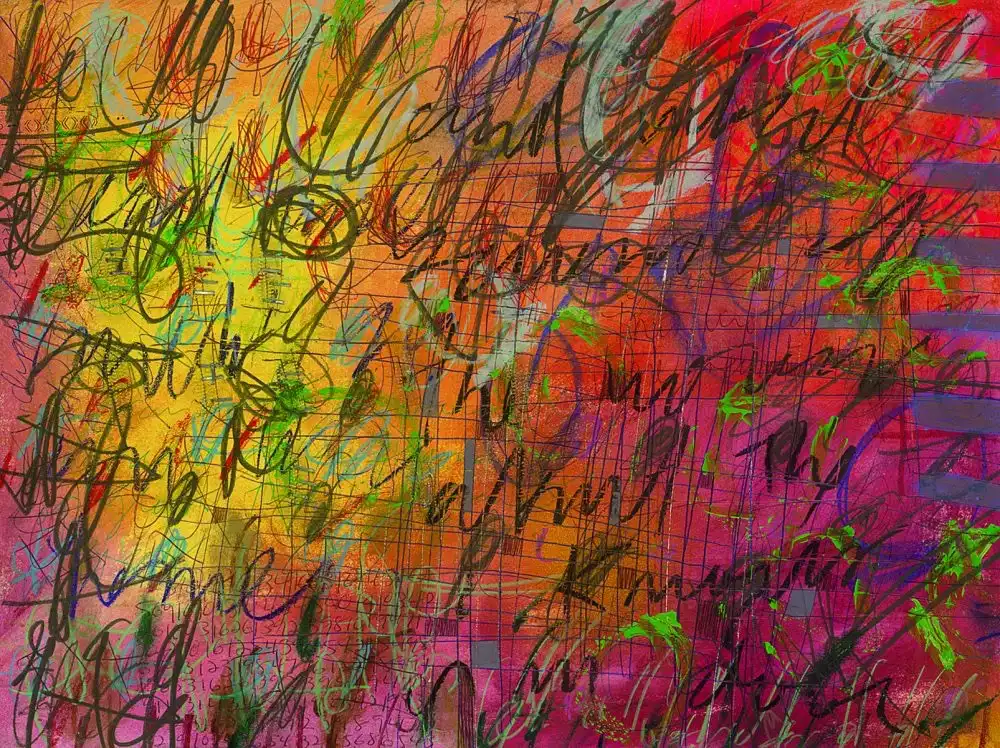
Each composition appears to have endured private revolutions. One work layers pinks and reds into translucent planes, scraped passages and blue descents that suggest architecture recalled through heat. Another is crossed with grids, drifting script and restless loops, as though language has dissolved into weather. In the largest canvas, yellow, orange, violet and cobalt meet in near-combustion, while white paint scatters like sparks after impact.
The art-historical lineage is visible, though never restrictive. Pollock’s kinetic sweep can be felt in the physicality of the mark. Cy Twombly flickers through the nervous calligraphy, while Hans Hofmann’s push and pull emerges through stacked planes and chromatic tension. Kandinsky’s belief in color as emotional language also feels near. Yanke enters this conversation without becoming captive to it, preserving the urgency of Abstract Expressionism while softening its appetite for psychic ruin.

Perhaps this is where the paintings acquire their particular fire. The canvas remains an arena, though not solely for catastrophe. Joy arrives with equal intellectual seriousness. Tenderness retains its strength, while hope is spared the indignity of becoming ornament. Yanke understands that radiance can possess rigor and that beauty need not apologize for surviving grief.
His process begins without a fixed destination or preconceived image. Yanke may enter the studio thinking in deep blue or violet, only to discover that brilliant orange has seized the composition and altered its emotional climate. Music, rhythm and bodily instinct guide the hand, allowing the painting to reveal itself before the intellect can overmanage it. Chance is welcomed, though never mistaken for carelessness. Beneath the abandon sits a trained understanding of balance and visual weight.
That openness gives color its authority. Pink carries intimacy without fragility. Yellow offers warmth without surrendering complexity. Blue introduces depth and, at moments, melancholy. Black interrupts, stains and wounds. The brighter passages do not erase those darker incursions; rather, they answer them. Hope, in Yanke’s work, is not naïveté. It is defiance after knowledge.
The emotional source of that conviction becomes especially poignant through the memory of his sister. In 1976, Yanke’s only sister died in a car accident at 20 while traveling home for Christmas. Shortly before her death, he had visited her in Arizona with his parents and encountered a landscape whose scale and chromatic intensity remained lodged in his imagination. Those memories later surfaced in his paintings, not as borrowed identity or decorative mythology, but as a private archive of love, rupture and remembrance. Color became, perhaps, his way of preserving what grief had threatened to erase.

His philanthropy follows the same emotional logic. Through an initiative tied to America’s 250th anniversary, $250 from every sale of *Yanke Doodle II* supports Operation Homefront and its work with military and veteran families. The gesture is patriotic, though its deepest strength lies in its usefulness. Symbolism becomes more persuasive when it shelters, stabilizes and serves.
Yanke’s flag paintings began after September 11, when he and his son raised a flagpole at their Michigan home. Rather than reproduce the emblem as fixed iconography, he opened it to unexpected color, allowing it to absorb the plurality, contradiction and promise of the nation. His work has since entered diplomatic and museum settings, including the U.S. Department of State’s Art in Embassies program and the Art Museum of the Americas, where abstraction becomes a language of encounter rather than a private monologue.
Yanke does not paint happiness as though darkness never occurred. He lets the scratches, stains and frantic handwriting remain, then gives them pink, gold, blue and enough room to breathe. Beauty, in his hands, does not deny the human condition. It faces the wound, floods it with color and refuses to let suffering possess the final word.
