This story was originally published by Chalkbeat. Sign up for their newsletters at ckbe.at/newsletters.
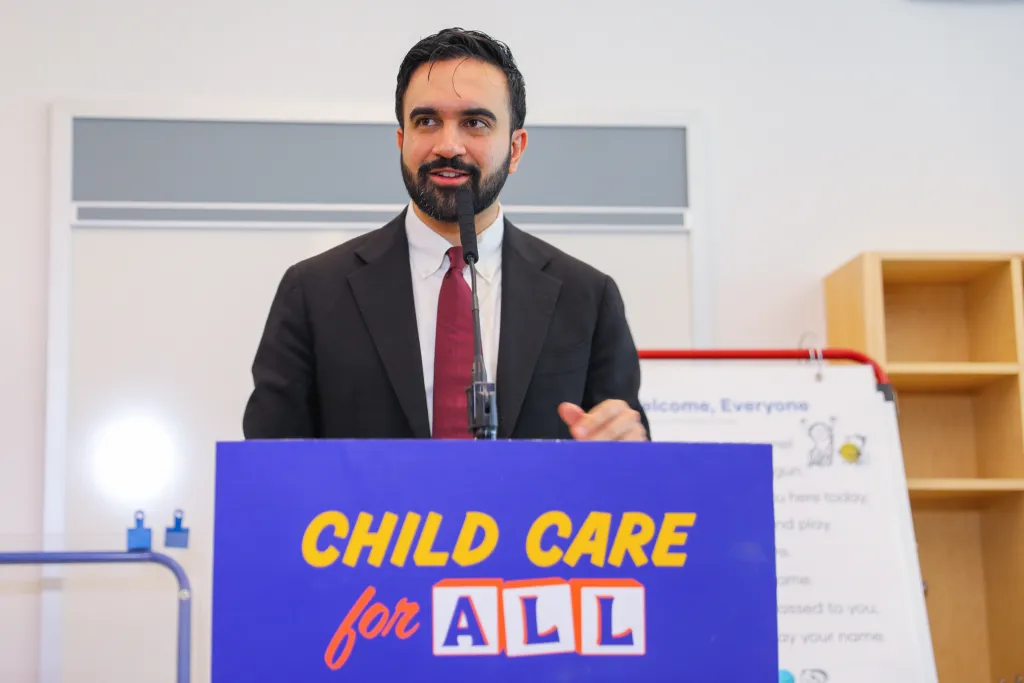
In his first six months in office, New York City Mayor Zohran Mamdani has issued a steady stream of announcements and policy initiatives in the three areas that powered his affordability-focused campaign: childcare for kids 5 and younger, transportation, and housing.
But when it comes to K-12 public education — the largest operation under Mamdani’s control by both budget and headcount — the story has been quite different.
Out of the hundreds of press releases Mamdani sent out since his term began, just 11 relate to K-12 education, according to a Chalkbeat analysis. Only one announced a new policy affecting what happens inside classrooms serving more than 800,000 elementary- to high school-age students. And even the new policy — expanding a reading and math curriculum overhaul launched under his predecessor Eric Adams — largely continued work already underway.
Other press releases related to winter storms, street safety outside schools, and the opening of new schools that started under a previous administration.
Mayoral press releases are an incomplete measure of Mamdani’s record and agenda on K-12 education, and schools Chancellor Kamar Samuels has introduced several initiatives of his own. But some longtime education watchers — including Mamdani supporters — said the dearth of attention to K-12 schools and absence of concrete policy proposals one-eighth of the way through Mamdani’s first term raises questions about how he will manage a core function of the city’s government.
“He’s the first mayor that I’ve seen … to have so little apparent interest in our public schools from K-12,” said Leonie Haimson, the executive director of Class Size Matters and a longtime education advocate. She argued that Mamdani could use his “progressive values to really make a difference in our schools,” adding that overseeing public schools “is a very critical part of his responsibilities.”
In many ways, the lack of focus on K-12 schools during Mamdani’s first months in office is not a surprise. Education didn’t figure prominently into his mayoral campaign, which focused on his key priorities and largely avoided political fights that could distract from those efforts. Some observers suggested that an aggressive push to make the K-12 system more equitable — a political minefield for progressive politicians — may feel too risky when Mamdani is still shoring up support for his core agenda.
Keeping up his “laser focus” on expanding free childcare — a broadly popular policy — could pay political dividends by providing economic relief for families while also better preparing children for K-12 schools, said Shael Polakow-Suransky, president of Bank Street College of Education and a former deputy chancellor under Michael Bloomberg.
“That is where the political capital on education will need to be spent over the next few years, if they’re going to deliver on that promise and actually get the educational benefits,” he said.
Polakow-Suransky and others familiar with the Mamdani administration’s education plans said the quiet start on K-12 policy may be a deliberate effort by Mamdani and Samuels to gather input before making potentially disruptive changes.
But other observers noted that while Mamdani still has time to make his mark on city schools, his current approach risks further entrenching a status quo marked by deep problems and inequities.
“The absence of any identifiable priority is a worry,” said David Bloomfield, a professor emeritus of education leadership, law, and policy at Brooklyn College and CUNY Graduate Center.
The longterm benefits of an improved K-12 school system take years to materialize, Bloomfield noted, unlike the more immediate benefits of Mamdani’s policy priorities.
“He seems to feel that what’s in place is good enough,” Bloomfield said.
Jenna Lyle, a spokesperson for Mamdani, disputed the idea that he has focused less on K-12 education in his early months than predecessors.
“Change isn’t measured by the number of press releases we send out. It’s measured by whether people’s lives are better because they were invited to shape the policies that affect them,” she said. The administration is preparing to “share our broader vision for public schools” by holding listening sessions and gathering community feedback, she added.
What has Mamdani done so far, and how does it compare to past mayors?
Mamdani offered few sweeping education promises on the campaign trail, but did stake out several positions that set him apart from his competitors, including ending mayoral control of city schools and removing kindergarten entry to the city’s gifted and talented program.
Neither has come to pass.
Mamdani reversed his position on mayoral control shortly before taking office. He also backed away from a campaign promise to quickly comply with the state’s class size law, instead asking for an extension to save money this fiscal year.
He has not advanced proposals to change the gifted and talented program or offer prospective new teachers tuition assistance, as he pledged during the campaign. He has made some efforts to reduce the Education Department’s astronomical contracts budget, but those efforts have been complicated by scrutiny over allegations that Samuels violated contracting rules in a previous role. He also continued a pandemic-era policy launched under Bill de Blasio and continued by Adams to spare schools with declining enrollment from budget cuts.
Most longtime education observers said Mamdani has focused noticeably less on K-12 education than his immediate predecessors, Adams, de Blasio, and Bloomberg — though several noted that those mayors’ education agendas didn’t fully come into focus during their first six months in office.
Adams issued 21 press releases related to K-12 education during his first six months, including announcements expanding the gifted and talented program, introducing dyslexia screening, and rehiring district superintendents, a Chalkbeat analysis found. His most recognizable education policy, NYC Reads, was announced more than a year into his tenure.
Bloomberg made controversial and sweeping reforms of the K-12 school system a centerpiece of his agenda. De Blasio, like Mamdani, initially emphasized childcare, but nine months into his tenure launched a major effort to flood struggling schools with additional resources.
Matt Gonzales, a longtime school integration advocate who served on Mamdani’s education transition team, said preserving programs for vulnerable students in the recent budget agreement between Mamdani and the City Council was a significant early policy achievement. He also argued that introducing new policies in the middle of a school year could be disruptive.
“I want all the big pronouncements and priorities laid out ASAP,” he said. But “there’s a real need to stabilize the system … and then move a vision for education in this new school year.”
What does Mamdani’s quiet start on K-12 education mean for schools?
While the Mamdani administration hasn’t offered a detailed public agenda for K-12 schools, officials have negotiated the budget and an extension of the state’s class size law deadline, said Aaron Pallas, a professor of sociology and education at Columbia University Teachers College. (The Education Department issued a press release with a quote from Mamdani detailing the new class size plan).
He added that making meaningful change in a system as sprawling as New York City is difficult and that “on the ground level, a lot can continue in a positive way without high-level policy pronouncements.”
But if outcomes such as test scores and graduation rates slip, Mamdani may face “pressure to do more,” he said.
Some advocates hope Mamdani will focus on increasing racial and socioeconomic integration, and merging underenrolled schools — two longtime priorities for Samuels. Others want him to stake out a firm position against artificial intelligence in schools.
Whatever the agenda looks like, some supporters hope Mamdani will bring the same public attention campaign he’s launched for childcare — including a jingle contest judged by Cardi B — to K-12 education.
“I’m hopeful that we see more of that kind of skill around education, especially as they really get to take the reins of things this school year,” Gonzales said. “That’s going to really need the mayor’s messaging and savviness.”
Michael Elsen-Rooney is a reporter for Chalkbeat New York, covering NYC public schools. Contact Michael at melsen-rooney@chalkbeat.org.
Our nonprofit newsroom relies on donations from readers to sustain our local reporting and keep it free for all New Yorkers. Donate to THE CITY today.
The post As Mamdani Focuses on Childcare, Some Experts Question His K-12 Priorities appeared first on The City Reporter.
