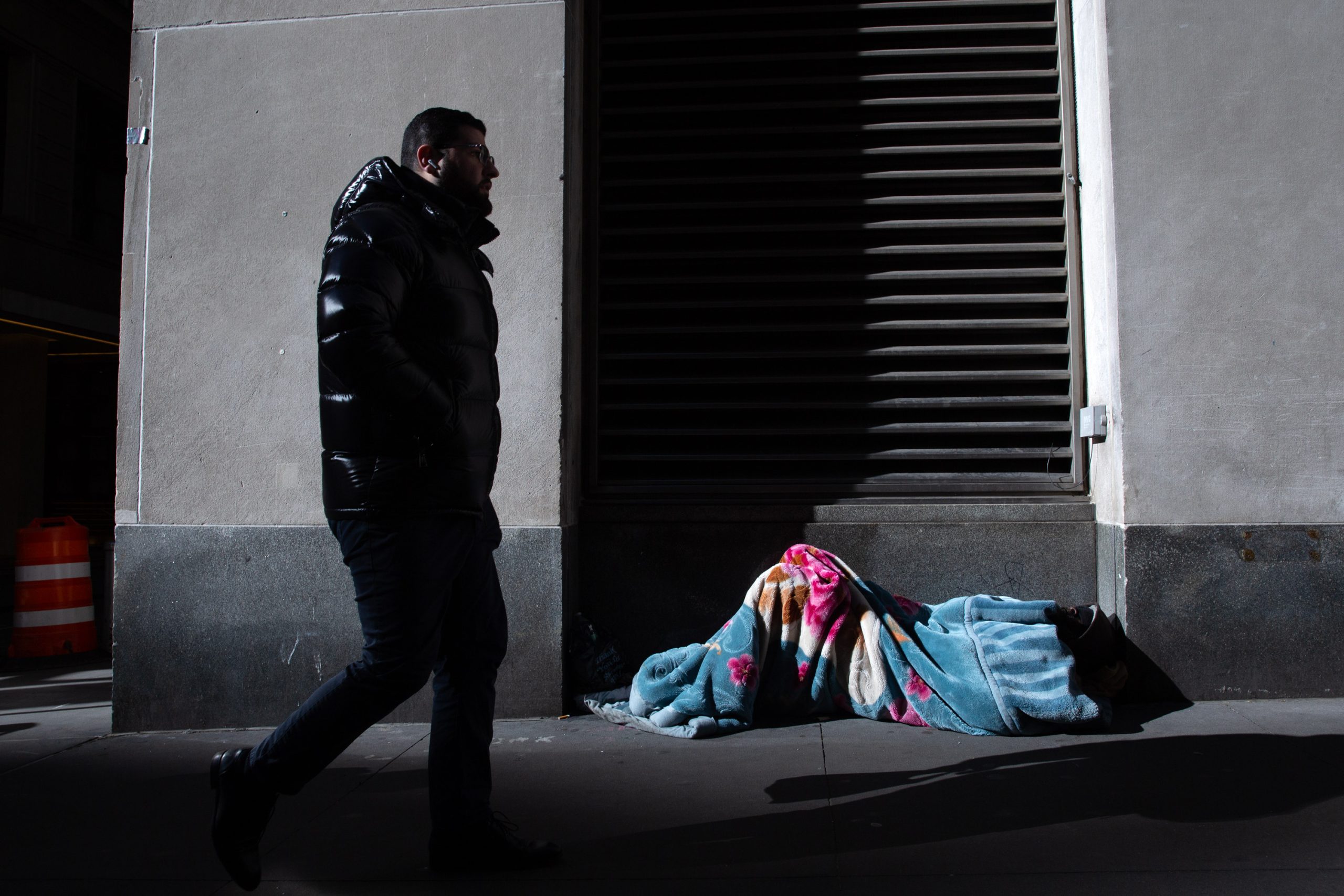
The sun has gone down and the temperature’s below freezing. There’s no sign of warmth outside, other than the steam pluming up from underground. You’re speed-walking to get inside, but you notice someone around the corner who’s unsheltered.
You want to help, but what actually happens if you call 311, the city’s service hotline? And what else can you do?
More than 4,500 New Yorkers live on the streets, according to the city’s latest estimate. And whenever the temperature, with windchill, dips below 32 degrees between 4 p.m. and 8 a.m., the emergency management team at the Department of Social Services issues a “Code Blue” alert.
That’s a signal for the Department of Homeless Services to follow specific protocols during their street outreach efforts, carried out by more than 400 workers around the clock daily.
On typical days, outreach workers — mostly contracted through non-profit organizations — are generally focused on canvassing the streets, building trust with unhoused individuals and responding to 311 calls about homeless assistance.
During Code Blue nights, however, outreach workers are focused on reaching individuals on priority lists, which are submitted by service providers to DHS before the beginning of the cold months.
DHS could not immediately provide the total number of people included on these lists. But outreach providers who spoke to THE CITY say the lists generally focus on unsheltered individuals who are older, who live with medical, mental health or substance use conditions, or who appear to be chronically underdressed. Outreach workers are supposed to contact those individuals every four hours starting at 8 p.m. until the Code Blue event ends the next morning, or once every two hours if there’s rain or snow.
Meanwhile, during those Cold Blue nights, calls to 311 related to homeless assistance are rerouted to 911 to be handled by first responders including police officers and emergency medical technicians.
“The cold volume at EMS is through the roof,” said Lt. Anthony Almojera, vice president of Local 3621, the union of the Fire Department’s Emergency Medical Service officers. “We’re always busy now. We have been getting a lot of people off the streets, but they’ve also been floating down into the subway system.”
Outreach teams dedicated to Code Blue emergencies within EMS are often short-staffed and dependent on EMTs who volunteer for overtime, according to Almojera, so other agencies like the Police Department help fill the gaps.
The city has issued 55 Code Blue alerts since November, according to DSS spokesperson Neha Sharma, with outreach workers making 1,400 referrals to shelters, drop-in centers, transitional housing facilities and hospitals.
“The last few weeks have been brutal, and I’m definitely nervous about this upcoming weekend with the snow coming,” said Tim Nugent, who oversees homeless outreach in Brooklyn and Queens for Breaking Ground, one of the city’s contracted providers.
“But honestly, once it turns into Code Blue season, it is very often Code Blue day after day after day. So in my mind, the end of November until the end of March is just kind of like one big Code Blue season.”
What Happens Once Responders Are On Scene?
As requests for cold-related help make their way to 911, emergency service technicians will send an ambulance on scene to evaluate the unhoused individual for cold-related injuries, Almojera said.
“But we’re so short that sometimes PD [police] takes them to a facility,” he added, referring to DHS sites.
DHS’s joint command center will also work in tandem with first responders to ensure a person receives timely accommodation into one of their sites, Sharma said.
Outreach specialists, who have already established relationships with unsheltered individuals on their priority list by the time they show up on scene during Code Blue emergencies, can make direct arrangements to get people placed in a DHS site if they agree to move indoors.
During that process, outreach workers will confirm that the individual is able to stay at a particular facility for the night before transporting them there, Nugent explained. This can involve several types of facilities, all of which have relaxed intake processes during a Code Blue:
- Traditional adult and family shelters will accept walk-ins and referrals from outreach teams without their usual intake screening for various eligibility requirements. People who’d previously been evicted from a shelter for breaking rules, for instance, are allowed to stay the night.
- Drop-in centers are required to take in as many people as possible within fire safety and health code limits. These are 24-hour sites that offer laundry, hot meals and case management services, and are generally furnished with reclining chairs or hard chairs rather than beds. Here’s a complete list of them.
- Safe haven sites and stabilization-bed programs are equipped with single-occupancy rooms. They both will allow walk-ins and referrals from outreach teams during the weather emergency without eligibility screenings, and let individuals remain in designated areas even if there’s no bed available.
- Hospitals emergency rooms receive a letter each year from DHS asking for their cooperation during Code Blue events to allow unsheltered individuals to stay in waiting rooms without being registered unless they present with a medical need.
For people who can’t be persuaded to go inside, however, a different kind of negotiation ensues, said Erica Strang, who manages outreach in Manhattan for Center for Urban Community Services, another contracted provider.
“That’s where the assessment comes in,” Strang said, raising an example of how a conversation would go. “‘If you’re telling me you’re not interested in coming inside in the way that I can offer, do you have a plan for how you’re going to stay warm?’ Like, ‘I’m gonna go into a McDonald’s,’ or ‘I know I can wait in this vestibule if I get really cold.’”
She continued: “Basically what I say to my staff is like, ‘Do you feel OK walking away?’” If not, she said, outreach specialists will reach out to supervisors to re-evaluate strategies. In rare cases, they may consider involuntary removals if the unmet needs are dire and if workers are concerned about the individual’s mental health.
Some of the unhoused people who are usually hesitant to agree to shelters because of negative experiences in the past have been more receptive during this year’s particularly harsh winter, Strang and Nugent noted.
“This past week we’ve had some big wins, actually,” Nugent said. “There’s a Queens client who’s encamped on the street … and he came into a drop-in center. I don’t think he’s been inside a DHS facility for years.”
How You Can Help
Experts and advocates who spoke to THE CITY unequivocally encouraged New Yorkers to call 311 if they are concerned about an unsheltered person’s wellbeing during the bone-chilling cold — even if they’re skeptical about some of the 911 first responders to whom those calls will be rerouted during Code Blue.
“So many people who are living unsheltered have not had positive interactions with the NYPD, so that’s not generally the approach that we would like to see,” said David Giffen, executive director for the Coalition for the Homeless. “But the first priority here is to keep them alive.”
According to the city’s latest count, nine unhoused people died of “excessive natural cold” between July 2023 and June 2024.
In addition to calling 311, however, Strang also suggested several questions to pose to an unsheltered person you may know from your neighborhood:
- Are you staying warm?
- Can I pick you up some hand warmers or blankets?
- Have you had enough to eat?
- What’s your plan for tonight if it gets colder?
“This is absolutely about life and limb,” Nugent added. “And people will freeze in the street, and we can help with that.”
Related
