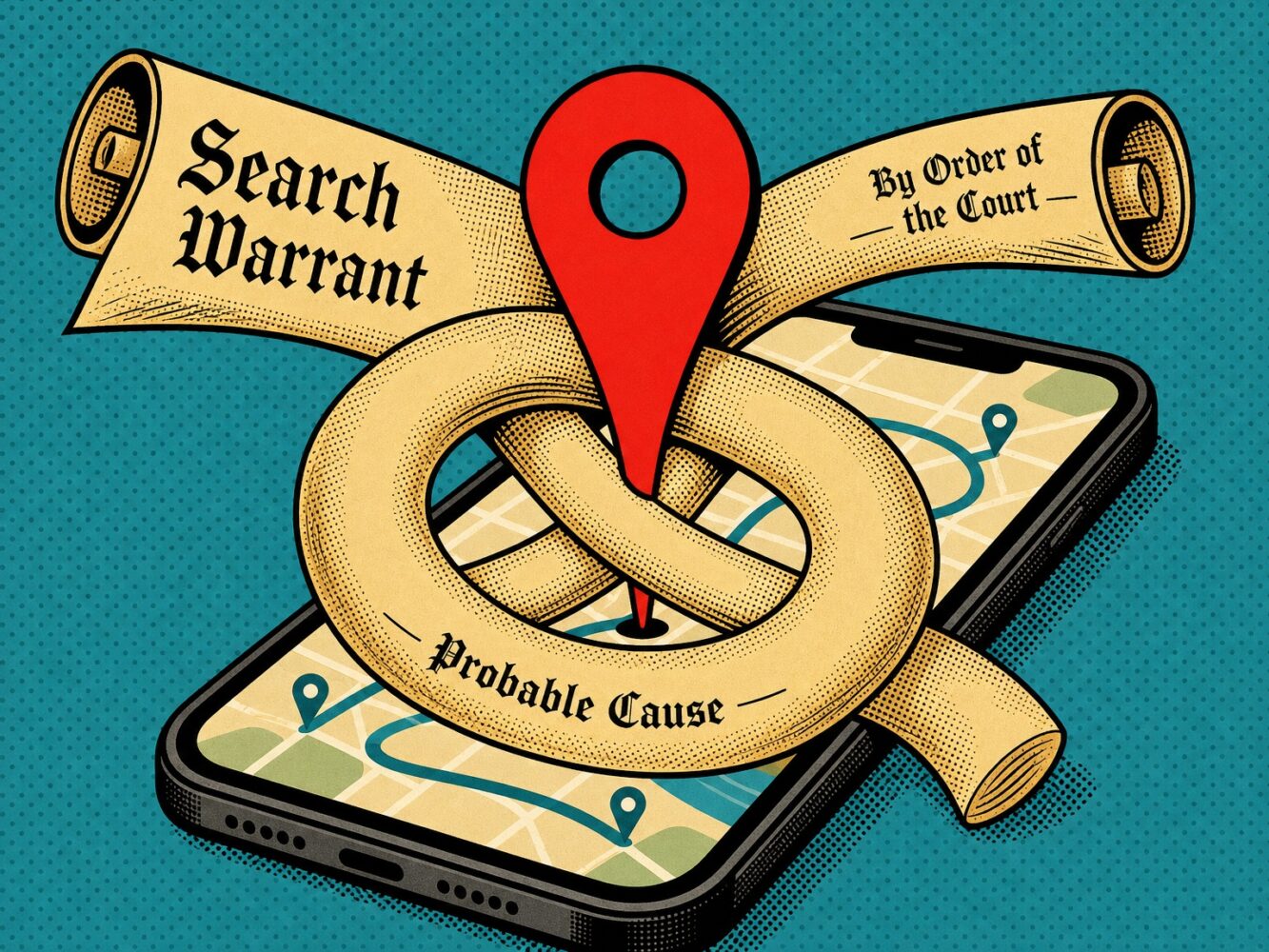
The Supreme Court just told police they cannot turn your phone into a witness against you merely because you walked through the wrong patch of pavement. That is the good news. The less comforting news is that the Court reached that result by dragging some badly aging Fourth Amendment doctrine along for the ride.
In its June 29 Chatrie v. United States decision, the Court held 6-3 that law enforcement conducts a Fourth Amendment “search” when it forces companies like Google to turn over users’ location-history data through a geofence warrant.
That is a major win for digital privacy. A geofence warrant lets police demand information about every device in a defined area during a set time—essentially asking first and sorting suspects later. The Court was right to rein in that digital dragnet.
But peer under the hood of Justice Elena Kagan’s majority opinion, and the legal engine sputters. The Court reached the right destination, but took the scenic route through a swamp.
To preserve the aging Katz “reasonable expectation of privacy” test—and its creaky cousin, the third-party doctrine—the majority tied itself into a logical pretzel. Justice Neil Gorsuch, concurring only in the judgment, offered the cleaner and more textually grounded path the Court should have taken.
Keeping Katz on Life Support
To understand the majority’s legal contortions, it helps to start with two pillars of modern Fourth Amendment doctrine: Katz v. United States (1967) and the third-party doctrine.
Under Katz, government conduct counts as a Fourth Amendment search only if it violates a privacy interest that society recognizes as “reasonable.” The third-party doctrine, which emerged from Katz in the 1970s, adds another wrinkle: if you voluntarily share information with a third party—such as a bank or telephone company—you generally lose any reasonable expectation of privacy in that information.
In Chatrie, the government leaned heavily on that doctrine. It argued that because Okello Chatrie chose to enable Google’s Location History feature, he voluntarily shared his movements with Google and therefore gave up any Fourth Amendment protection in that data.
Faced with the prospect of allowing police to obtain the minute-by-minute location histories of hundreds of millions of Google users without a warrant, the Court had two options. It could reconsider the third-party doctrine altogether, or it could conclude that users never truly “voluntarily” shared their data in the first place. The majority chose the latter.
Writing for the Court, Justice Kagan argued—drawing heavily on Carpenter v. United States—that smartphone location data is different because smartphones have become an indispensable part of modern life. Users do not share their location history in the ordinary sense of wanting Google to have it, the Court reasoned. Instead, disclosing that information is simply “the automatic price of conventional cell-phone usage.”
As the majority explained:
[The third-party] argument ignores some pertinent facts about how and why Google users turn on Location History. As described earlier, Google prompts a user, and repeatedly, to turn on the service—when he sets up a Google account, when he sets up an Android phone, and when he sets up a Google app. See supra, at 3–4. The prompt often informs him that his device will not “work correctly” unless he does so. 2 App. 140–141. By contrast, it does not tell him quite what he is signing up for: “how frequently Google would record [his] location”; “how precise Location History can be”; or how Google might give all that minute-by-minute location information to the government. 590 F. Supp. 3d, at 936; 136 F. 4th, at 128 (Wynn, J., concurring in judgment). In those circumstances, it is hard to see how any user is, in the normal sense, “sharing” with third parties a comprehensive catalog of his physical movements. Carpenter, 585 U. S., at 314.
That reasoning has implications well beyond geofence warrants. It effectively casts doubt on whether consumers meaningfully consent to the standard-form contracts that govern modern digital services. In today’s economy, users routinely exchange data for free or discounted access to hardware, software, and online services. If that exchange is not truly voluntary, the legal foundation for countless digital transactions becomes far less certain.
The Court’s rationale depends on precisely that premise. It notes that more than 90% of Americans own smartphones and suggests many are effectively dependent on apps and services that collect and store “detailed information about all aspects of a person’s life.”
The result is a curious theory of privacy. Under the majority’s approach, you retain a reasonable expectation of privacy in data that you knowingly allowed a global technology company to collect, record every few minutes, and store on its servers because modern life and take-it-or-leave-it contracts left you with little practical choice. By recasting ordinary participation in the digital economy as a form of structural coercion, the majority keeps Katz alive only by carving out a highly subjective, ad hoc exception to the third-party doctrine.
The Property Path Not Taken
Justice Gorsuch’s concurrence points to a better path. He agrees that the government conducted a Fourth Amendment search requiring a warrant, but rejects the Katz framework altogether. Instead, he asks a much simpler question grounded in the Constitution’s text: Is your digital location data your property? Is it one of your “papers” or “effects”?
Gorsuch argues that the Katz test has “no basis in the Constitution’s text or history,” relying instead on the shifting and unpredictable intuitions of judges. He similarly criticizes the third-party doctrine as an artificial rule that departs from traditional property law.
In everyday life, entrusting your property to someone else does not mean surrendering your rights to it. As Gorsuch explains, when you “toss your keys to a valet at a restaurant” or “ask your neighbor to look after your dog while you travel,” you have entrusted your property to someone else. You have not abandoned it, exposed it to the public, or given the police permission to rummage through your trunk or seize your pet.
The law has long recognized this arrangement as a bailment—a legal relationship in which one person temporarily entrusts property to another while retaining ownership and the right to exclude everyone else. Gorsuch argues that storing data with Google is no different.
Why should digital property receive less protection than physical property? Chatrie’s Location History is, in effect, an electronic diary or a detailed map of his movements. He retains the right to use it, modify it, delete it, and exclude others from it. That includes contracting with Google to store the data under an agreement promising to protect it from “unauthorized access, alteration, disclosure, or destruction.”
By grounding the Fourth Amendment in property rights rather than amorphous expectations of privacy, Gorsuch avoids the majority’s logical trap. If Chatrie’s location history is one of his digital “effects”—his personal property—the government cannot search or seize it without a valid warrant. It makes no constitutional difference that Google stores the data, just as it would make no difference if Chatrie kept his private journals in a rented storage unit.
The Right Result, the Wrong Rule
Some might argue that once the Court required a warrant for geofence warrants, the underlying legal theory became an academic debate. It did not. The majority’s convoluted reasoning leaves our digital rights on shaky ground.
Under Katz, those rights depend on whether five Supreme Court justices decide a particular app, device, or service is sufficiently “compulsory” or “revealing” to deserve constitutional protection. That invites years of feature-by-feature litigation. The government will continue arguing that users “voluntarily” disclosed their information by adopting the next new technology, or that whatever technology is at issue is not truly indispensable to modern life.
A property-based approach offers a sturdier foundation. It does not ask judges to psychoanalyze why people use smartphones or speculate about whether consumers had a meaningful choice. Instead, it asks whether an individual retained a legal right to exclude others from the information.
That principle is hardly novel. The law has long recognized that people can protect their property through practical measures, such as locking a door or building a fence, and through legal arrangements, such as contracts or bailments. Properly understood, many of the values underlying the “reasonable expectation of privacy” test can be preserved by grounding them in longstanding principles of property and contract law rather than in evolving judicial intuitions.
Chatrie v. United States is a landmark victory for digital liberty. But the next generation of constitutional disputes—many involving artificial intelligence and technologies that do not yet exist—will demand more than the right result in one case. They will require the right constitutional framework.
If the Fourth Amendment is to protect our digital “papers” and “effects” as faithfully as it protects their physical counterparts, the Court should stop stretching Katz to fit the digital age and start taking the Constitution’s text at its word.
