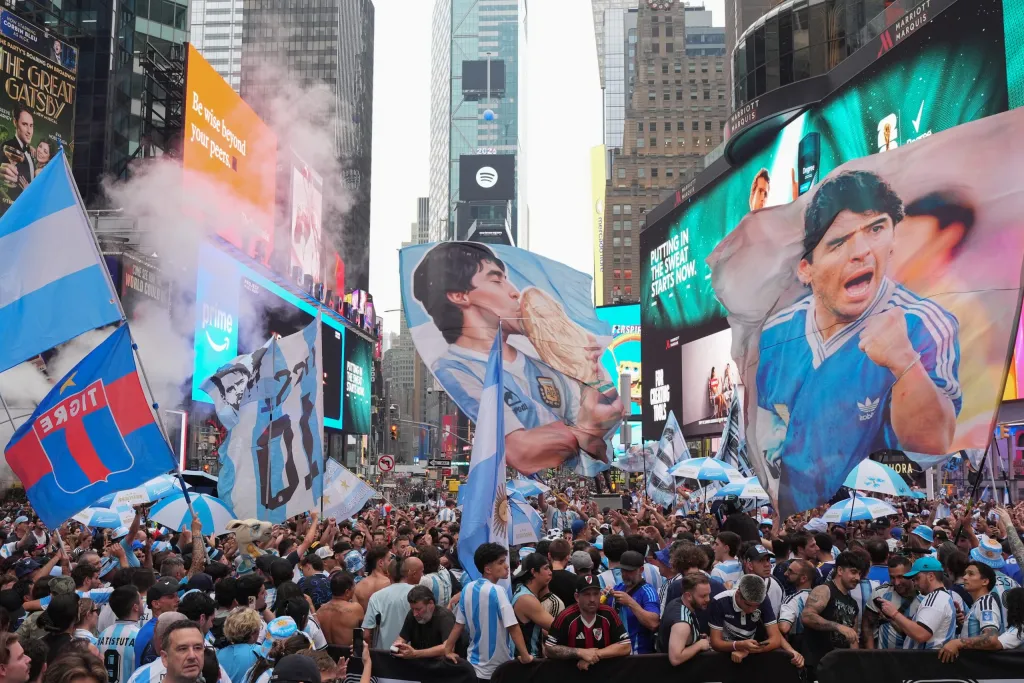
Thank you, Argentina.
With the final numbers on the economic impact still trickling in, it is clear a sudden flood of fans swelled into New York for the World Cup final on July 19, boosting hotel occupancy and the rates hotels were able to charge.
A Hotel Association of New York City analysis suggests that hotels collected almost $100 million in the last week of the tournament, and the group now says that local hoteliers are likely to see the additional $300 million in revenue that it first predicted back in December.
The Hotel Association ascribes the last-minute boost to finalists Spain — the World Cup victor — and Argentina having far fewer visa barriers to entering the U.S. compared with some other countries in the playoffs, allowing fans to visit New York en masse for the Sunday match at MetLife Stadium.
“This was unexpected but welcome,” said Vijay Dandapani, the hotel association’s president and CEO. “But one summer does not make a turnaround.”

The figures will be welcome news to officials at New York Tourism + Conventions and the Mamdani administration, which had insisted last-minute bookings would show big gains, even as early numbers were disappointing.
Manhattan was awash in fans wearing Argentina’s blue and white colors the weekend of July 18 and 19, even as the defending champions lost 1-0. Red-clad supporters of Spain packed into Times Square and venues around the city for the match.
Dandapani noted that bookings for the rest of the year trail comparable numbers for the record tourism year of 2019, when the city saw 66.6 million bookings — a number 2026 is unlikely to beat. A report last week from state comptroller Tom DiNapoli showed that hotel employment is 13% below pre-pandemic level, and that New York rooms rates also lag 2019 when adjusted for inflation.
Restaurants and bars have more to celebrate, though the boost to their business was also uneven.
Seated diners increased by 15% in June and 13% in July, compared to last year, according to reservation data from Open Table. However, the NYC boost trailed other cities including Baltimore, which saw an increase of 25% in June, while Minneapolis posted an increase of 62% in June and 54% in July. (Reservation data may also understate the World Cup effect, since fans are more likely to walk into venues to watch games rather than make a reservation.)
But if a restaurant or bar did air the games on big TVs, the gains were impressive. Sixty-three percent of respondents to a snap survey by the New York Hospitality Alliance reported a boost in sales and almost a third experienced a significant sales increase.
Andrew Rigie, the alliance’s executive director, said that restaurants who did not have a TV fared worse than the venues that were able to stream the matches.
Out of the surveyed businesses that did not air the matches, two-thirds reported that their sales declined from a normal business period.
“The World Cup brought energy, visitors, and business to many bars and restaurants,” Rigie said in a press release. “It’s clear New York can host major events, but earlier communication, stronger coordination, and broader promotion can help even more local businesses and neighborhoods benefit.”

Some other numbers are subject to more analysis. For example, the economic impact is the sum of two figures: direct spending by visitors and the added spending that money generates as it flows through the economy.
Gov. Kathy Hochul said the tournament delivered $1.2 billion in direct visitor spending, which generated a $2.1 billion total economic impact through the first five group-stage matches. Such estimates are always prone to exaggeration, but if accurate the final number might come close to matching an early FIFA prediction of a $3 billion economic boost.
The governor also said the event had brought $228 million in state and local tax revenue. But the governor’s press office didn’t respond to a question about whether that was a total or an increase over the same period a year ago. Before the World Cup got underway, city Comptroller Mark Levine estimated added tax revenue for the city would not offset the costs it incurred through police overtime and other measures.
One number is for certain. All eight matches at New York New Jersey stadium, the temporary name given to MetLife stadium, were sold out, packed with a total of 562,000 fans.
Our nonprofit newsroom relies on donations from readers to sustain our local reporting and keep it free for all New Yorkers. Donate to THE CITY today.
The post World Cup Final Score: A Win For NYC Hotels appeared first on The City Reporter.
