Bay Ridge, Brooklyn, has tree-lined streets, views of the Verrazzano-Narrows Bridge and, compared to most other areas in the city, hardly any new housing.
But the neighborhood’s pace of development could soon change because of a new voter-approved City Charter measure meant to speed up new residential construction in areas that haven’t recently had much of it.
Starting in January, the measure — passed with nearly 60% support in last year’s general election — takes the final say over development projects requiring rezonings in certain community districts away from city councilmembers, who have long had the power to advance or kill such projects in their neighborhoods under a principle known as member deference.
The change allows new developments with affordable units to get on a “fast track” in 12 community districts that produced the least amount of affordable housing over the past five years, which proponents say will help create new homes as the city grapples with a dire housing crunch. Projects would enjoy a quicker review period and bypass the City Council, instead going to the mayor-controlled City Planning Commission for approval.

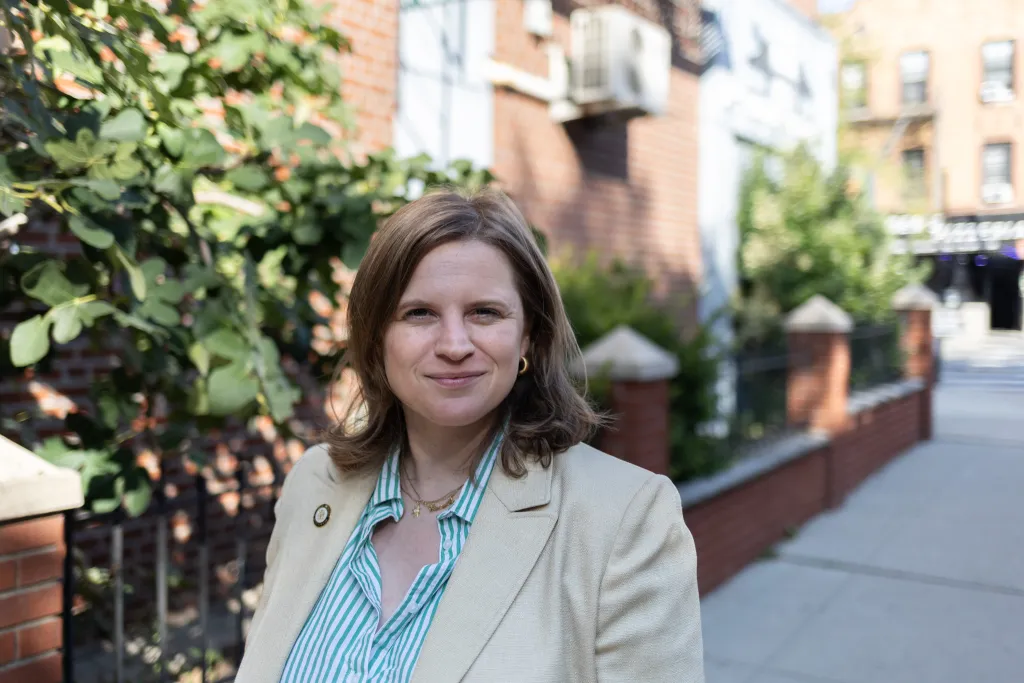
Councilmember Kayla Santosuosso (D-Brooklyn), who represents Bay Ridge, Coney Island and parts of Dyker Heights and Gravesend, said she’s trying to get ahead of that expected loss of power by taking steps to shape a development boom she knows could come to her corner of the city. Santosuosso was elected last year after working as a staffer for her predecessor Justin Brannan and is the first councilmember to announce a neighborhood redevelopment plan in response to the approved ballot measure, which the City Council fiercely opposed along with two other affordable housing initiatives voters passed.
“What we are trying to do as a community is to respond to the charter changes in a way that acknowledges that we have housing to build but also protects what we love about the neighborhood,” she told The City Reporter. “This is about to be a sea change for the neighborhood, and we need to try to be as proactive as we can in making this something that’s actually beneficial.”
Santosuosso said she wants to change land-use rules for a triangle-shaped commercial area of Bay Ridge where auto shops, car dealerships and vacant storefronts are common. She’s proposing to allow more housing in that area in the hopes developers build there rather than elsewhere in the neighborhood and spur investments in parks and streetscapes.
Her idea for rezoning the triangle, which covers 86th to 95th streets between Fourth and Fifth avenues, is in early stages, and Santosuosso has not specified how large buildings could be under her vision. She said she will host a community event on Tuesday to collect ideas for the plan. City election results show most Bay Ridge voters voted against the initiative to expedite planned development reviews.
Annemarie Gray, executive director of pro-housing group Open New York, said Santosuosso’s plan for Bay Ridge shows the early effect of last year’s ballot measures, which her organization supported and were initiated by a Mayor Eric Adams-launched charter commission.
“This is real evidence of how the ballot measures are already reshuffling the politics of housing,” Gray said. “Local electeds in districts where we haven’t seen the growth will need to be proactive leaders in how they build more housing in their communities.”
Member Deference Overruled
The councilmember’s proposal comes as Mayor Zohran Mamdani’s administration estimates the city needs to add 700,000 new homes over the next decade to address the affordable housing shortage. Mamdani, who as the Democratic mayoral nominee revealed his support of the ballot initiative on Election Day last November, is backing neighborhood rezonings in the North Bronx and south of Prospect Park in Brooklyn, and has also proposed growth targets for all neighborhoods.
“We’re ready to work with communities across the five boroughs and our partners in the City Council to build the homes New Yorkers need and make this city more affordable for working people,” City Hall spokesperson Casey Berkovitz said in a statement when asked about Santosuosso’s plan.

The Department of City Planning will in October identify the least-productive community districts in terms of new housing, and Bay Ridge is expected to make the list. The community district containing Bay Ridge and neighboring Dyker Heights netted just 580 new homes from 2010 to 2025, according to DCP figures, the lowest-producing district in the city.
“There are many of us in the community that are just concerned about what happens if essentially the City Planning Commission is willing to just let developers do whatever they want,” Santosuosso said. “We’re talking about probably thousands and thousands of units that are going to come to Bay Ridge, which hasn’t seen an increase like that in a long time.”
The fast track is meant to add more housing, more quickly, in neighborhoods that haven’t built at the rate others have. But Santosuosso said she doesn’t want to see high-rise apartment buildings jutting into the sky on low-slung residential streets, which are common throughout Bay Ridge.
In the past, when a rezoning proposal went before the City Council, members would almost always follow the desires of that district’s representative. Councilmembers have argued this practice gave them leverage with developers to negotiate better deals for their communities — but the custom also torpedoed many projects throughout the years, or discouraged developers from proposing projects altogether.
Bay Ridge voters were not as enthusiastic about the ballot measure creating the fast-track process for the bottom-12 community districts as voters citywide were, according to city Board of Election figures. Just 44% of Bay Ridge voters cast ballots in favor of the measure, compared to about 59% citywide.
“This is our best way to fight back,” Santosuosso said. “You won … I have to build all this housing. Let me do it in a way that makes sense for my neighborhood and takes into account my neighborhood’s concerns. Otherwise, there will be all of these one-off developments that just won’t be part of a cohesive neighborhood.”
Triangulating New Development
Santosuosso’s concerns echo familiar ones related to new housing: increased traffic and flooding, insufficient school seats, loss of neighborhood character. She said she wants to preserve Bay Ridge’s “feel and spirit,” with its “quaint residential blocks.”
The final details of her rezoning pitch will affect whether developers decide to flock to the triangle she’s identified, which is accessible by the R train on Fourth Avenue and multiple bus lines. Still, builders will likely still eye areas outside of it, incentivized by the new fast-track approval process, said Paul Proulx, a land-use lawyer with the firm Pryor Cashman.

“This is a very big change in how things work,” said Proulx, who is representing BWH Group as it pursues a rezoning for a mixed-use development with nearly 300 apartments at the current site of a Staples store and parking lot on an edge of the triangle. “Developers who can secure site control over a large site in Bay Ridge would be foolish not to consider a rezoning.”
Santosuosso said she picked the triangle, where she used to own a bar, because she sees how it could be improved. She said she’d welcome a street redesign to calm traffic and make the area more walkable, as well as new green space, plazas and investments in schools and sewers.
She said she has the support of Council Speaker Julie Menin, who in a statement emphasized the Council’s role in addressing the housing shortage by “thinking creatively about where we can maximize the creation of new homes for New Yorkers.”
Brooklyn Borough President Antonio Reynoso, who last year proposed redeveloping the triangle as part of a Brooklyn-wide plan, also said in a statement he was excited “for Bay Ridge to contribute to a growing borough.”
Santosuosso demurred on exactly how much density she’d want for the area, but she acknowledged Bay Ridge needs to produce thousands of apartments to shed its status as one of the 12 lowest-producing community districts.
“I’m not shy about the fact that part of why we’re doing this is so we can build enough to get back our vote,” she said. “The pace at which other community districts are building that we have to keep up with is also part of the calculus here.”
Haidee Chu contributed reporting.
Our nonprofit newsroom relies on donations from readers to sustain our local reporting and keep it free for all New Yorkers. Donate to THE CITY today.
The post To Spur More Housing, NYC Voters Weakened Pols’ Power. One Still Wants a Say. appeared first on The City Reporter.
