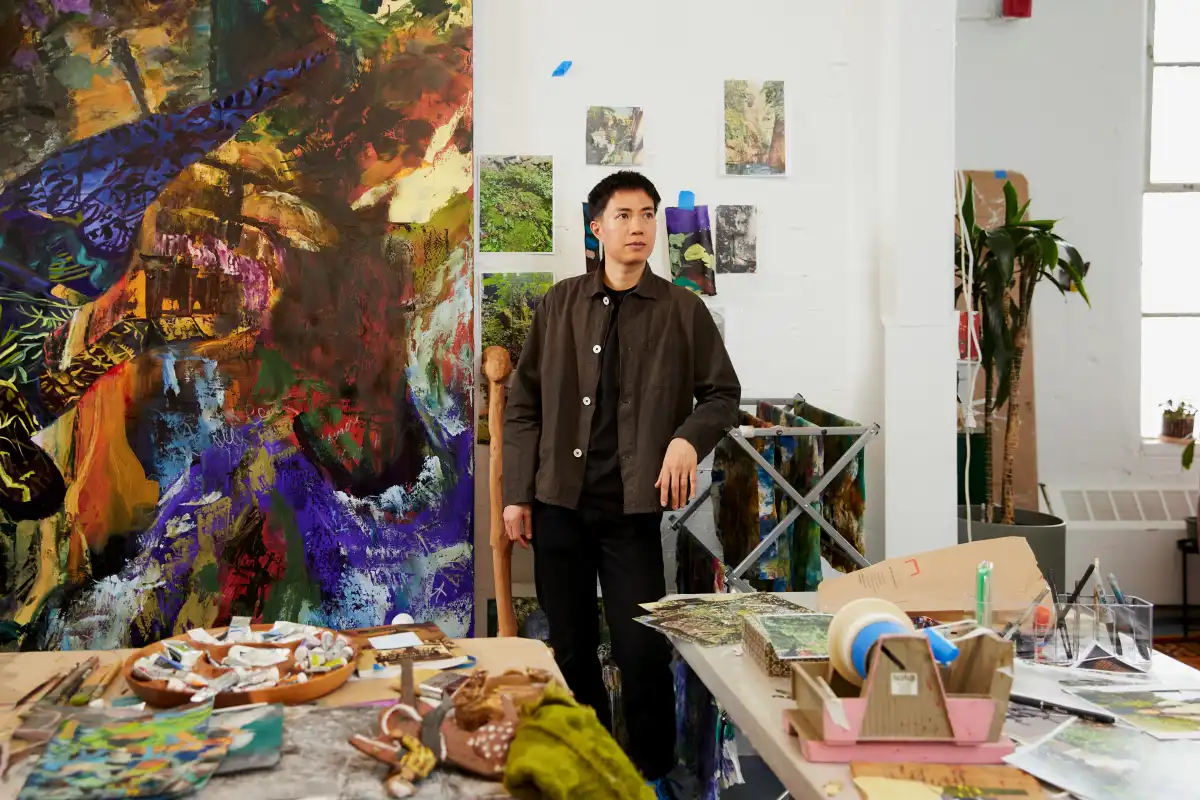
Since entering Maia Cruz Palileo’s upstate studio this summer, I have waited—rather impatiently and without apology—for the artist’s New York exhibition. Nearby, quite fittingly, lay the origins of the Hudson River School, whose inheritance echoed at every street corner, as though landscape might still reveal a nation’s destiny.
Once inside, however, the ground beneath us did not feel entirely still. Before Palileo’s monumental paintings—lush, fevered and narratively all-consuming—one could feel, almost physically, the unbearable weight of a history buried rather than resolved, still raging in muted agony beneath our feet. Yet, remarkably, something else rose through it: elevation, safety, the suggestion of passage and, dare I name it, hope.
In many ways, that contradiction is essential. Where nineteenth-century painting often imagined American wilderness as vast, providential and available, Palileo turns the inherited sublime inside out. The painter’s terrain is never empty or innocent. Mountains bear witness; foliage suffocates even as it shelters; horizons rupture; figures appear, vanish and return. Beauty does not anesthetize the wound. Rather, it persuades us to remain.
That tension, perhaps inevitably, echoes through Palileo’s own history. Born in Chicago to parents from the Philippines, the artist has spent two decades examining migration, remembrance and the unstable idea of home. Trained at Mount Holyoke and Brooklyn College, Palileo approaches linen like a builder: mass accumulates, perspective folds and oil acquires the density of earth.

At the inquiry’s heart, of course, lies a past the United States has too often pushed from view. In 1898, after Filipino revolutionaries fought Spain and declared independence, the Treaty of Paris transferred the archipelago to American control without Filipino consent. The Philippine-American War followed in 1899. Although the war officially ended in 1902, occupation, resistance and colonial rule continued until independence in 1946.
American colonial rule, however, was sustained not only through military force, but through the deliberate production of images and information. Cameras, botanical surveys, labels and ethnographic classifications transformed the Philippines into something that could be studied, ordered and, ultimately, controlled. Presented as objective documentation, these photographs reduced human beings to racial “types” and living landscapes to territory available for possession, allowing occupation to masquerade as knowledge.
Within this troubling inheritance, Palileo’s 2017 research at Chicago’s Newberry Library proved pivotal. There, the artist encountered the vast Filipiniana collection, including Dean C. Worcester’s photographic archive, whose images helped shape American opinion about Filipinos. Never neutral, the archive’s apparent objectivity concealed an architecture of supremacy.
Against that machinery of classification, Palileo’s response is both intellectually rigorous and beautifully defiant. The artist redraws figures, plants, animals, mountains and moons from archival sources, cuts them free from inherited frames, then rearranges them into endlessly changing narratives. The colonial image is, quite literally, taken apart. Once translated into paint, the archive’s authority fractures further as chronology loops, bodies recur and composition behaves like a skipping record.

In one immense canvas, for instance, an X-like formation gradually reveals itself as dozens of armed soldiers marching toward something resembling infinity. What initially reads as scenery becomes recurrence: war folding back upon itself, refusing the comfort of a clean ending. The work does not merely illustrate violence; rather, it holds us inside its terrible persistence.
Across The World Tangled in You, meanwhile, Palileo pushes this language toward extraordinary material force. Oil builds like sediment, each layer persisting beneath the next. Deep blues, heated reds, dense greens and historically researched hues flicker across forests, bodies and unstable skies. At moments, the surface feels almost overgrown—seductive, parasitic, alive. Elsewhere, however, an opening appears, allowing the eye somewhere to breathe.
Perhaps this is why the upstate studio felt simultaneously besieged and held. These paintings arrive as siege and abandon, beacon and warning—large enough to engulf the body, intricate enough to resist conquest in a single glance. Palileo does not offer optimism as sentimentality, nor does the artist pretend art can reverse atrocity. What painting can do, however, is refuse the conqueror’s final word. It can return mystery to a body once classified, intimacy to a face once exploited and spiritual presence to land treated as property.
Over time, that intervention has carried Palileo’s work through solo exhibitions at the Wattis Institute, the Cummer Museum, the Kimball Art Center and the American University Museum, with works entering public collections. Yet institutional recognition, significant though it is, does not fully explain Palileo’s importance. More profoundly, the artist overturns the logic of the colonial archive, which reduced living people to static evidence beneath an occupying gaze. Through paint, those figures are released from imposed identities and returned to the fullness of human presence—to movement, mystery, dignity and futures the original photographs were constructed to deny them.

Now, The World Tangled in You marks Palileo’s first New York exhibition with David Kordansky Gallery, on view from September 10 through October 24 at 520 West 20th Street. I have carried that encounter—and this impatience—through the summer. Certainly, these works deserve to be witnessed at full scale, where beauty can engulf and warning remains impossible to domesticate.
Ultimately, Palileo does not ask the past to rest. The artist sets it in motion. In doing so, the paintings gently remind us that the ground may contain violence without belonging forever to it. Beneath our feet, the buried record still rages. Before us, however, the canvas opens—and there, trembling but unmistakable, is a way through.
