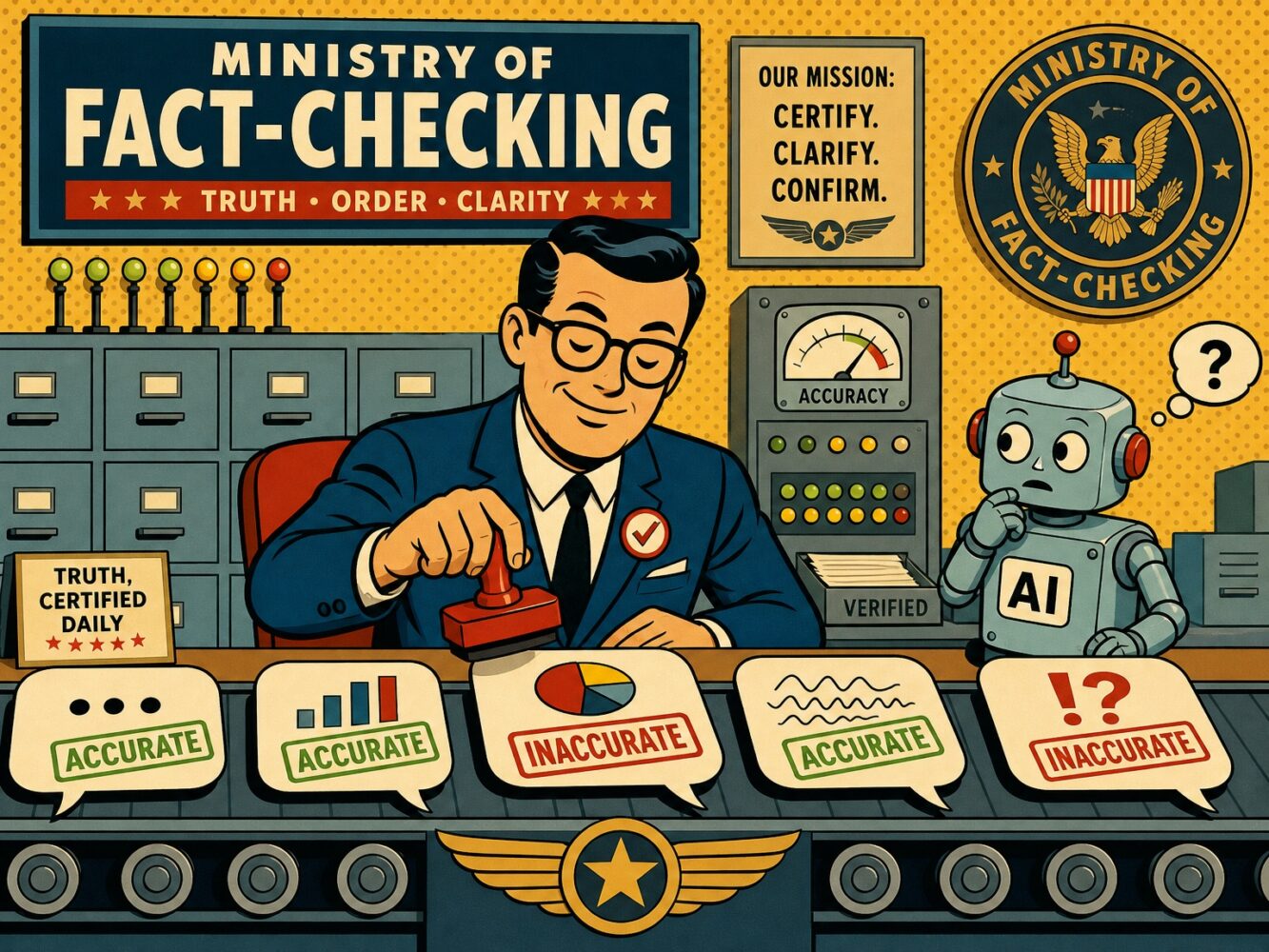
A policy statement about accuracy should, at minimum, be precise. The Federal Trade Commission’s (FTC) Proposed Policy Statement Concerning the Suppression of Accuracy in Artificial Intelligence Systems (AI Policy Statement) struggles with that assignment.
The International Center for Law & Economics (ICLE) submitted comments in response to the FTC’s request for input, and this post is, in part, a digest of those comments. The statement gets some important things right, including the risks of excessive regulation and a patchwork of state laws. But it offers little concrete guidance on deception, leans on dubious assumptions about consumer expectations, wanders into constitutionally protected editorial judgments, and treats federal preemption as more wish than doctrine.
In other words, the AI Policy Statement needs considerable work. Then again, perhaps guiding enforcement was never quite the point.
But first, some context.
Just Asking Questions—and Testing the Limits
Way back in February 2025, the FTC issued a Request for Public Comment Regarding Technology Platform Censorship (RFI). There, as you may recall, the agency explained:
FTC staff is interested in understanding how consumers have been harmed—including by potentially unfair or deceptive acts or practices, or potentially unfair methods of competition—by technology platforms that limit users’ ability to share their ideas or affiliations freely and openly.
FTC staff was, as the kids say, “just asking.” Then again, perhaps it was not just asking. The RFI sought comment on whether technology platforms’ content-moderation practices might violate either the consumer-protection prong of Section 5 of the FTC Act—unfair or deceptive acts or practices (UDAP)—or its competition prong—unfair methods of competition (UMC). Some questions seemed loaded—and loaded for bear, at that. Comments from FTC leadership describing tech “censorship” as “un-American” did little to dispel that impression.
ICLE’s comments on the RFI raised those concerns, as did submissions from the Program on Law, Economics, and Privacy at George Mason University’s Antonin Scalia Law School, the Foundation for Individual Rights and Expression (FIRE), the American Enterprise Institute (AEI), and the Cato Institute. ICLE offered “reasons why both the law and underlying economics support limiting how the FTC acts in response to the information gained in this RFI,” while acknowledging that “a call for diverse public comments is likely the best means at the agency’s disposal to gather preliminary information, and that no subsequent formal economic study or law-enforcement action is implied by such an inquiry.”
Still, our comments were heavy on the limits and brief on the allowance. Some addressed the potential use of the FTC’s UDAP authority against technology platforms’ content-moderation policies and practices. The rest considered whether the FTC could use its UMC authority—or the federal antitrust laws more broadly—to challenge content moderation.
That emphasis reflected a multipronged initiative by both the FTC and the U.S. Department of Justice’s (DOJ) Antitrust Division suggesting that content moderation might violate the antitrust laws. Beyond the RFI, FTC Chair Andrew Ferguson made informal comments about “tech platform censorship,” while Dina Kallay, deputy assistant attorney general for antitrust at DOJ, offered related remarks.
DOJ also filed a statement of interest in a private antitrust suit brought against several major news publishers by Children’s Health Defense and other plaintiffs. U.S. Health and Human Services Secretary Robert F. Kennedy Jr. previously chaired Children’s Health Defense. The suit itself seemed dubious, and The Wall Street Journal was no more impressed by DOJ’s statement of interest, which it called “bizarre.”
To be clear, our position was not that content-moderation policies could never support a viable antitrust or UDAP claim. It was that the space for such claims was narrow. Among the hurdles, platforms’ content-moderation decisions are themselves protected by the First Amendment to the U.S. Constitution.
The Supreme Court’s decision in Moody v. NetChoice seemed especially relevant. The case concerned Florida and Texas laws that sought to regulate “large social media companies and other internet platforms.” As the Court explained, those laws would “curtail the platforms’ capacity to engage in content moderation—to filter, prioritize, and label the varied third-party messages, videos, and other content their users wish to post.”
That holding did not foreclose every possible challenge to content-moderation policies or practices, but it narrowed the field considerably. Platforms, like newspapers, may still face liability for price fixing or unlawful monopolization in their business dealings, even when their content-moderation decisions qualify as protected speech.
For more on this Scylla and Charybdis—and the dangerous route between them—we recommend Content Moderation Antitrust, a collection published by Concurrences and edited by Bilal Sayyed, former director of the FTC’s Office of Policy Planning. It includes our article, “Is There an Empty Set at the Intersection of Antitrust and Content Moderation?” (available free here).
In the year that followed, the issue seemed to fade. Or, at least, neither the FTC nor DOJ took it to court.
Credit Where It’s Due—Before the ‘But’
Concerns about artificial intelligence (AI)—and proposals to regulate it—are myriad and, in many cases, “out there.” That does not mean there are no legitimate concerns, or that policymakers could not design well-tailored rules to address durable market failures that harm consumers. We simply have not seen many such rules proposed or adopted.
As ICLE’s comments on the AI Policy Statement observe, “[t]he FTC gets much right in this proposed AI Policy Statement.” There is a “but” coming, but credit where it is due.
First, the statement understandably responds to White House executive orders and policy directives. As the Supreme Court recently reminded us in Trump v. Slaughter, the FTC is an executive agency, and the Constitution vests “the executive power” in the president of the United States.
Questions about the proper scope of that power aside, it is entirely appropriate for the FTC and its commissioners to respond to executive orders issued by the White House—and not merely because the Court has held that the president may remove a commissioner at will and without cause.
It is fitting, then, that the AI Policy Statement responds to several White House documents, including an AI Action Plan, a report on AI from the Council of Economic Advisers, and two executive orders (here and here).
Four Things the FTC Gets Right
Several policy observations in the FTC’s statement seem salutary.
First, we agree that consumers and competition at every level of the AI stack may be better protected by uniform federal policy than by a motley collection of state regulations. That is not because federal law should generally displace state regulation—there is no good reason to think so—or because, to borrow Justice Louis Brandeis’ phrase, a state cannot serve “as a laboratory” for testing novel policies, assuming it collects the right data and conducts careful analysis.
Leave aside, for now, that some state proposals strike us as bonkers. The central problem is that several features of AI weigh against state-by-state experimentation: the rapid pace of AI development, the interstate reach of leading firms and their products, and the nationwide distribution of consumers. State AI policies are therefore likely to produce substantial spillover effects beyond their borders.
A thicket of potentially conflicting state regulations would also add considerable complexity—and other costs—to AI development. We are therefore inclined to agree that the country needs a “national AI framework” that will “protect innovation and competition by providing national regulatory clarity and certainty and avoiding a balkanized or patchwork regulatory approach driven by States—or, most dangerously, imposed by certain anti-innovation State governments on the rest of the country.”
That is not an endorsement of the effectiveness or efficiency of any particular federal policy. But it is not nothing.
Second, the AI Policy Statement declares that “[e]xcessive AI regulation would undermine American AI supremacy by deterring and suppressing the same ingenuity responsible for making American AI great.” That seems right, almost by definition. And while “supremacy” is not obviously a Section 5 concern, excessive AI regulation—whether federal or state—would plainly tend to impede innovation in ways that harm competition and consumers.
These observations may not provide much concrete guidance, but they could still support useful research and advocacy by FTC staff—work that former FTC Chair William Kovacic called the agency’s “policy R&D” mission.
Third, and perhaps more directly relevant to enforcement policy, the FTC is right that AI providers are not generally exempt from scrutiny under the FTC Act. Section 5 expressly excludes certain firms and types of commerce, including banks and common carriers, and Section 4 implies an exemption for nonprofits. But the statute contains no general exemption for AI providers at any level of the stack.
At a minimum, AI firms could violate Section 5’s deception prong by making false or misleading claims about their products or services when those claims are material, likely to mislead reasonable consumers, and likely to cause harm.
Whether any firms have done so is another question. Still, the statement’s citation to the FTC’s 1983 Policy Statement on Deception signals a grounded approach.
Fourth, while the AI Policy Statement tells us relatively little about the AI industry, it does recognize that AI is “an umbrella term covering a universe of different tools and systems.” That may be a feature rather than a bug, but it also points to the complications ahead.
Reasonable Expectations Require Actual Evidence
There remains the question of when AI firms might—and might not—face liability under the FTC Act. On that, the AI Policy Statement tells us far less than we might like.
The Commission is right that “AI” covers a wide and evolving range of products and services. It is also right to emphasize innovation in a field that changes at remarkable speed. But much of the FTC’s discussion of deception rests on quick, oversimplified assumptions about consumer expectations—“baseline consumer expectations,” “consumers’ reasonable expectations” about chatbots, and so on.
Those expectations are likely to vary across consumers, products, and services. They are also likely to shift as consumers gain experience with an ever-changing array of AI-based tools.
That is not to say that consumer expectations do not exist or should not inform Section 5 analysis. But beyond a few basic assumptions about how consumers interpret factual claims in advertising or other marketing assurances, the Commission should not presume much without careful, context-specific inquiry.
Even seemingly straightforward assumptions about advertising claims can prove controversial. For a sense of the complications, compare two statements by Maureen Ohlhausen in the FTC’s POM Wonderful case: the Commission opinion and her concurring statement. In the latter, she disputed several implied claims identified by the Commission majority, as well as its substantiation standards—concerns later shared by the D.C. Circuit, which rejected the majority’s substantiation standard.
From Consumer Protection to the Ministry of Truth
Of course, AI firms—like other firms—may engage in commercial fraud. Nothing about AI makes its providers categorically incapable of violating Section 5 through false or misleading advertising claims, marketing materials, or other conduct.
Newspapers may be the firms most strongly protected by the First Amendment’s Speech Clause, and the Supreme Court has specifically held that the Constitution protects their editorial discretion. But newspapers may still violate the antitrust laws—and, by extension, Section 5—when their business dealings, apart from speech or editorial discretion, are anticompetitive. We might similarly expect a UDAP claim unrelated to content to survive First Amendment scrutiny. Given the right facts, the FTC could establish a violation of the FTC Act.
Apart from clear and relatively trivial cases, though, the AI Policy Statement does little of what agency guidance is supposed to do. How will—and should—the Commission evaluate AI-provider conduct under its deception authority? How will it approach cases in ways that reflect what the Commission and its staff learn about the industry? And how will it apply its established authority to that industry-specific knowledge?
An error-cost framework helps illustrate the shortcomings. Core UDAP cases involve clear consumer fraud. In those cases, overdeterrence poses little concern because the conduct has no procompetitive rationale, and there is no such thing as too little fraud.
Borderline cases are different. When enforcement targets conduct whose meaning, materiality, or likelihood of consumer harm remains unclear, two concerns arise. First, although such cases may help develop the law, they also create a risk of false positives. That raises questions about both the frequency and cost of false positives—not merely false negatives. Here, one might return to the early law & economics literature on efficient penalties or fines, comparing, e.g., Steven Shavell’s work with that of Louis Kaplow and Robert Cooter.
Second, when liability turns on a firm’s decision to provide information in the first place, pursuing unclear cases makes disclosure itself risky. That can suppress useful information along with noise or harmful claims.
False promises about, e.g., an AI product’s performance might be actionable. But this is where the AI Policy Statement goes off track. As ICLE’s comments acknowledge:
Published AI policies and marketing materials could, in principle, mislead reasonable consumers. The representations cited in the Statement, though, appear limited. Most providers do not promise certainty or perfect accuracy. Instead, they expressly warn users that outputs may contain errors.
For example, the statement claims that “[i]n marketing their products as problem-solving tools, AI companies have represented explicitly and implicitly that their AI systems aim to produce the best output possible given technological and resource constraints.” Perhaps some have. But its first example is an OpenAI statement that reads more like a warning than an assurance: “At OpenAI, we’re working hard to make AI systems more useful and reliable. Even as language models become more capable, one challenge remains stubbornly hard to fully solve: hallucinations.”
There could, of course, be other statements, other materials, and demonstrable consumer harm. But if this is the statement’s illustration of the Section 5 problem, one wonders. Taken one by one, its citations to statements from OpenAI, Anthropic, and Grok look like strained examples of misleading speech, if not outright counterexamples to the Commission’s point. Statements from Google (about Gemini), DeepSeek, and GabAI seem similarly cautious.
Cases built on dubious readings of marketing statements give AI companies an incentive to tell us less, not more. Harmful omissions or “reasonable” consumer expectations? Maybe. Tell us more.
More troublingly, the statement focuses on “outputs that are distorted by undisclosed ideological objectives,” models with “ideological bias,” and a “hidden agenda.” Those phrases are exceedingly vague and seem like a frolic and detour from ordinary deception law. Worse, they point toward precisely the kinds of conduct entitled to the highest level of First Amendment protection, whether by newspapers, as the Court held in Miami Herald Publishing Co. v. Tornillo; technology platforms, as it held in Moody v. NetChoice; or, we expect, AI providers.
There is much to say about how the First Amendment will likely protect AI chatbots. Chatbots answer questions—including, but hardly limited to, questions of objective fact—which is paradigmatically speech. AI companies also exercise considerable editorial judgment when selecting inputs, training models, and testing outputs for consistency with company policies and objectives. Users, in turn, have a First Amendment interest in “hearing” what chatbots have to say.
There is no reason to think AI chatbots lack a general right to participate in the “marketplace of ideas.” The FTC should be wary of becoming Oceania’s Ministry of Truth, charged with deciding whether particular AI outputs are “accurate” enough to survive government review. As with social media, government failure in regulating AI misinformation seems more likely than market failure.
Preemption by Wishful Thinking
The AI Policy Statement’s last major problem lies in its remarkably thin—and remarkably wrong—account of federal preemption.
We will be brief, partly because the ICLE comments offer a fuller discussion and partly because we recognize that not everyone—even among our readers—wants to plunge into preemption doctrine, which stems chiefly from the Constitution’s Supremacy Clause, with an assist from the Necessary and Proper Clause.
The AI Policy Statement says:
Although the FTC Act does not expressly preempt state law, state law is impliedly preempted to the extent it conflicts with a federal regulatory scheme. A state law that requires an AI firm to deceive its consumers obviously conflicts with Section 5’s express purpose of protecting consumers from such conduct.
A state law requiring firms to deceive consumers would have all sorts of problems, including constitutional ones. But implied preemption through “obstacle preemption”—on the theory that such a law conflicts with Section 5’s “express purpose”—is not among them. The statement’s preemption argument is not merely exceedingly brief. It is rubbish.
Many of the Commission’s UDAP enforcement actions under this administration have appeared well-grounded. That is a welcome development. The AI Policy Statement is something else: less a guide to enforcing Section 5 than an invitation to improvise beyond it.
