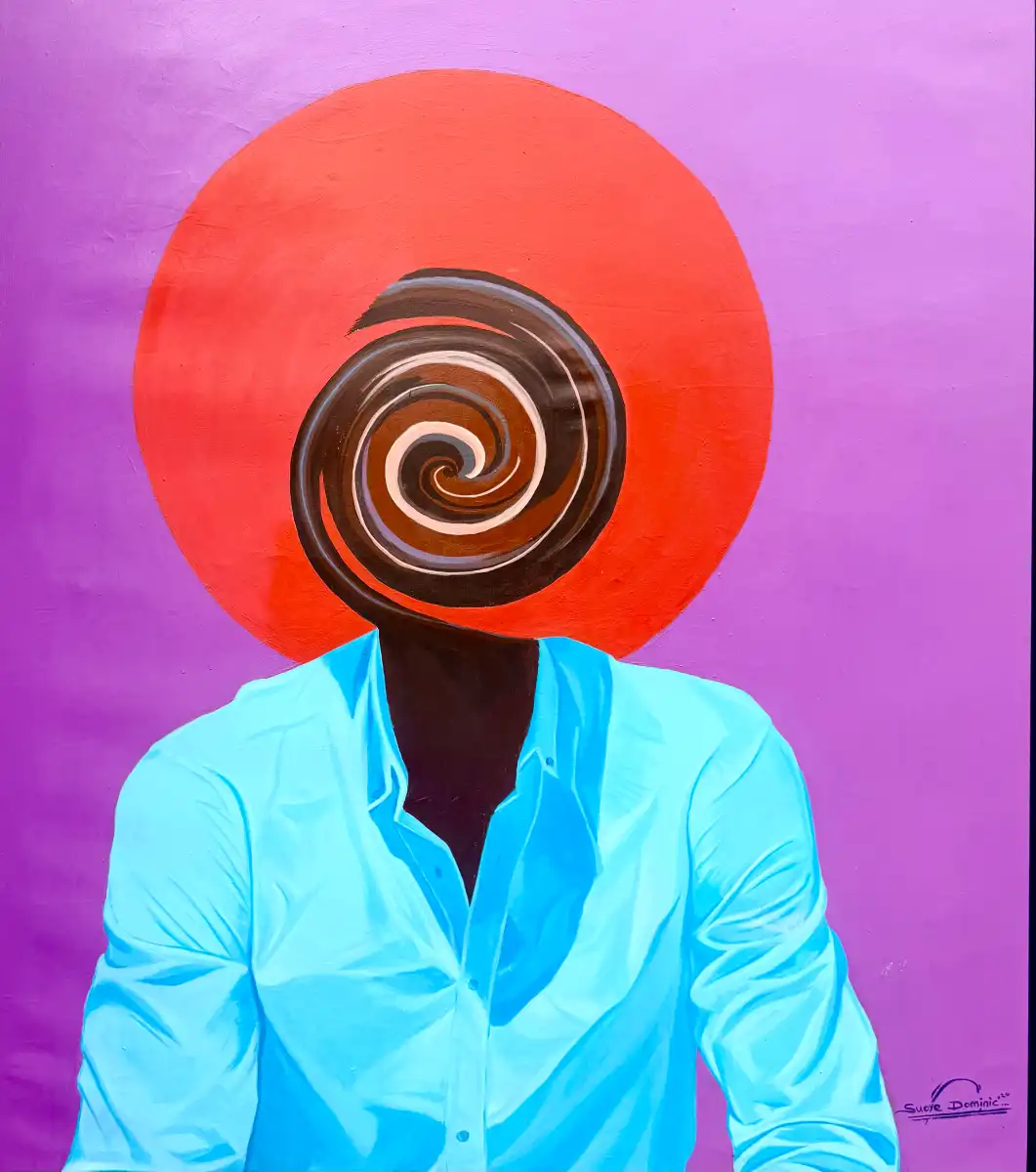
Plato feared art might seduce us from truth. Aristotle, more generous and better company at dinner, believed it could disclose what fact alone cannot. Centuries earlier, Egyptian sage Ptahhotep placed wisdom within Ma’at, the ancient African order of truth, balance, right relation, and the humility to listen. All three might have debated in Harlem; Plato would have complained, naturally, then stayed for the oxtails.
For two days, Gallery Guichard—the storied Black-owned Chicago institution founded in 2005 by Andre Guichard, Frances Guichard, and Stephen Mitchell—transported its diasporic vision from Bronzeville to Harlem for the inaugural Sherri Shepherd Fine Art Exhibition. More than 100 works by over two dozen artists across three continents filled five floors and a rooftop; 49 originals sold. The triumph, crucially, was not creation, which had always flourished, but acquisition—a glimmer of hope in the market’s murkier waters, where collectors were not merely admiring; they were committing.
I arrived Sunday afternoon, as the rain released Harlem back into light. At the door, Moët waited in tulip champagne flutes beside miniature fans—a kindness in August, when New York expects women luminous and weatherproof. A wooden bannister climbed through exposed brick, paintings, sculpture, voices, and heat; Southern fare moved with the authority of a family secret. The oxtails vanished first, as they should. Black hospitality has never needed a wall label to identify the masterpiece.

In its waning hours, the house hummed. The diaspora appeared not as a catalogue of captivity, but as rhythm, appetite, color, wit, beauty, and creative freedom. Each landing sharpened the thesis; every chamber altered the mood. This was vision-led curation, not inventory beneath flattering light.
Gallery Guichard makes advocacy tangible through its Bronzeville base, Bridge program linking Chicago with Africa, and catalogues preserved by the Met’s Watson Library.
In Harlem, arrival felt like kinship. Its ghosts murmur through stoops and salons. Charles Alston’s 141st Street studio gathered artists and intellectuals; in Washington, James Herring and Alonzo Aden later opened Barnett-Aden inside a home when the establishment declined Black modernism. Black artists have often had to make a salon before being offered a museum.
Movement, after all, is among the diaspora’s oldest intelligences. Ideas cross oceans in cloth, sound, prayer, adornment, and memory, changing form yet keeping source intact. The pop-up was no detour, merely continuation: art taking the shape required to reach another mind.

That intimacy mattered, perhaps more than pristine walls. The white cube’s cleverest con was persuading us that blankness bore no ideology; yet art is emotion and intelligence pressed into matter, and beside a dining table or old brick, a piece reveals how it might share a life. Proximity restores sensation to connoisseurship.
Turning into the dining room, I encountered Ebenezer Akinola before knowing his name. His figures, gathered around the table, were modern, carefree, figurative, and almost insolently chic; lush pigment gave each one its own weather. Black subjects are too often expected to carry suffering, ancestry, and explanation. Akinola’s carried themselves. Their freedom was what history was supposed to have purchased for them.
Al Burts worked in a different register. Ballpoint, collage, fabric, wood, and painted surface gave his forms tactile force. His headwork pulsed, not with the exhausted gravity of the past, but with the voltage of the future. Adornment emerged as visible thought; heritage became propulsion.
Nearby, Thelia Burts was no filial footnote. She clothed the face in protection and rebellion: revolutionaries peering from behind reading glasses, or draped in the American flag as though patriotism itself had been summoned for interrogation. Her practice turned continuity into conversation rather than echo—an image passed forward, still warm enough to change in the receiving hand.

Stephen “Sayo” Olalekan made painting and sculpture stop pretending they were unrelated. Line curled outward until drawing acquired shadow; color behaved like muscle, generating rhythm, friction, and depth. One had to circle and return until the body joined the encounter. Zimbabwean stone held ancestral knowledge while remaining emphatically contemporary.
Alpha Bruton supplied the philosophical undertow through figurative works robed in the violence of color. A glare seemed to live beneath the paint, arresting the eye and urging a longer pause. Memory operated as active intelligence rather than sealed archive; the past interrupted, revealed, concealed, and invented, yet lost the vanity of the final word.
Together, these artists complicated the ancient quarrel. Plato distrusted seduction, yet their beauty drew the eye so thought could enter; Aristotle trusted representation to reveal the universal through the particular; Ptahhotep supplied the ethical condition—attention free of distortion, admiration free of extraction, and collecting that does not treat culture as quarry.
That distinction is urgent. The market’s treatment of Black makers is too often grotesquely seasonal: neglect, discovery, feeding frenzy, moral press release, extraction, amnesia. Technique vanishes beneath biography; trauma masquerades as provenance; identity flattens into sales copy. Gallery Guichard rejected that machinery, presenting creators as authors, not evidence.

Hospitality, rather beautifully, sustained that attention. Moët, fans, Southern food, laughter, and rooftop air were not peripheral pleasures; care slowed the pulse until curiosity ripened into recognition.
Forty-nine red dots are not philosophical proof, and money is no synonym for virtue. Still, each sale meant choosing to live with an artist’s mind afterward. This was not faith in Black imagination, whose flame remained incandescent, but hope that ownership and stewardship might finally match the brilliance.
Gallery Guichard did not bring overlooked artists to Harlem for the thrill of declaring them found. They were never lost; institutions had simply misplaced their ability to see.
The future of Black art had not come to the brownstone to petition for discovery. It was hosting—opening the door, filling the glasses, selling the work, and leaving the rest of us to catch up.
GALLERYGUICHARD.COM