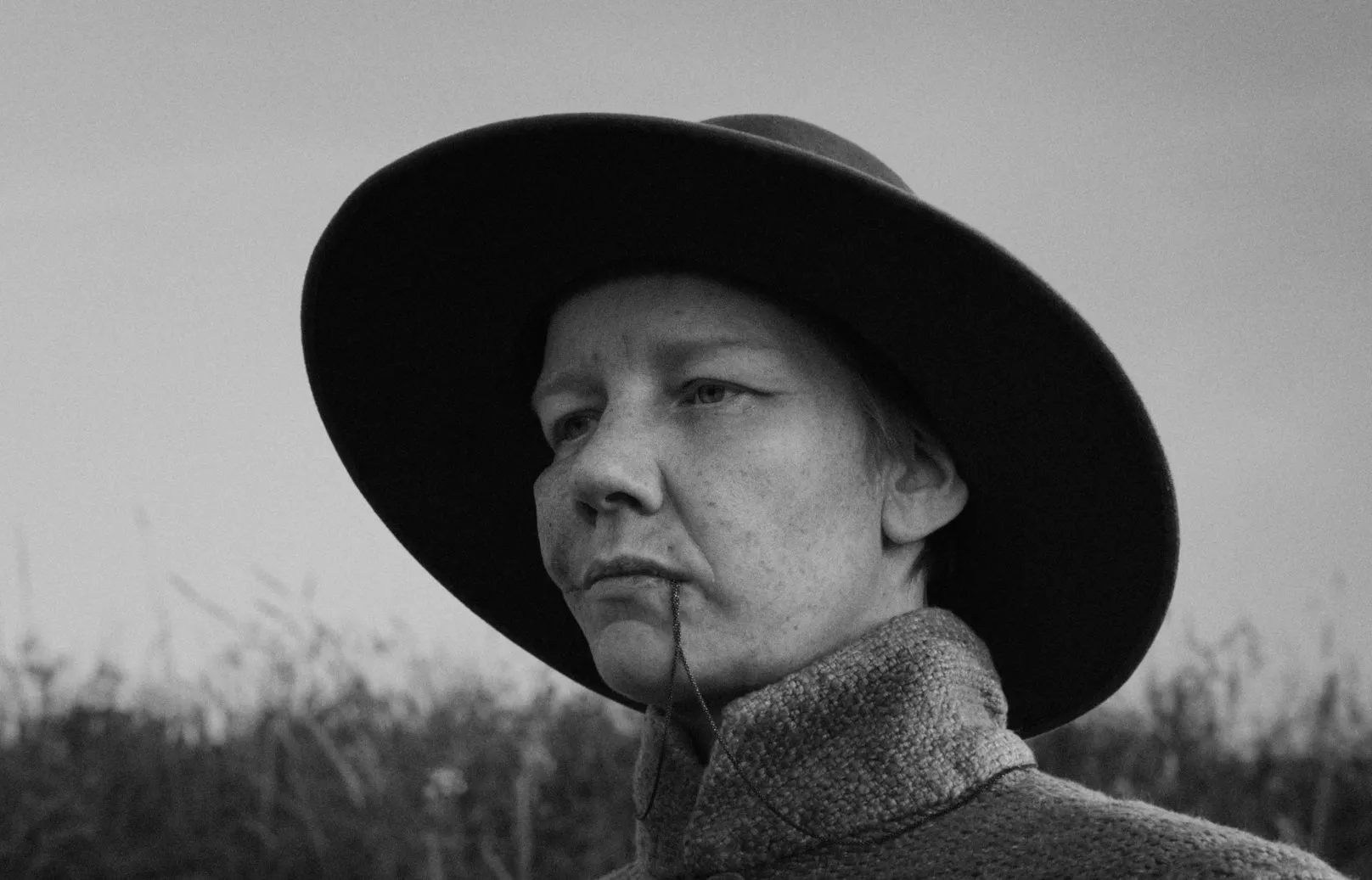
Markus Schleinzer’s Rose, an distinctive historic fiction, doesn’t a lot transport you to the previous because it brings you to the sting of the translucent curtain that always obfuscates historical past from view. The stark monochrome drama follows a Seventeenth-century lady within the guise of a person—such is the nomenclature utilized by the characters and the light narrator (Marisa Growaldt)—however its underlying emotional mechanics are distinctly queer. This brings to the fore the query of who and what the film is de facto about, however that very important dilemma is nestled throughout the bigger, extra urgent, impeccably carried out story of an individual whose precarious freedom rests on a knife’s edge, leading to Sandra Hüller being awarded the Berlinale’s Silver Bear for Finest Lead Efficiency—her second time profitable the trophy since Requiem in 2006.
Someplace in Germany through the Thirty Years’ Conflict, a facially scarred soldier, referred to in voiceover solely as Rose (Hüller), inherits farmland by impersonating a fallen comrade and establishes a homestead—a luxurious solely afforded to males. The narration units the story’s parameters: that of a lady pretending to be a person as she tries to dwell free from the confines of structural misogyny. Historical past is stuffed with girls donning trousers to flee patriarchal norms, but in addition with probably transgender males who might have been conferred this designation in instances and locations the place no such language for trans-ness existed. However whichever method a contemporary viewers may interpret this story, its telling aligns—usually deliberately—with that of the conservative Protestant villagers from whom Rose should cover the character of her id.
This isn’t so troublesome at first since she lives alone, surrounded solely by servants and farmhands with separate quarters, although out of warning, she nonetheless sleeps in a horizontal cabinet. Nonetheless, it isn’t lengthy earlier than a neighboring farmer gives her his daughter’s hand, a proposal which Rose can not convincingly refuse. As soon as the bride arrives—the younger, homesick Suzanna (Caro Braun)—her day by day routine turns into a fascinating tightrope of deception.
After all, injecting themes of duplicity right into a narrative ostensibly of trans id, even in its subtext, comes with up to date issues, given the dangerous stereotypes of trans folks making an attempt to idiot potential suitors or drive their method into bogs underneath false pretenses, usually leading to actual violence towards them. Whereas the filmmakers might not consider Rose as a transgender story, it speaks the language of 1, and Hüller appears to have approached it with a gray space in thoughts (in an interview on the Berlinale, the actress talked about taking inspiration from Albert Nobbs, the 2011 drama by which Glenn Shut’s eponymous character walks an analogous line). However even when Rose is considered by itself phrases—a lens it will definitely justifies by some intriguing, contradictory dialogue concerning the character’s previous—the movie’s discomforts relating to trendy queer points grow to be a key a part of its textual content. For one factor, Rose retaining her supposed façade a secret is a matter of fundamental survival slightly than deceit. For an additional, when minor characters start to have their suspicions, their intense concentrate on her genitalia as proof optimistic of her lived reality can’t assist however replicate the hateful pushback to trendy trans liberation.
Nonetheless, even when one have been to undertake the best, or least controversial, model of the story, i.e., the saga of a lady pretending to be a male soldier, this could nonetheless afford Hüller the complete spectrum of significant dramatic efficiency. There’s a broadness at first to Rose’s cautious, stilted gesticulations, to not point out her quick mood and verbose arguments, which could initially learn to trendy viewers because the overt efficiency of gender. Nonetheless, hidden inside this specter of social masculinity is an alluring authenticity. The extra time we spend observing Rose, the more durable it turns into to interpret her broad-shouldered rigidity, matched by cinematographer Gerald Kerkletz’s cautious compositions, as something however a product of deep-seated concern slightly than trickery.
|
ROSE ★★★1/2 (3.5/4 stars) |
Hüller, from beneath her calculated gait and facial prosthetics, reveals Rose’s idiosyncrasies and anxieties, comparable to repeatedly chewing on the flattened bullet that scarred her cheek, which she retains shut by, tied round her neck. Demise and ache are by no means removed from her thoughts or from her physique. The way in which she bristles at solutions she doesn’t like or that endanger her secrets and techniques, or how she loses her cool with Suzanna even behind closed doorways, may be traced to her dire want for self-preservation. It’s an impressive efficiency—not for its pretense however for its uncooked emotional honesty. Although let it not go unsaid: Braun’s work as Suzanna, an initially restrained lady who slowly emerges from her shell, is simply as fascinating and gives Rose the difficult likelihood at one thing resembling sincere companionship and thus true freedom, in no matter method it could actually exist for her.
The looming questions of trans-ness are answered and refuted by the textual content in equal measure, although the way of every occasion is essential to how the movie may be learn. Rose does, in a single second, state that she had no intention of really being a person, however the specifics of who she confesses this to, and why, make her an unreliable narrator (as soon as once more, all of it comes again to her guiding survival intuition). The one different time the query is explicitly broached comes from the story’s narrator, who hints that Rose started experimenting with male costume from an early age. Who, right here, is to be believed, and what are the underlying implications of this assertion in each a contemporary and historic context? Properly, that’s a query value confronting, however the film makes figuring out this with any certainty troublesome. Even the narrator’s view of this story feels incomplete, since she doesn’t ever point out the male title Rose offers to different folks—one thing that will, the film ultimately suggests, have been misplaced to the pages of historical past alongside Rose’s firsthand accounts.
Whether or not Rose is a trans man making an attempt to dwell authentically or a lady cross-dressing to flee oppression, the implied and express brutality upon being discovered—and being seen as a lady making an attempt to determine her place on the earth—stays no much less troubling by the point the credit roll. That is what in the end makes Rose so engrossing and what helps situate Hüller’s efficiency throughout the overarching drama. Whereas there’s solely a lot we are able to know concerning the character, given the space at which she’s offered—often, we are able to discern this solely from what she says to different folks and what’s stated about her—the care and intimacy with which Schleinzer presents Rose make her uniquely compelling. She’s a protagonist whose wishes are basically at odds with the fundamental tenets of conventional cinema. She needs solely to embody the mundane and the unremarkable, however the motion round her repeatedly forces her into positions of bravery and principled stands.
In its mere 93 minutes, Rose creates a whole world that skirts alongside the sides of historicity, demanding that or not it’s learn within the vein of a dusty historic document on which we’re more likely to mission our trendy understanding of social norms and even perhaps wrestle towards them, to say nothing of trans viewers who may determine with the story. No matter kind the hero takes, the villains—whose violent bigotry comes dressed within the robes of spiritual conservatism—stay a terrifying historic echo. The consequence, in the long run, is an enthralling drama that’ll rile you up for the appropriate causes if you happen to let it.
Extra in Film Critiques