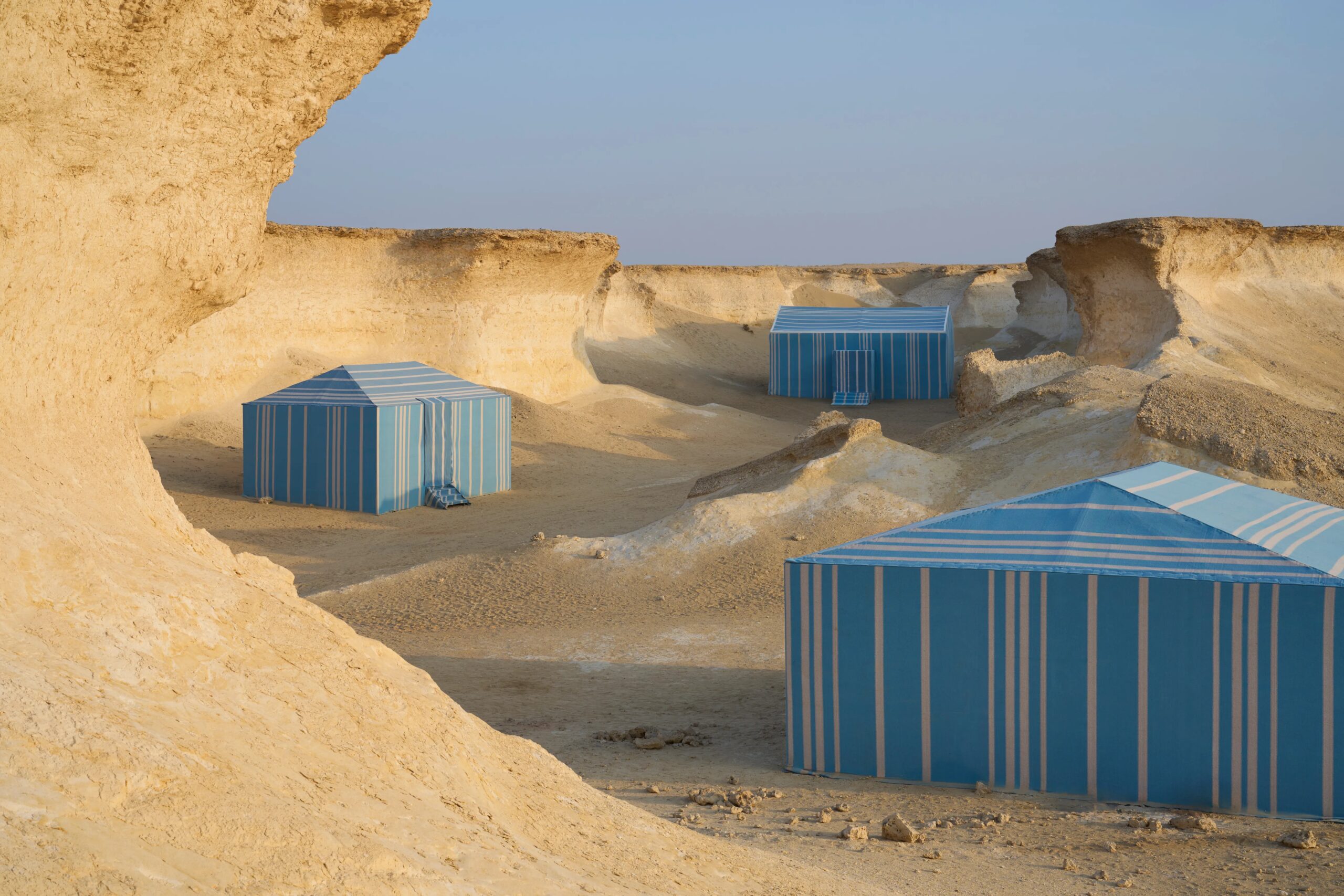
Generally there are tales so extraordinary they really feel extra like a romance. The one we’re about to inform, specifically, carefully mirrors what Paolo Coelho described in his memorable e book The Alchemist, the place the protagonist leaves the Western world to embark on an unbelievable journey into the desert in a means of unlearning and rediscovery. As in Coelho’s narrative, this journey is much less concerning the vacation spot than about attunement and discovering which means via motion, disorientation and pause.
In Qatar, in a tent in the course of the desert—but not removed from Richard Serra’s monolithic set up East–West/West–East (which turned an Instagram should for Artwork Basel Qatar guests) and solely about an hour’s drive from Olafur Eliasson’s monument for cosmic connection—an surprising exhibition invitations guests to rediscover a contemplative relationship with nature. It posits the universality of this want throughout cultures and latitudes via work by a various group of artists from completely different components of the world. They communicate very completely different visible languages, but all draw inspiration from the earth.
On the coronary heart of the initiative is Sheikh Mohammed Rashid Al-Thani, one of many youngest members of the ruling Al-Thani household, who now resides in New York, the place he based the Institute of Arab and Islamic Artwork (IAIA). He, together with acclaimed designer William Cooper founding father of William White, conceived Rahaal, a brief nomadic museum unfolding throughout three pavilions erected within the historic nature reserve of Zekreet, Qatar, and mounted the present, which is on via February 21, 2026.
“It was essential to be in a spot that genuinely speaks to the thought of community-building round nature,” Mohammed Rashid Al-Thani advised Observer once we met within the desert. Attending to Rahaal is not any easy matter—our driver obtained misplaced a few instances, regardless of having been there a number of days earlier, because the desert itself is in steady movement. After we lastly arrived, greater than an hour late, Rashid Al-Thani welcomed us casually, smiling, inviting us into the majjii pavilion to sit down on colourful cushions coated in Moray textiles he had organized to create a big, welcoming couch. Virtually instantly, his employees served espresso and tea with dates.

The thought for Rahaal got here to Rashid Al-Thani after seeing William Cooper’s New York studio—a room totally wrapped in shirting cloth and cotton, creating an environment each modern and deeply resonant. That use of cloth carried a strong sense of familiarity for Rashid Al-Thani, evoking regional traditions by which textiles aren’t confined to interiors however prolong outward, most visibly in tents coated in wool. The shared aesthetic impressed a playful imaginative train between them by which they envisioned a traveler from New York journeying to the small nation of Qatar. “Think about they take this journey by
“That’s what Arabs do; we construct group round nature,” Rashid Al-Thani defined. “That’s how the thought got here collectively. As you drive right here, you see encampments in every single place. It doesn’t matter who you’re—each single individual I do know on this nation understands that intuition.”
He added that many households in Qatar nonetheless preserve a tent within the desert, and persons are accustomed to driving out to assemble and meet there on weekends. “If you already know that somebody has a tent, you already know you may go there—you may be part of anytime, with out formal invitation.” Whereas at the moment permits are required to construct one, the desert itself remains to be largely understood as a shared house. There isn’t a absolute possession. The challenge takes its identify from the Rahaal (رحّال), which interprets as traveler or nomad—somebody who strikes throughout land moderately than settling in a single place, a desert determine accustomed to crossing huge, open landscapes. “After they noticed a tent, they noticed a group. They noticed a spot to relaxation, a spot of refuge. That’s what we wished for individuals coming to the nation: to really feel there’s a non permanent place of connection.”
Qatar, now one of many world’s main international stopover hubs, nonetheless embodies this concept of steady transit. What usually will get misplaced, nevertheless, is the chance to attach with the place itself whereas passing via. “Folks arrive, go to the key museums and go away with out sensing it,” Rashid Al-Thani mirrored. “What we wished was for guests to expertise what you’re experiencing now—the identical feeling you’ll have in my dad and mom’ residence or another tent or household residence within the desert.”
Historically, these tents have been all the time open, welcoming individuals and increasing into non permanent communities. “It creates a deep sense of connection. It may be formal or casual, personal or public—it is dependent upon the individual and the event,” he stated, noting how within the Western world, that dimension usually doesn’t exist anymore, as hospitality has develop into one thing separate, usually related to areas outdoors the house. That is notably felt in massive cities, notably after the disappearance of “third areas” that after facilitated fluid transitions between personal and social life.

Drawing from the traditions of Qatar’s basically nomadic tradition and the heritage of the majlis, Rahaal was conceived at the beginning as a platform for human connection and multicultural encounter, each between individuals and with nature. It’s a web site the place nature, tradition and artwork converge as a part of a single, transformative expertise that displays centuries of Arab rituals rooted in community-building, formed round pure cycles and rhythms.
That sense of openness—of arriving with out announcement—is what Rashid Al-Thani and Cooper sought to seize with Rahaal. He recollects that simply earlier, Perrotin had stopped by and requested whether or not he knew they have been coming. The reply was no, however they have been welcomed all the identical. “What mattered was that individuals have been acquired generously. That was the core concept,” he stated, noting how completely different that is from the cultural paradigm within the U.S. In New York, hospitality exists, however Rashid Al-Thani misses the immediacy of hospitality in his tradition, the place it’s not a courteous efficiency however deeply embedded in historical traditions.
For that reason, he has tried to recreate it in his own residence within the West Village. “I inform my pals, ‘Simply name me. I’m there. My espresso is prepared. My tea is prepared. My dates are prepared.’ And now they really do it each weekend,” he shared. “They name and say, ‘We’re within the West Village—can we come by?’” For him, the reply is all the time sure. “I get up, put together the espresso and tea, set out six cups, and whoever comes has a house—a spot of refuge, even when only for that second. That’s what we hoped to translate right here.”
The central pavilion, Al Ma’rad, hosts the inaugural present, “Anyplace Is My Land,” curated by Rashid Al-Thani with work by modern artists from numerous geographies, all imagining panorama not as an outline of place however as fragments of reminiscence carried inside the traveler—seen, altered and remembered in movement. The notion of fixed motion knowledgeable the exhibition’s title, impressed by Antonio Díaz’s collection Anyplace Is My Land, created whereas he was in exile in Italy. “The thought of land, and the place you discover it, turns into very highly effective—particularly right here, the place land is known as a typical house,” Rashid Al-Thani mirrored.

That includes each established and rising artists, the exhibition leaves viewers with a way of feeling at residence—even within the desert—via the opportunity of reconnecting with pure scenes that resonate in another way with every individual’s background and recollections. Collectively, the works affirm the universality of humanity’s want for contemplation of nature as a method to reattune to probably the most primordial truths of our existence inside a broader cosmic order. All hanging, Salon-style, in a vibrant constellation in opposition to the fabric-lined partitions, the works on view vary from the poetic, limitless starry evening of Vija Celmins and materials collaborative connections with the prime parts of Arte Povera masters Giuseppe Penone and Pier Paolo Calzolari, to the lyrical, extra summary, artificial visions of artists from the area akin to Etel Adnan and Huguette Caland, and the archaic, archetypal reappearances of Simone Fattal, amongst different names.
“The whole lot in life feels so linear. Even museums are linear: you progress from one level to the following,” Rashid Al-Thani defined. “The desert interrupts that. It forces you to assume in another way. Generally it offers you a second of reflection. Generally you end up solely once you’re misplaced. I do know it sounds very poetic, however each time I come right here—besides possibly as soon as, after I went straight via—I really feel like I lose my method, however I discover one thing else.” It’s from this particular relationship with the desert—one which requires humility and receptivity within the face of nature’s infinite and overwhelming drive—that the event of astronomy in Islamic civilization emerged. It was born from the necessity to find oneself and discover route, as a result of Arabs have been all the time on the transfer.
On this sense, Rashid Al-Thani might have discovered an much more resonant interpretation of “Turning into,” deeply rooted in a spot and its traditions, however overtly encouraging all these in transit via Qatar to exit their Western culture-shaped consolation zone and “get off the street,” get to the desert and embrace the tradition.
The response, not solely from individuals visiting Artwork Basel Qatar but in addition from locals, has been extremely telling. “Somebody messaged me and stated, ‘I’ve been right here for 15 years, and I’ve by no means skilled one thing like this.’ That type of response is precisely what we have been hoping for,” he stated. “If something goes to vary how individuals understand each other, it must be via connection.” It was that seek for connection that introduced him to artwork within the first place, and it’s a deeply humanist method that he has embraced.

Since its founding in 2017, his Institute of Arab and Islamic Artwork has been centered on altering the notion individuals have of Islamic and Arab tradition by creating events for significant encounters via the showcasing of up to date and historic artwork from the Arab and Islamic worlds. “I felt a rising exhaustion being boxed in as ‘the Arab.’ I wished individuals to not be scared once they encountered somebody like me,” Rashid Al-Thani stated, recalling how, when he moved in 2014, worry and misunderstanding towards Islamic tradition have been very current within the U.S., fueled by a political agenda.
“It’s about normalizing what it means to be Arab or Muslim by putting it inside a broader modern observe, whether or not that’s design, artwork or structure,” he stated. “With out these moments of connection we shared, my perspective may by no means have reached a wider viewers, and the identical is true for his. However connection is totally central to each of us. It’s what we’re deeply invested in, and I consider it’s exactly what has made this challenge profitable.”
Over near a decade in New York, the IAIA has helped facilitate broader worldwide recognition of a number of key figures of Arab artwork, together with Ibrahim El-Salahi, Behjat Sadr and the now-rising Huguette Caland, amongst others. The IAIA presents each exhibitions and site-specific interventions, every completely researched and curated to open up advanced narratives about artwork from the Arab and Islamic worlds. The institute highlights traditionally important artists who’ve been underrepresented in international modern artwork discourse and goals to problem stereotypes about Arab and Muslim cultural manufacturing.
To encourage spontaneous encounters with Islamic tradition, the IAIA launched its inaugural Public Artwork program final fall with Huge Rumi, a sculpture by Ghada Amer, marking the artist’s first public artwork set up in the USA. On view via March at 421 sixth Avenue in New York, its latticework is formed in house by the repetition of the Arabic quote attributed to the Thirteenth-century mystic poet Rumi, which, translated into English, reads: “You’re what you search” or “What you search is in search of you.”
As U.S. establishments more and more flip their consideration towards the Islamic segments of America’s multicultural inhabitants, works beforehand exhibited by the IAIA have entered the collections of main museums, together with the Metropolitan Museum of Artwork. In a world—and a rustic—ever extra divided, Arab tradition, from the rise of the Gulf to the election of New York’s first Muslim mayor, is more and more central to public discourse, the IAIA’s mission and Rashid Al-Thani’s welcoming method to exhibiting artwork really feel not solely well timed however deeply resonant.

Extra Arts Interviews

