Ten human remains found at a historic African burial ground in Queens were disinterred and placed in storage. Now, the pastor of the church that is steward of the site wants them reburied and the plot transformed into a memorial to the slaves and freed slaves still buried there.
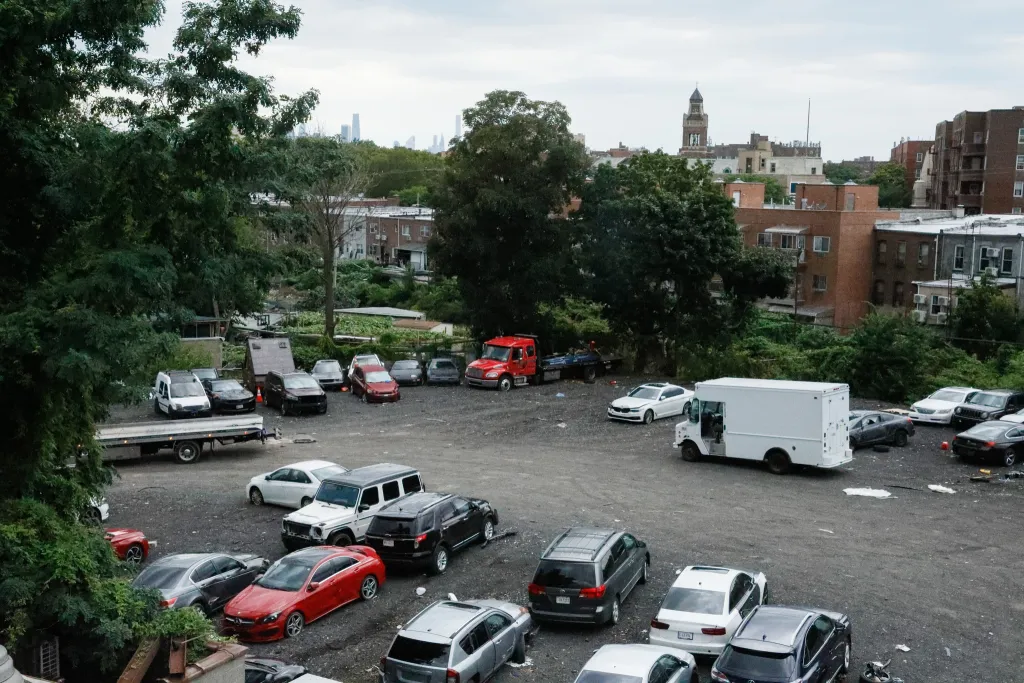
The Rev. Kimberly Detherage, pastor of St. Mark African Methodist Episcopal Church, is calling on the city to buy the historic site once owned by the church — and recently turned into a parking lot by a limited liability company that’s since ghosted the property, as revealed last week by The City Reporter.
“The church has survived all these years, but we want to do right by the people buried there. We want them reinterred and their stories told,” Detherage told The City Reporter. “To erase a burial ground, you erase the people in it. You erase the contributions they made to the community.”
In an interview Friday, the pastor also supported a new effort to landmark the property and said she would like to see the site turned into a memorial that provides visitors with portraits of the men and women buried there. She suggested the city could buy it.
“It’s important that the history of African Americans in Elmhurst be documented for future generations,” she said.

The site attracted national attention in 2011 when an iron coffin containing the remains of a freed slave who died around 1850 was unearthed during construction of luxury condos on the Elmhurst property.
A subsequent archaeological exploration there uncovered multiple graves, including 10 people whose remains were disinterred for study and have remained off site in storage ever since, The City Reporter has learned. One of those bodies was discovered inside a second iron coffin.
Chrysalis Archaeological Consultants, the firm in possession of the remains, also wants to find a way to properly reinter them.
“We are still in possession of human remains. It’s very disheartening and upsetting to me,” Alyssa Loorya, president and principal investigator of Chrysalis, told The City Reporter. “I would very much like for them respectfully to be reinterred. We should have respect for these things. That is part of our culture [as archaeologists].”
The remains of the 10 individuals are primarily skeletal, but the woman found inside an iron coffin at the site in 2011 was remarkably well preserved because the coffin was sealed airtight. Loorya wouldn’t discuss the second iron coffin, but did note that one of the bodies now in storage belonged to “an elderly man who still had hair.”
The Chrysalis team wrapped them up archivally to ensure they stayed intact and placed them in secure storage, along with a variety of funereal items, including the clothing, buttons and jewelry they were buried with. Loorya declined to discuss their current location.
“It is an extremely unfortunate situation,” she said. “They are people who were respectfully interred. You know the history of the cemetery. That was the intention of the families who buried their kin there — with the intent of a final resting place.”
LLC Abandons Lot
The problem of what to do now is complicated by the fact that the burial site is private property owned by a limited liability company, 90 Queens LLC, that defaulted on its mortgage and then disappeared.
As a result, the lot is now in foreclosure and controlled by another LLC, 90 Street Realty LLC, which bought the original loan and now wants to sell it to recover at least some of the $6.5 million it is owed.
Matthew Barish, an attorney for 90 Street Realty LLC, did not respond to several calls seeking comment on how the owner intends to address the issue of the burial ground as it tries to sell the property.
The City Reporter reached Jiashu Xu, listed as a principal of 90 Street Realty LLC, on Friday. Told of the existence of the burial ground at the property, he angrily responded, “We are a bank. We bought a loan. We don’t know nothing else.”
“If the state of this lot is to be developed, if that is what the bank wants to do, they still have to acknowledge this,” Loorya noted. “Nothing can happen until they address this.”
The lot is currently subject to the state’s Unmarked Burial Site Protection Act and has a restriction stipulating whoever wants to develop it must first address the existence of the burial site, which Chrysalis estimates still contains dozens more human remains.
The act requires the involvement of the state archaeologist in any effort to remove human remains from such sites, but it didn’t go into effect until 2023 — two years after Chrysalis performed its exploration at the Elmhurst site and removed and stored the remains off site.
In response to questions from The City Reporter, State Archaeologist Christina Rieth said because of the timing, “We have not been involved in and have no knowledge of any reinterment efforts.” But going forward, Rieth noted, “If someone is seeking assistance with proper reinterment, they can contact us and we will be happy to provide guidance to them in our official capacity.”
‘What Would It Take to Quash This?’
When the first iron coffin was discovered during construction of condos at the site, the project was put on hold for a time. The owners, 90 Queens LLC, then reached an agreement to proceed with St. Mark AME, which once owned the property but sold it in the 1930s and moved to Jackson Heights.
Under a “memorandum of understanding,” 90 Queens LLC promised to create a special community room and an exterior memorial that would tell the stories of those buried at the Elmhurst site in exchange for continuing with the condo plan.
The owners hired Chrysalis, which soon found a prior examination triggered by the iron coffin discovery “grossly underestimated” the scope of the site as containing no more than a dozen graves. Chrysalis ultimately excavated 10 graves which were regularly spaced in a pattern that indicated there were likely more than 100 bodies buried there.
Corroborating that analysis, prior historical records cited by the city Landmarks Preservation Commission estimated upwards of 300 individuals — most likely slaves or freed slaves — had been buried there dating back to 1818.
At first, the Chrysalis team had great plans to do a proper exploration of the site to gain insight into the lives of African Americans in New York City in the 19th century, a history that has long been neglected, Loorya said.
“It was an excellent opportunity,” she said. “We talked about doing more than [performing] just the average archaeology, doing some research about who these people are, what can we learn from them? There’s a broader opportunity to look at the materials they were buried with, look at the [skeletal] morphology, learn who these people were.”
To ensure the integrity of the effort, Chrysalis worked to establish a relationship with Rev. Detherage, and in November 2020 — as COVID-19 consigned the world to wearing masks and standing six feet apart — a memorial ceremony was held at the site with Detherage and members of the congregation.
By then, the ground had frozen and Chrysalis felt it couldn’t remove the remains without damaging them, so the firm waited until it got warmer. The 10 human remains were removed that spring and placed in storage.
Then, 90 Queens LLC stopped returning St. Mark’s calls about the promised memorial room. The last time all the stakeholders had meetings to discuss the resolution of the site was in August and September of last year, and the owner was not present. Instead, someone claiming to be 90 Queens LLC’s “representative” appeared.
“He said, ‘What would it take to quash this?’” Rev. Detherage recalled. “They offered me several hundred thousand dollars.”
She demanded to speak to the owner and was given a contact number. When she called and identified herself, she said he hung up.
Now the archaeological project was no longer certain. Chrysalis was out $167,000 the owner never paid, and the 10 sets of human remains were now caught in a kind of archaeological Twilight Zone.
In 2025, 90 Queens LLC paved over the site and turned it into a parking lot. Dozens of junked cars wound up sitting on top of the graves, including cars and trucks brought there by a vendor hired by the NYPD to tow abandoned vehicles off the streets.
“We never expected that they would renege on the [MOU] agreement,” Rev. Detherage said. “That’s what’s so dishonest, that they don’t care about the gravesite. They desecrated it. You allowed cars towed off the street to park there.”
‘It’s Still Sacred Ground’
What will happen to the human remains in storage and the site itself remains unclear.
After the iron coffin was discovered, the Elmhurst History and Cemeteries Preservation Society drafted an application to officially landmark the site, which — if granted — would restrict how the property could be developed. James McMenamin of the society said that effort “wound up in purgatory” after St. Mark agreed to allow the condos to go forward in exchange for the now-defunct community room and memorial.
On Friday morning, the group submitted the draft application to the Landmarks Preservation Commission.
“Now that must be considered null and void and we can pursue a second landmarking effort,” McMenamin told The City Reporter. “Even though it’s been disturbed many times, it’s still sacred ground.”
For Loorya of Chrysalis, the question of how to honor the slaves and freed slaves buried at the site brings up larger issues beyond bureaucratic inertia.
“There are certainly places throughout the city where people of color — enslaved and free — were interred. Poor people who have been interred that have been forgotten,” she said. “How do we as a society and as a community address this?”
Our nonprofit newsroom relies on donations from readers to sustain our local reporting and keep it free for all New Yorkers. Donate to THE CITY today.
The post Pastor Calls for Remains of Freed Slaves to Be Reinterred, Urges City to Landmark Site appeared first on The City Reporter.
