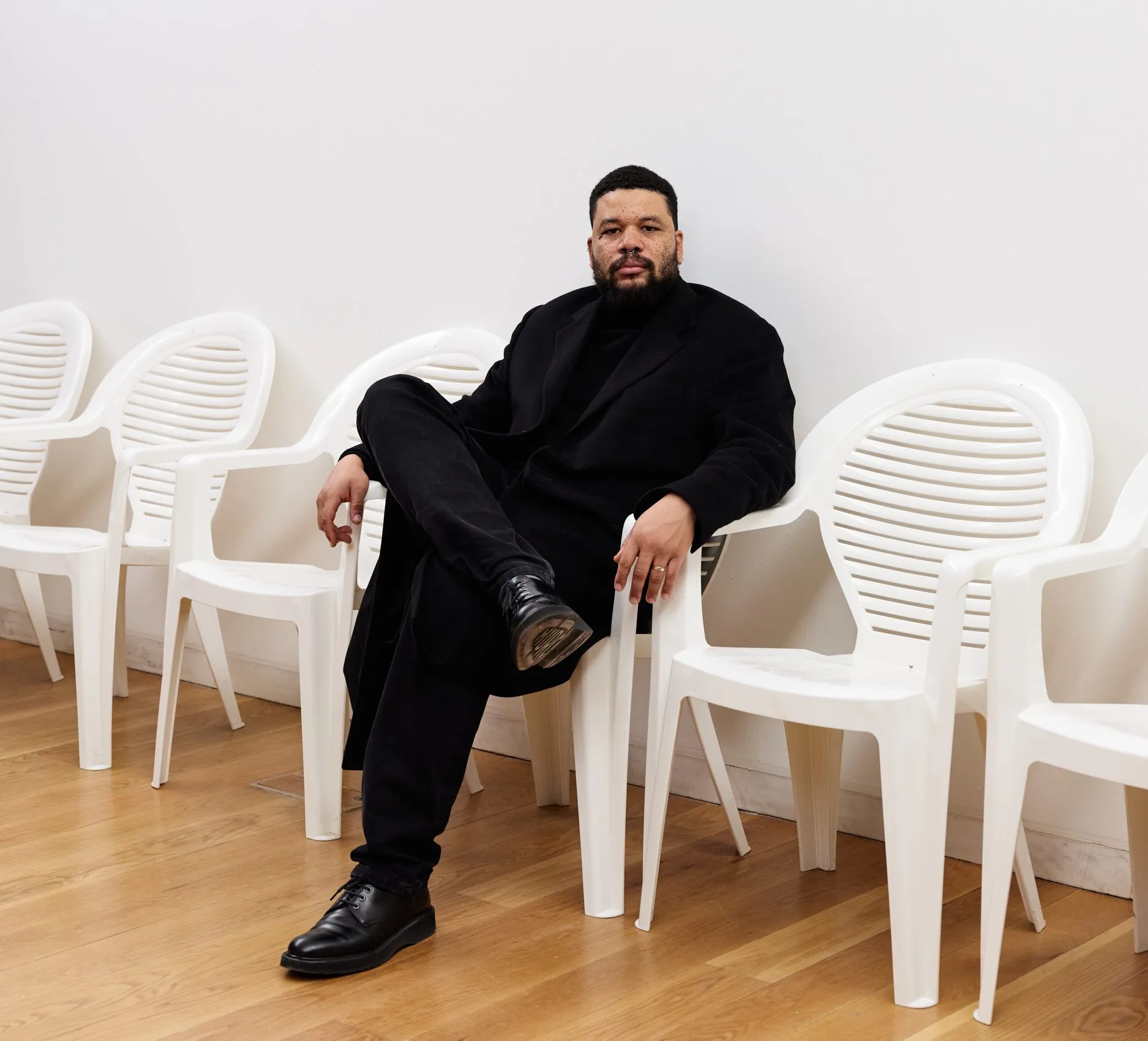
These artwork aficionados who aren’t in Doha this week are possible in Mexico Metropolis for ZONAMACO. Yearly throughout Mexico Metropolis Artwork Week, kurimanzutto, the town’s most prestigious gallery, levels an bold exhibition at its sprawling house in San Miguel Chapultepec, and this 12 months’s, “oscar murillo: el pozo de agua,” brings collectively 15 years of labor by the famous person painter. We caught up with the artist to listen to extra concerning the present, which is a can’t-miss in the event you’re in CDMX this week.
The press launch for this present opens with a poem that makes reference to the “sedimentation of time.” What does that line imply for you, and the way does it tie into the remainder of the present?
Sedimentation of time references Frequencies as an index, an encyclopedic library, a universe in how I view the world—maybe a gesture towards how totally different historic temporalities, experiences and layers of that means settle and accumulate over time. It suggests historical past isn’t linear, however relatively a coexistence of a number of, overlapping layers (constructions, behaviors, occasions) that function at totally different speeds, like a Flight drawing, the act of drawing on the pace of flight—say, at 600 mph or, otherwise, let’s say a 14-year-old baby in a faculty in Singapore taking six months to contribute to the Frequencies database in 2014.
This present collects work from the final decade and a half of your follow. What’s it been prefer to see all of it collectively on the identical time? Did you be taught something about your self?
Time exists otherwise; it’s not linear. So it’s not a survey of time as your query suggests. Just like the work, Telegram, it comes collectively by way of the sedimentation of time. Or like The
How would you describe your relationship to the surfaces of your work? How has that developed through the years?
These surfaces register marks and vitality. I don’t have an obsessive relationship to the floor within the plastic sense of portray, however I do take into consideration depth each within the bodily and psychological sense.
I appreciated your work at this fall’s São Paulo Biennial, whereby you positioned surfaces across the constructing for others to mark. How did you come to this concept and the way does it relate to the remainder of your follow?
In some ways, Social mapping is an evolution of Frequencies with a really brief performative tempo, in addition to a special performative construction for most people. Within the context of a cultural establishment and the streets themselves, it’s also a tool to file the passing of the plenty, by way of the easy act of constructing a mark. Alternatively, Frequencies is a worldwide community, it attaches itself to the framework and infrastructure of the varsity, and it collaborates with youngsters as vessels. Social mapping coincides with this second of censorship and turbulence we live by way of, whereby layers upon layers of marks reveal the ideas that persons are freely recording and sharing, nevertheless trivial or profound.

Whenever you had been first beginning out, you quick turned a market darling. How does that have inform the artwork you’re making at present?
Your query is considerably sensationalist. I’m not a star of something, I don’t recall such a time. I do keep in mind steady focus and experimentation within the studio.
What are the variations between how your work is obtained in Latin and South America versus elsewhere on this planet?
Concepts within the work are borne out of a shifting international order that’s at present underneath risk. Social mapping is probably a response to this. It’s my manner of being on the street as a witness.
Do you have got a favourite work within the present? One which resonates with you for private causes?
The set up of The
On this sense, The
Extra in Artists