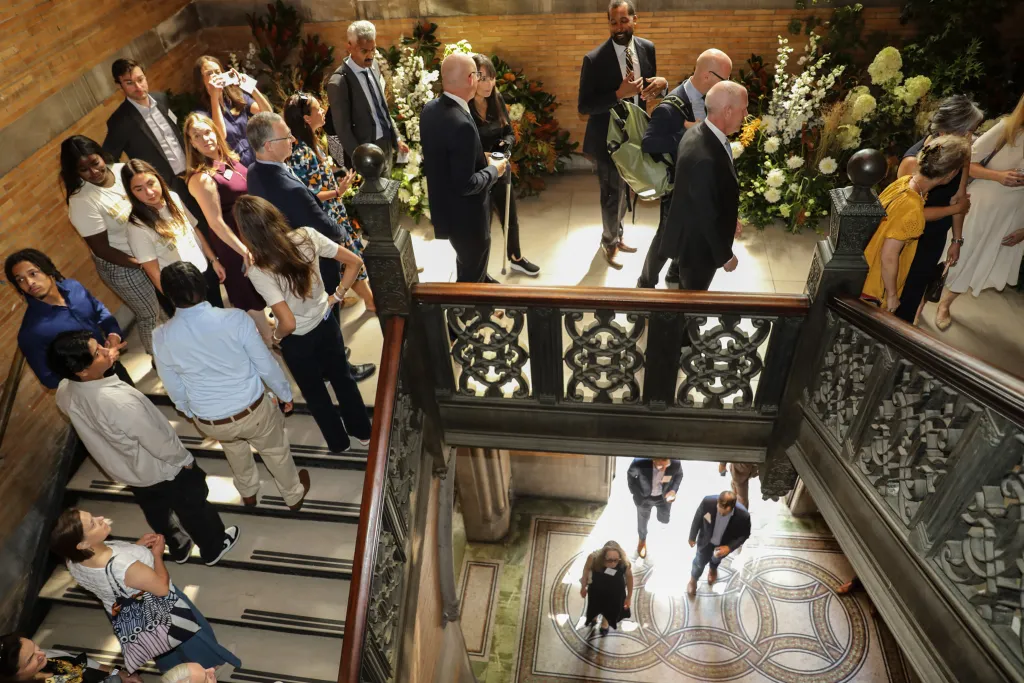
Last Sunday, 87 Vanderbilt University students moved into their rooms at the Nashville university’s new campus in Chelsea, pioneers in the school’s plan to establish an outpost in New York City that will offer a semester away for undergraduates and create a new graduate program in technology and business.
Vanderbilt has committed to spending $44 million on a 99-year lease for the 13 Gothic-style buildings around the leafy quad of the General Theological Seminary of the Episcopal Church. Current renovations on the campus — located a block from the High Line — will cost it about $50 million, with millions more to update additional buildings.
“Our students were telling us for several years now that they wanted to be in New York City,” said James Kellerhouse, the assistant chancellor recruited to get the outpost off the ground. “We knew that because we were recruiting them from New York but they were coming back here after graduating.”
The headlines about the state of higher education in the United States have been dire. “Once globally prominent, U.S. universities are sliding into decline,” proclaimed a headline in the Hechinger Report earlier this month. Even well-known liberal arts colleges like Hampshire College are closing.

Closer to home, the New School, in Greenwich Village, has offered buyouts, laid off 60 professors and staff and closed several academic departments in an effort to close a $50 million deficit. In Gramercy Park, the School of Visual Arts has seen enrollment drop by more than 30% since 2017 and is grappling with a $22 million deficit.
And the pool of potential pupils is shrinking as the Trump administration works to sharply reduce the number of international students coming to the United States while cutting federal funding for academic and scientific research.
But New York’s college sector continues to grow as its major institutions power through the headwinds and new entrants either establish operations or merge their way into the city.
Employment at private colleges and universities in the city increased about 5% to a record 170,000 in April, according to the state Labor Department, while nationally higher ed jobs declined by 3%. The city’s Economic Development Corp. counted 516,000 college students in 2024, the most recently available numbers.

“There is a flight to quality and students are choosing names they know,” said Ed Venit, who has spent 20 years researching trends in higher education. “Columbia, New York University, Fordham and St. John’s all have brand names. You have Ivy League, Ivy League-adjacent and Fordham with its strong regional identity.”
Vanderbilt illustrates why New York is so attractive to both students and the institutions recruiting them.
Start with the city’s unrivaled attractions. On the first day of classes, the students went to the Upper West Side, SoHo, Little Italy, and Greenwich Village, in part by bus and Citibike. “New York is really their classroom,” Kellerhouse said.
Internships are key for Vanderbilt and no place can offer more opportunities than New York. Vanderbilt’s program requires a 20 to 25-hour-a-week internship and it established more than 140 for the first group of students, including at museums like the Whitney, the High Line, nonprofits like Safe Horizons and several law firms.
MORE: Inside NYC’s K-Shaped Economy: A Few Do Well, Most Do Not
Vanderbilt counts 10,000 alumni working in New York, the highest number anywhere, an increase of almost 2,000 in recent years. The new campus will allow the school to strengthen its ties to that network.
Also crucial are the strong academic reputations of the city’s other colleges and universities.
“Students who are paying for their education are voting with their feet,” said Preston Cooper, an expert on higher education at the American Enterprise Institute. “Lower quality schools have seen a plunge in enrollment. Those with the best education have seen their enrollments grow.”
Admittedly, not all schools in the city are thriving. The New School has seen its enrollment fall to 8,500 in the last academic year from slightly more than 10,000 in 2001 and its finances are shaky.
“There is a flight to quality and students are choosing names they know.”
Ed Venit, Higher education researcher
For other institutions in trouble there are options. With its future in doubt, Marymount Manhattan College on the Upper East Side merged with Northeastern University of Boston, which is trying to build a bigger footprint by taking over small colleges across the country.
“We want to be in New York,” Northeastern President Joseph Aoun said when the deal was announced in 2024. “No institution, even the constellation of institutions that exists in New York, can meet all the needs.”
Increasing the number of private colleges and universities in the city was a priority of the Adams administration, which in 2024 put out a major report which said the sector contributed $35 billion a year to the city’s economy. The new team at City Hall is equally committed to the sector.
“The Mamdani administration will continue building partnerships with our city’s leading research and educational institutions to expand opportunities for working-class New Yorkers and ensure that New York remains a global destination for young talent,” said spokesperson Cassio Mendoza.
Meanwhile, the public City University of New York, with more than 275,000 students, has seen its enrollment grow by 21,000 since 2021.

Federal efforts to restrict international students will be a key factor as the fall semester begins.
The number of international students applying to U.S. schools fell by 10% for the new academic year. Columbia University and NYU may face big challenges this year. One quarter of NYU students and 18% of Columbia students come from abroad. Columbia did not provide information on its enrollment for the new semester. Columbia did not supply information on international students. NYU did not either, but the school, which last year enrolled 57,000 degree seeking students and employs slightly more than 28,000 people, knows what is at stake.
“We are a global university, and our international students are part of the fabric of NYU and our international student enrollment remains strong,” said spokesperson Joseph Tirella.
Vanderbilt’s decision to spend more than $100 million on its lease and renovation suggests the city’s strengths will win out.
“New York is essential to our vision,” the school’s chancellor, Daniel Diermier, said at the formal opening of the Chelsea campus on Tuesday. “There are few places in the world where so many of the forces shaping our future work, business and finance, technology and media, arts and culture, public policy, global affairs are present.”
Our nonprofit newsroom relies on donations from readers to sustain our local reporting and keep it free for all New Yorkers. Donate to THE CITY today.
The post Nashville to New York: Some NYC Colleges Thrive Amid Headwinds appeared first on The City Reporter.
