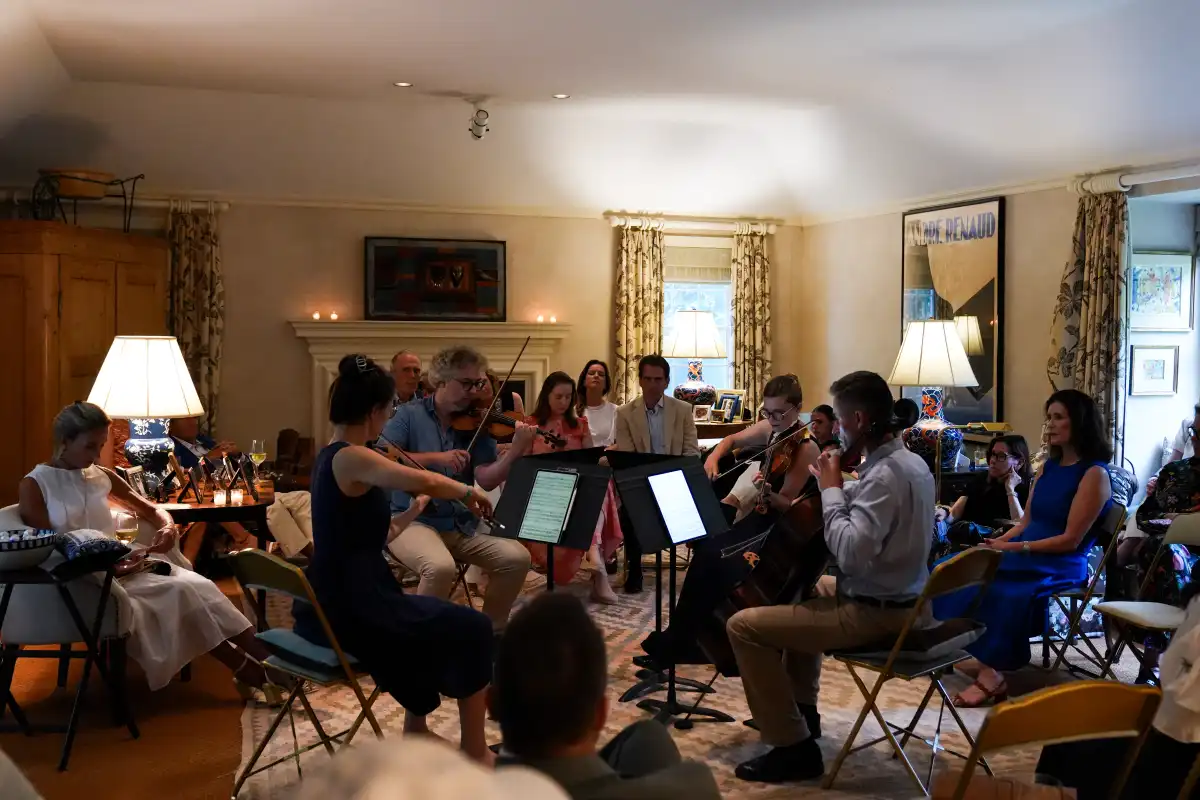
Mozart arrived in Southampton not as a marble bust, a powdered relic or some dutiful lesson in cultural refinement, but as something far more alive. At the residence of Maryann Marston, beneath the softened glamour of an East End summer evening, his music moved through the air with all its old intelligence intact—restless, intimate, playful and, at moments, almost unbearably beautiful.
There, supporters of the American Mozarteum Society gathered for cocktails, canapés and a special concert hosted by Kimberly Allan, Ellie Manko Libby and Marta de Radzyminski. The setting was certainly grand, though never stiff: a private Southampton home, generous hospitality and the Boho4 String Quartet performing Wolfgang Amadeus Mozart’s String Quartet No. 15 in D Minor, K. 421, interwoven with live readings from Dutch author Anna Enquist’s Kwartet. Music and literature leaned gently toward one another, allowing the evening to feel less like a recital than a private passage into the emotional architecture of the work.
My love of Mozart in adulthood nearly matches my childhood obsession with Gershwin, which is saying rather a lot. Gershwin gave me the city in rhythm—the wit, ache, romance and beautiful nerve of American modernity. Mozart arrived differently: ethereal, transcendent yet deeply human. His music seems to enter from somewhere beyond language, arranging emotion before the mind has had the opportunity to name it.


These composers, these artists, these visionaries remain intrinsic to the human condition because they do not merely depict feeling. Quite often, they direct it. A phrase can make longing appear where none seemed present. A minor key may reopen a grief thought neatly filed away, while one sudden turn toward brightness can make hope feel less theoretical. Art does not always wait politely for our experience; sometimes, rather mysteriously, it creates the experience for us.
Mozart understood that power with almost unnerving fluency. Born in Salzburg in 1756, he emerged as a child prodigy and performed before European courts while most children were still learning the limits of a staircase. Yet the grandeur surrounding his early life should not obscure the human complexity beneath it. His brief adulthood held ambition, financial uncertainty, artistic rebellion, domestic tenderness and an astonishing torrent of composition. He died at only 35, leaving music that still seems to know more about us than we know about ourselves.
The D Minor Quartet carried that complexity beautifully. Its elegance never erased its shadows; rather, the refinement gave the darker passages somewhere graceful to reside. Boho4, co-founded by Marston’s close friend Jessica Tortorice, approached the piece with sensitivity and restraint. The readings from Enquist’s novel added another current, drawing attention to the fragile negotiations within any quartet: four distinct voices listening, resisting, yielding and somehow building a single emotional world.
For the American Mozarteum Society, the U.S. affiliate of the International Mozarteum Foundation in Salzburg, preserving that world is both mission and inheritance. AMS President Andrew Hawkins described the organization as small, though possessing “a big heart” and a formidable cultural name. Joined by his wife, Lisa Walsh, and daughter, Lauren Walsh, Hawkins spoke warmly about protecting the legacy entrusted by Mozart’s widow and children while encouraging younger audiences to discover the joy, passion and fun within this music.


That last point matters. Reverence can sometimes make great art feel unnecessarily remote, as though beauty must be approached with folded hands and a frightened expression. Mozart hardly requires such punishment. His brilliance contains mischief, seduction, contradiction and delight. The Society’s work, at its best, allows scholarship and pleasure to share the same glass of champagne.
Board members Kimberly Allan, Jonathan Marder, Marta de Radzyminski, Lauren Walsh and Lisa Walsh joined guests including Rob Allan, Patricia L. Francy, Laura and Jim Freeman, Ellie Manko Libby, Charlotte and Andrew Pilaro, and Sabine Riglios.
The coming season extends that enchantment. December brings a rare Palm Beach concert featuring Mozart’s original violin, along with New York gatherings with tenor Rolando Villazón and soprano Kathryn Lewek. In January, members will travel to Salzburg for Mozartwoche, returning the music to the city of its birth.
Southampton provided a particularly radiant prelude. As daylight softened and the quartet drew its final breath, the evening offered something beyond performance: a reminder that music survives not only through institutions, archives and devotion, but through the private astonishment of being moved. Centuries later, Mozart still enters, rearranges the heart and leaves the air slightly altered behind him.
Fellow Mozart lover? Check out mozarteum-us.org