It was after a crushing Copa America final defeat against Chile at MetLife Stadium that Lionel Messi announced his premature retirement from international football in 2016, and the venue could provide the stage for Messi to bow out of international football again after another devastating final defeat ten years later.
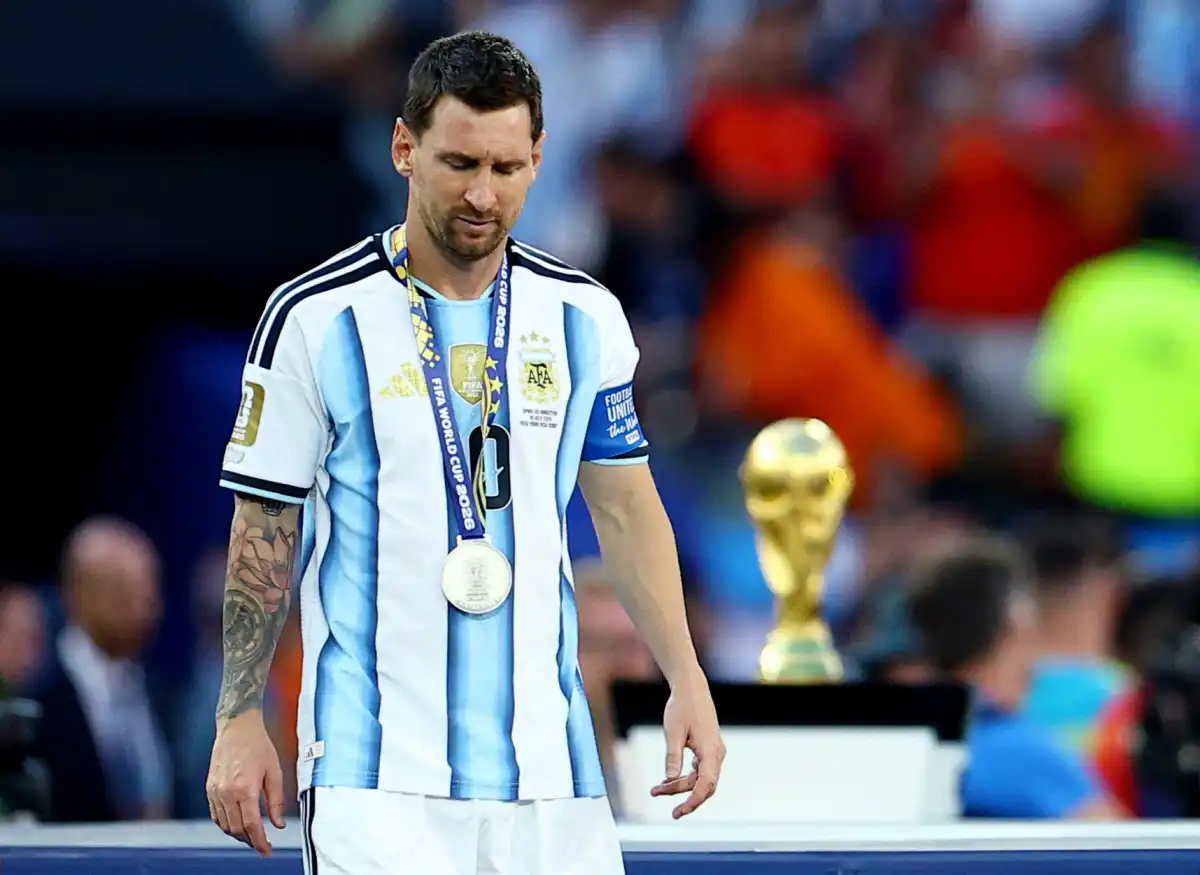
Messi has not officially announced his retirement after Argentina’s 1-0 defeat to Spain in the World Cup final Sunday afternoon, but the tears he cried after collecting his silver medal said everything. He is unlikely to ever grace the world stage again, at least in a World Cup.
But Argentina and the global football community can be thankful that Messi did not call it quits for good when he did announce his retirement in 2016 after losing his fourth international final – when ne seemed to finally buckle under the unbearable weight of Argentinian expectation.
His return to international football has been a near decade-long swan song that has witnessed some of the greatest triumphs in the greatest sporting career of all time.
It did get off to an inauspicious start, however, with a meek exit from the 2018 World Cup at the hands of France appearing to signal Argentina’s continued decline. A sobering exit in the 2019 Copa America semi-final against Brazil followed, but everything changed at the same tournament two years later.
In the midst of the Covid-19 pandemic, Messi and Argentina finally broke their 28-year wait for an international trophy with a 1-0 win over Brazil in front of a sparse crowd in Rio.
It was that victory that seemed to infuse Argentina with belief that they could finally land the big one in Qatar by winning the World Cup for the first time in 36 years.
Messi was like a man possessed in that tournament, almost single-handedly dragging Argentina through the group stages with a stunning winning goal against Mexico and then producing herculean display after herculean display during the knockout stages to set up a rematch with France.
Argentina’s victory in that dramatic final felt very much like Messi’s victory, like an Everest had been scaled, like an incredible career had gotten the ending it deserved.
No one would have blamed Messi if he called time on his career then and there – two goals shy of 100 international goals – but the maestro stayed the course, winning a third consecutive international trophy when Argentina went back-to-back at the Copa America in 2024, albeit playing a far less significant role than he did in 2021.
There were doubts about the kind of influence a 38-going-on-39-year-old Messi could have on the biggest stage in football ahead of the 2026 World Cup, especially after spending three years in the MLS, but he proved all doubters wrong with arguably his best ever tournament.
Messi was less involved than when he dragged Argentina to the 2014 World Cup final in Brazil and that bit slower than he was four years ago, but he was still capable of producing game-defining moments like no one else.
As if by sheer force of will, he saved Argentina from elimination in the last-16 against Egypt, producing an exquisite assist for Christian Romero before firing in the equalizer as Argentina fought back from 2-0 down to win 3-2. In the semi-final, Messi tore England apart in the final half-hour, registering two assists as Thomas Tuchel’s side wilted against his genius.
He was at his quietest in the final, but there was little he could do against a dominant Spain side that literally suffocated a limited Argentina in its own half for much of the contest. He still came alive in the dying moments of extra time when Spain had taken the lead and the fat was in the fire, looking like the only Argentinian player capable of hurting a watertight Spanish defense.
In many ways, his quiet performance in the final encapsulates what this Argentina team will look like once he does step away. Without Messi performing, Argentina looks barely average – and that is how they will look in the near future. It also begs the question of just how poor Argentina would have been over the last decade had Messi not returned.
Even with such a limited team, Messi managed a campaign to remember, scoring eight and assisting four to finish second behind Kylian Mbappé in the Golden Boot race – a race he would have won had Mbappé not scored twice in the irrelevant third place play-off.
Defeat against Spain denied Messi the chance to complete a full-circle moment at the stadium that caused arguably his greatest heartache, but it is nowhere near as devastating as that defeat ten years ago.
Then, Messi announced his departure from international football in the wake of intense criticism in his beloved Argentina, his career forever compared to Diego Maradona and his failure to win an international trophy used as a mark against his legacy.
Now, should he decide to step away, he will ride off into the sunset with three international trophies to his name and a World Cup legacy that far outshines Maradona’s. Victory at MetLife would have simply added the icing on the cake, but it was not career-defining in the way that 2016 seemed to be.
He was already the greatest player to ever touch a football prior to his premature retirement. His astonishingly successful return merely put the matter beyond any doubt.