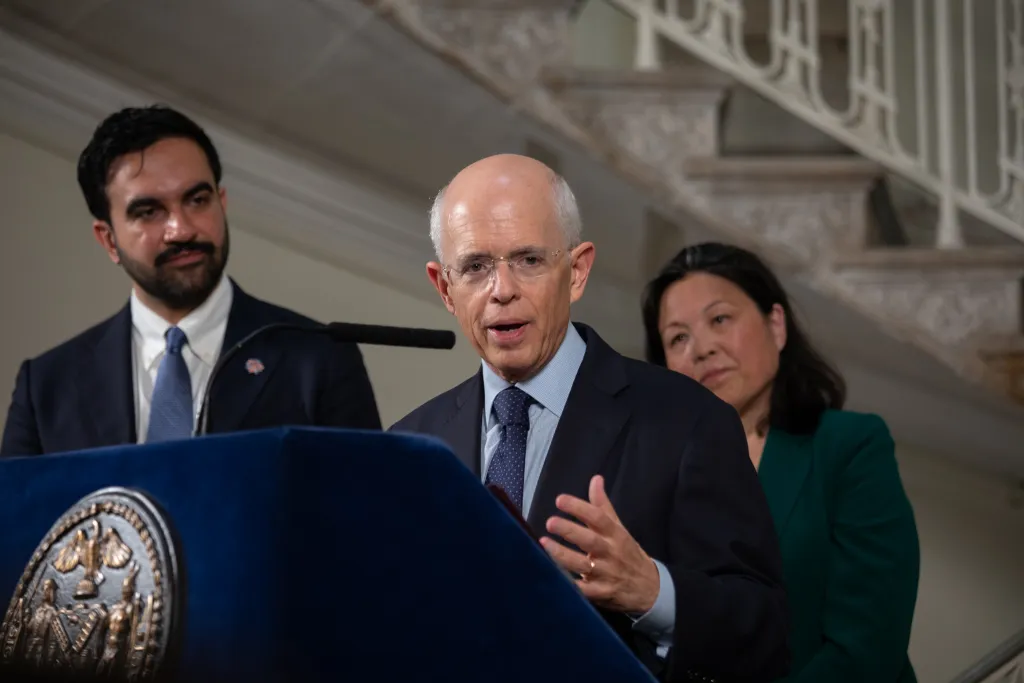
Months after scrapping a $9.9 million McKinsey & Co. consulting contract as part of an effort to rein in city spending, Mayor Zohran Mamdani on Wednesday turned to a veteran McKinsey partner who had worked on that contract to lead New York City’s top economic agency.
Mamdani appointed Anthony Shorris — a former first deputy mayor under Bill de Blasio who joined the consulting giant after leaving City Hall — to head the city’s Economic Development Corporation (EDC).
During the de Blasio administration, Shorris hired McKinsey in a failed effort to use an algorithm to reduce violence on Rikers Island, even as mayhem at the jail complex increased.
In his new role, Shorris will head an agency that provides tax incentives and grants to businesses and real estate developers to encourage economic growth in New York City.
“We believe that economic development and economic justice must go hand in hand. This is no radical concept; if anything, it is unified,” Mamdani said while introducing Shorris at City Hall. “Time and again he has proven himself unafraid to use the levers of city government to deliver real benefits for working New Yorkers.”
Shorris joined McKinsey as a partner in 2021 after more than four decades in public service and the nonprofit sector. According to his biography on the firm’s website, he advises state and local governments, public authorities, health care systems, universities and real estate developers on strategy and management.

Shorris’ appointment comes just months after Mamdani canceled one of the city’s largest consulting contracts with McKinsey, a $9.9 million retainer to advise the Department of Social Services (DSS) on various topics, as part of an effort to find $1.7 billion in savings.
At a press conference at City Hall, Shorris acknowledged that while he was a partner at McKinsey he “did spend some time working on that” contract. He did not elaborate on his role.
The McKinsey contract, which was scheduled to run through March 2026, had already netted the consulting firm about $7.2 million before the city pulled the plug.
City records offer a small window into what taxpayers received for that spending.
The contract’s first assignment, for which McKinsey received roughly $3.4 million, is described simply as “business consulting services” without further explanation. Another major component focused on reducing errors in the city’s administration of the Supplemental Nutrition Assistance Program, or SNAP, as states faced increased federal scrutiny over erroneous benefit payments.
A City Hall spokesperson did not respond to questions Tuesday about why, out of the hundreds of thousands of city contracts, the administration singled out the McKinsey contract. The DSS contract was expected to continue through next year but city records show the last payment to McKinsey was made on Monday.
The city recently announced it would use artificial intelligence to help reduce the SNAP error rate.
City records also show McKinsey has a $909,000 contract tied to the Mayor’s office, but zero payments had been made as of this week.
‘Sour’ Rikers Island Contract
Shorris worked with McKinsey during his time in the de Blasio administration — including on a failed attempt by the consulting giant to reduce violence on Rikers Island.

Shortly after de Blasio took office in 2014, then-First Deputy Mayor Shorris spearheaded a $27.5 million contract for McKinsey to overhaul how the Department of Correction classified and housed detainees at Rikers Island.
The firm’s algorithm-based system, known as the Housing Unit Balancer, was intended to reduce violence by using dozens of factors to determine where detainees should be housed — but violence continued to rise. The system was widely criticized by correction officers and jail officials, and it was abandoned in 2022 after just four years.
“There was a lot of disappointment with the McKinsey stuff,” then-Correction Commissioner Vincent Schiraldi told The City Reporter after ending the program. “It made the whole city sour.”
The ‘McKinsey Family’
Shorris’ appointment prompted questions from government watchdogs about the revolving door between public office and private consulting firms — where former officials take prominent jobs in the private sector before returning to positions where they oversee public policy and spending — sometimes to the benefit of their former firms.
“McKinsey is much more than just a specific firm; it is a network,” said Jeff Hauser, executive director of the Revolving Door Project, a watchdog group focused on corporate influence in government. “If you just said Shorris can’t be involved in a contract with McKinsey, that means one thing. But if he is involved with companies that are run in part or in whole by McKinsey alumni… that’s very much still within the McKinsey family.”
McKinsey’s work for government and corporate clients has been widely criticized.
In 2024, the firm agreed to pay $650 million to settle claims tied to its work advising opioid maker Purdue Pharma, though it denied wrongdoing. That work reportedly entailed advising the pharmaceutical company how to better target doctors who were prescribing opioids.
It has also faced criticism for consulting work on behalf of U.S. Immigration and Customs Enforcement (ICE) during the Trump administration.
McKinsey consultants working on an ICE contract identified ways to cut costs at immigrant detention facilities, including recommending reductions in the amount of food served to detainees, the New York Times reported. The firm’s work for ICE prompted backlash from employees and immigration advocates.
In-House Sceptic
There is no indication Shorris was involved in McKinsey’s work for ICE or the firm’s other controversial engagements. He joined McKinsey as a partner in 2021, years after the ICE consulting project and the recommendations involving detention facilities.

But even Lina Khan, a progressive former head of the Federal Trade Commission, who Mamdani named Wednesday to chair the EDC board — overseeing Shorris’ work — has questioned the legitimacy of governments relying on McKinsey to solve its problems.
In an interview last week with economist Paul Krugman, Khan said: “I think we’ve all seen the news stories about New York City having paid millions of dollars to McKinsey to produce a report saying, effectively, ‘Put your garbage in garbage cans’.”
She added, “Over-reliance on outside consulting firms can also deprive the state of building in-house state capacity, which can be incredibly important for the long term.”
‘Lack of Accountability’
Shorris’ previous tenure at City Hall was not without controversy.
In 2016, the city’s Department of Investigation criticized the de Blasio administration’s handling of the sale of the former Rivington House nursing home on the Lower East Side after officials lifted a deed restriction that required the property to remain a nonprofit nursing home, allowing it to be sold for luxury condominium development.
Investigators questioned Shorris’ role in the transaction. He told DOI that he had instructed city staff to keep the deed restriction in place but acknowledged there was no written record of that direction. Shorris also said he never read a subsequent memo informing him that the restriction had been removed.
Investigators concluded that senior city officials “knew or should have known” the restriction had been lifted and said the episode exposed “a complete lack of accountability” and significant communication failures within City Hall.
Our nonprofit newsroom relies on donations from readers to sustain our local reporting and keep it free for all New Yorkers. Donate to THE CITY today.
The post Mamdani Tapped McKinsey Partner After Axing $9.9 Million McKinsey Contract appeared first on The City Reporter.
