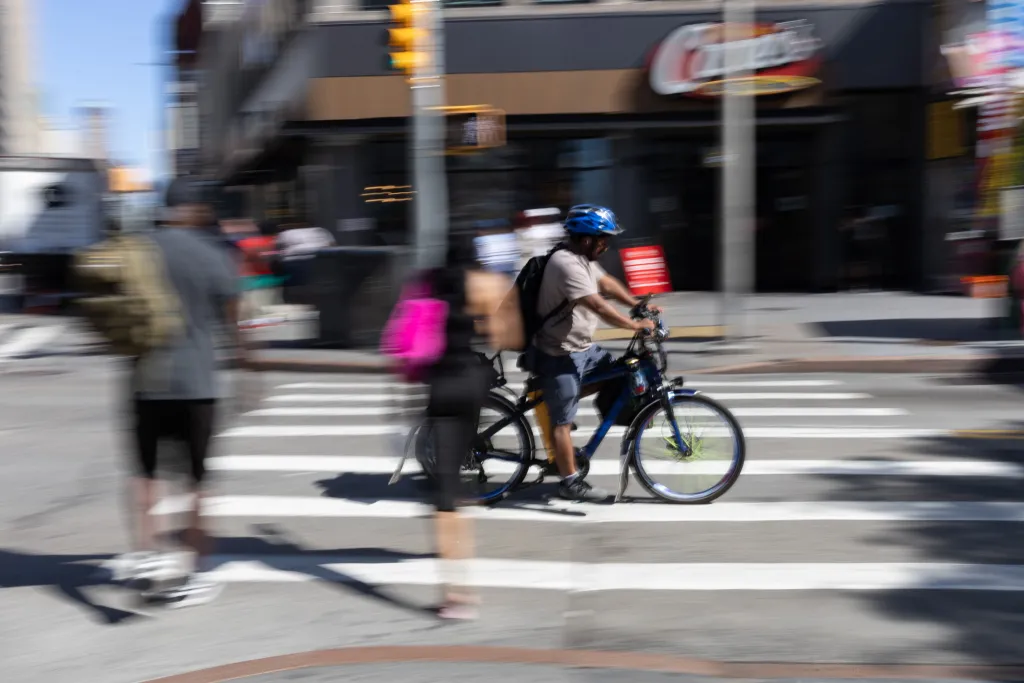
As the Mamdani administration ramps up to release its first legally mandated streets plan, advocates on Tuesday will present a roadmap designed to push City Hall to meet its marks.
The five-year streets outlook, due by the end of this year, follows the city Department of Transportation’s lapses under previous Mayor Eric Adams, when it struggled to hit even the halfway point on the number of miles of protected bus and bike lanes that by law should have been built between 2022 and 2026.
That failure led to City Council Majority Leader Shaun Abreu slapping DOT with a “big, fat F” in March. It also resulted in 10 transportation and safe streets advocacy groups urging the city to more clearly chart its progress on goals that include speeding up some of the country’s slowest buses, connecting a protected bike lane network, expanding pedestrian space and reducing the use of vehicles.
“It’s a vision for a people-oriented city,” said Sara Lind, co-executive director of Open Plans, a safe streets advocacy group. “That doesn’t mean no driving, but that does mean that the design of our streets and public spaces is commensurate with the people who use it, the majority of whom don’t drive around the city on a regular basis.”
In a letter to city Transportation Commissioner Mike Flynn, the advocates framed the call for more transparency as key to saving New Yorkers time and money.
“As you finalize the plan, we urge you to adopt metrics tied to affordability, liability and the freedom to move,” reads the letter, which was provided to The City Reporter.
A New ‘Vision Zero’ Plan to End Traffic Deaths
The push for more frequent updates from the city in what is being done to speed bus service and make other street-level improvements came as the Mamdani administration will release a separate plan for street safety on Tuesday.
“Vision Zero Reimagined” is billed as a 10-year blueprint to cut down on traffic fatalities and create the city’s first pedestrian-only and pedestrian-priority districts. According to DOT, traffic deaths have fallen by 30% since Vision Zero was launched in 2014 under then-Mayor Bill de Blasio.
“That progress is just that — progress — and alone is not enough,” Flynn said at a Monday press briefing. “Too many families are still experiencing preventable loss and too many of the most dangerous behaviors persist.”
The updated Vision Zero plan’s goals include removing dangerous drivers from city streets, promoting “safe, certified micromobility” with stronger licensing requirements for mopeds and motorcycles and cutting down on larger vehicles that account for a disproportionate number of pedestrian deaths.
The Vision Zero update is on top of the city and state’s bus action plan launched in July. That plan is geared toward boosting bus speeds, cutting travel times and improving service along 50 of the city’s most problematic corridors.
But the other half of Mamdani’s bus-centered transit campaign pledge — to have fare-free rides — has yet to materialize and has drawn pushback from the head of the MTA.
Achieving — and Communicating — Progress on Safer Streets
The first New York City Streets Plan was introduced in December 2021 under a law passed by the City Council more than two years earlier. It requires the city to present a five-year vision for improving the safety, accessibility and quality of city streets, while also curbing the use of automobiles.
But over the course of those years, the DOT did not come close to meeting its annual mandate of protecting 250 miles of bike lanes and creating 150 miles of dedicated bus lanes with camera monitoring.

Danny Pearlstein, policy director for Riders Alliance, a transit advocacy organization, said City Hall must hit its marks and provide progress reports to the public. He cited how the MTA provides reams of metrics that detail how its trains and buses are performing, along with its elevators and escalators.
“The MTA has certainly come a long way with its open data work,” Pearlstein said. “We’re asking the city to meet and then exceed those expectations by communicating directly and regularly with the public about how well our streets are performing, whether they’re providing the transit service we deserve, the safety and accessibility that we deserve and whether they are, in fact, lowering the cost in time and money of living in New York.”
Will Livingston, a DOT spokesperson, said the suggestions “align with how we will be approaching the next Streets Plan.”
“The Mamdani administration is committed to reimagining New York City’s streetscape through bold and innovative design strategies that make traveling throughout the five boroughs safer, more affordable and more accessible,” he said in a statement.
Advocates expressed hope that the city will show significant progress from what was made under previous administrations.
“What’s important looking forward is not only that the marks are met, but that the results are being communicated,” Pearlstein said. “I think the mayor understands this extremely well, that transforming the streets is about demonstrating that New Yorkers are deserving of a transformation of those streets.”
“Nothing shows that like showing the direct benefits in people’s lives, whether that’s faster buses, safer crossings or more kids able to walk to school by themselves,” he added.
Our nonprofit newsroom relies on donations from readers to sustain our local reporting and keep it free for all New Yorkers. Donate to THE CITY today.
The post Mamdani, Here’s How to Do Better on Street Safety, Advocates Plead appeared first on The City Reporter.
