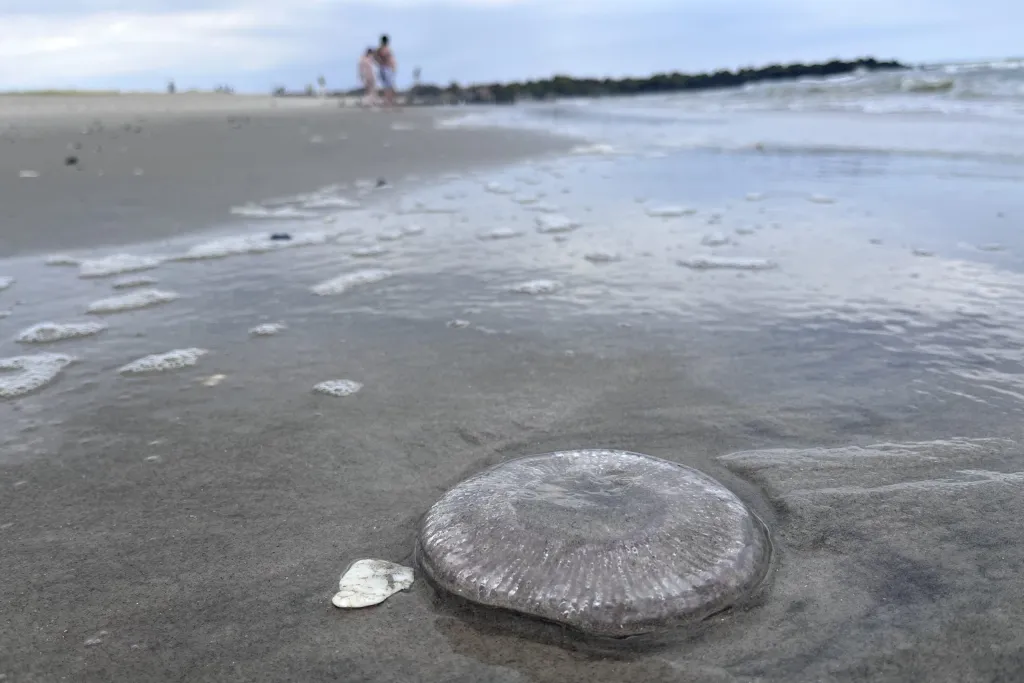
The end of summer can sting. And for many beachgoers in the Rockaways, that’s not a metaphor.
A plethora of jellyfish have appeared on the peninsula’s shores and in its Atlantic waters in numbers locals haven’t seen in years, New Yorkers have said in recent weeks.
The squishy creatures have been spotted floating in the ocean and sitting as blobs on the sand. Swimmers and surfers have reported stings on social media and message boards, ranging in severity from pain similar to a fly bite to requiring medical attention.
“Jellyfish are a normal part of the ocean, so it’s not unusual that we see a variety of species show up,” said Paul Bologna, a marine biologist at Montclair State University who studies the invertebrates.

But in the last couple of weeks, he said, a pink- and purple-colored species called mauve stingers that typically stay farther offshore have moved closer to beaches, especially those in New Jersey and Long Island. He chalked up the jellyfish’s movement to winds and tidal currents.
“The big problem with them is they’ve got a really nasty sting,” Bologna said. “I stung myself with one once just to see how bad it was about a decade ago, and I said a lot of choice four-letter words.”
Getting stung by a mauve stinger, which has long tentacles and is also known as pelagia noctiluca, can result in large, red welts.
“We have a bunch of different jellies in our area. Technically, all of them can sting you if they’re true jellies, but a lot of them, it’s not really problematic,” Bologna said. “These mauve stingers — I have often heard them referred to as purple meanies — are one of those that really cause a lot of pain.”
‘Poison Ivy’-like Sting Marks
Bobby Butler, a longtime Rockaway Beach lifeguard, said he noticed the “kind of beautiful, purplish” mauve stingers for the first time just last week, when he got stung himself.
“It almost looks like I have poison ivy on my arms right now,” he said. “I’ve heard more jellyfish complaints in the past three days than I’ve heard in 25 years lifeguarding.”

Paula Garcia-Salazar, a lawyer who lives in South Slope, likely experienced the wrath of a mauve stinger. During a swim at Rockaway Beach on Aug. 22, she said she felt a hard pinch on her right forearm.
“I thought I was gonna pull my arm out of the water and see a crab hanging there,” she said.
After a few days, Garcia-Salazar said, the stinging got worse and itchier, then her arm became swollen and the mark looked like a burn. She went to an urgent care facility and got a topical steroid. A week later, after some improvement, she went to a doctor because the sting flared up again.
“I didn’t think that the jellyfish in the Rockaways stung so badly,” Garcia-Salazar said, noting she’s still using the steroid. “My arm is full of blisters and I keep it wrapped up because it’s gross.”
Different Types of Jellyfish
Workers at the National Park Service put up signs at Riis Beach and Fort Tilden Beach this past weekend, warning about jellyfish in the water.
Bologna reviewed photos of jellyfish washed up near the beach at Fort Tilden and identified both the perfectly clear ones and ones with subtle pink stripes as lined water jellies, or rhacostoma atlanticum. Compared to mauve stingers, there’s no need to worry about lined water jellies, he said.

“They’ve got little tentacles. Their stinging cells are really small,” he said. “It doesn’t puncture your skin, and by the time they wash up on the beach, they’re completely harmless.” The mauve stingers, however, can still sting even when dead, so beachgoers should steer clear of those sitting on the sand.
Rose Mayo of Astoria said she got stung Friday after a few minutes of swimming at Rockaway Beach.
“You know biting flies? It felt like a little more intense version of that,” she said. “It wasn’t terrible.”
Mayo, 37, said the sting on the inside of her thigh looked like a blotchy group of bumps that swelled up for about an hour or two. The next day, the bumps were gone.
Bologna recommended spraying white vinegar on jellyfish stings to immobilize any leftover tentacles or stinging cells, then rinse with salt water. Tap or bottled water will cause an osmotic shock, where the cells swell and burst, resulting in a worse sting. After you wipe the area clean, use a hot compress.
It’s a myth that urinating on a jellyfish sting helps reduce the pain, Bologna pointed out.
“The peeing thing — no,” he said.
Our nonprofit newsroom relies on donations from readers to sustain our local reporting and keep it free for all New Yorkers. Donate to THE CITY today.
The post Jellyfish Clog Shores and Sting Swimmers as Summer Wanes in Rockaway appeared first on The City Reporter.
