Berlin-based collector Julia Stoschek is broadly recognized within the artwork world not just for assembling one of many world’s first and largest non-public collections devoted to video artwork, movie, efficiency documentation and digital practices but additionally for championing these mediums nicely earlier than they grew to become central to inventive and public debate. With greater than 900 artworks by 300 artists from the Sixties to the current, Stoschek’s assortment spans video, movie, single- and multi-channel moving-image installations, multimedia environments, efficiency, sound and digital actuality, with some supplementary images, sculpture and portray.
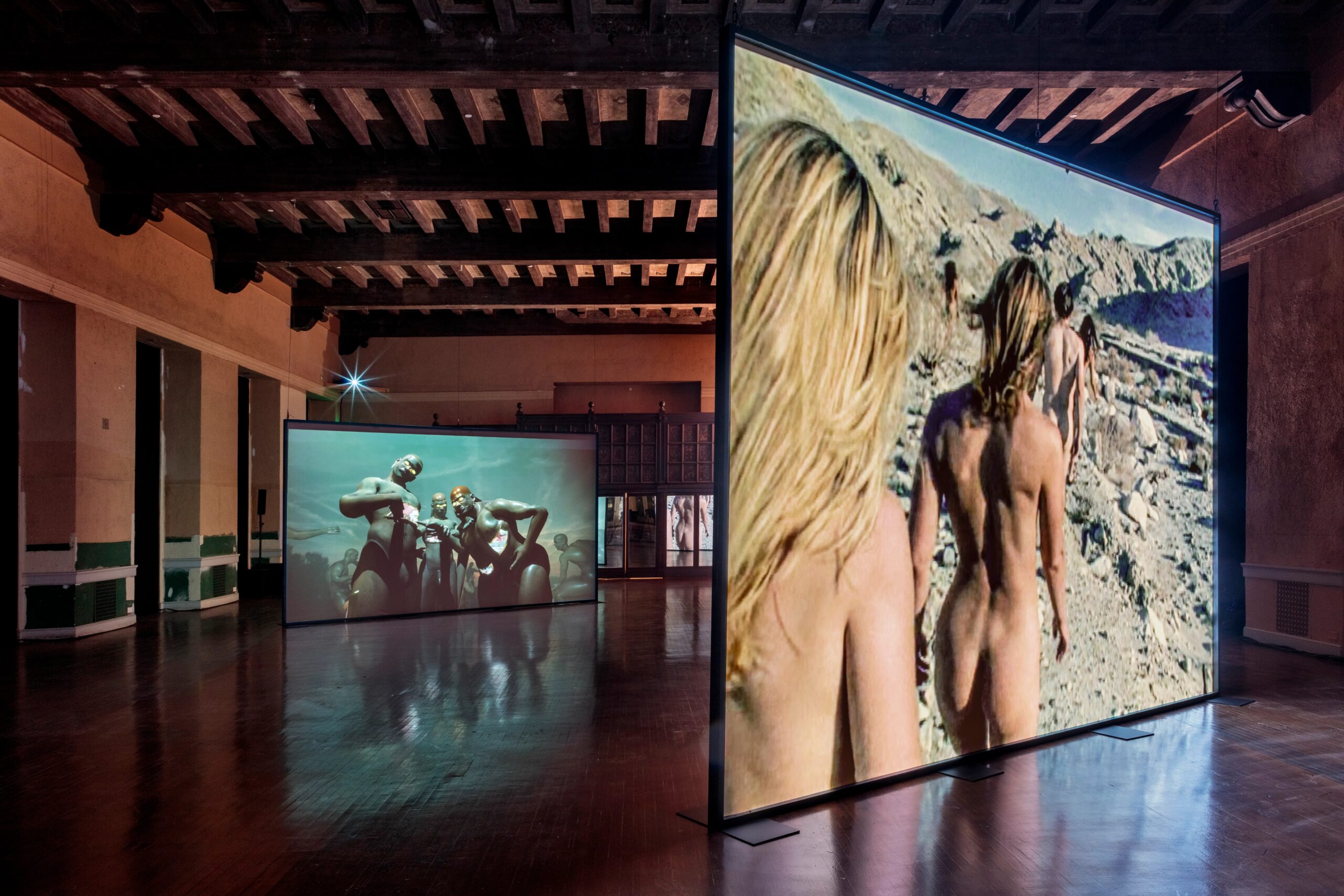
Weeks forward of Frieze L.A., her assortment arrived within the U.S. in an expansive exhibition on the Selection Arts Theater in downtown Los Angeles, one of many metropolis’s most iconic venues tied to film and leisure historical past. On view by March 20, “What a Fantastic World: An Audiovisual Poem,” edited by curator Udo Kittelmann, is a sweeping, immersive audiovisual odyssey staged throughout the six-story Venetian-style landmark with works by a few of the most groundbreaking up to date artists working with video, together with Marina Abramović, Cyprien Gaillard, Arthur Jafa and Lu Yang, alongside milestone moments from the historical past of cinema by Luis Buñuel, Walt Disney, Alice Man-Blaché, Winsor McCay and Georges Méliès. The result’s an unsettling, soul-stirring cinematic journey tracing how the fluidity, narrative openness and imaginative expansiveness inherent to transferring photos have accompanied, mirrored and challenged totally different trajectories of human evolution, whereas empowering the creativeness to examine and query its future.
On the event of the primary main presentation of her basis’s work within the U.S., Observer caught up with Julia Stoschek to study extra about her accumulating journey into the realm of time-based artwork and the way her ardour and imaginative and prescient take form on this exhibition, conceived in shut collaboration with Kittelmann.

When requested whether or not she will hint the origins of her ardour for video, Stoschek remembers rising up watching MTV, like many from the era born within the Eighties and Nineties. “I used to be a traditional MTV child within the ’80s. I beloved music movies, and I nonetheless do. I really like motion. I really like photos. I really like the transferring picture,” she says. Her grandmother was an actress, and her father was deeply concerned in images and filming. “Plenty of necessary moments from my childhood had been captured on video, so I used to be surrounded by images and video rising up. It feels very pure to me. I acknowledged fairly early on that this was a medium I used to be deeply fascinated by. That’s why I began specializing in time-based media artwork.”
Stoschek also can level to a exact second—and a selected work—that profoundly formed her accumulating journey. In 2003, she noticed an exhibition by Douglas Gordon at Gagosian and was deeply struck by Play Useless; Actual Time, a groundbreaking three-channel video following a four-year-old circus elephant performing a sequence of gestures, together with standing nonetheless, begging and enjoying useless. Filmed inside a gallery, the work concerned bringing a stay elephant into the area and recording it with a number of cameras because it slowly lay down and enacted its personal “loss of life.” The set up pairs two large-scale projections displaying the elephant at life dimension with a smaller monitor positioned on the ground, zooming in on the animal’s eye. The simultaneous screens create a pressure between monumentality and intimacy, spectacle and vulnerability. “It’s very highly effective. There’s additionally a beautiful background story,” Stoschek says, recalling how she was struck by the work’s scale and by the confrontation imposed by the life-size presence of the elephant. “I used to be utterly fascinated. I spent hours and hours within the gallery.”
Whereas Play Useless; Actual Time just isn’t a part of her assortment, Stoschek later acquired different works by Gordon, together with Making of Monster from 1996, which is within the L.A. exhibition. Within the video, Gordon movies himself in a toilet mirror, drawing stripes throughout his face. To intensify its resonance, the work is put in inside one of many constructing’s loos. “I really like that set up and the way it works inside the Selection Arts Theater,” Stoschek says with real pleasure.
The primary work Stoschek ever acquired was by Aaron Younger in 2004. On the time, she was a board member at MoMA PS1 and met Younger within the cafeteria. “He opened his laptop computer and confirmed me a piece titled Excessive Efficiency,” she remembers, describing a video during which a bike and rider carry out a 360-degree rubber burn on the road. “The work combines every thing: it’s like a portray, with the rubber marks on the bottom, however it’s additionally a efficiency and a video. I used to be fascinated and requested him if it was potential to accumulate the work.” On the time, Younger didn’t but have a gallery and had little sense of how you can promote the piece or at what worth. “We ended up discussing a really low worth collectively. It was so humorous. Nevertheless it was by no means so romantic once more, I can let you know.”
As this primary acquisition already suggests, accumulating time-based artwork comes with a singular set of complexities—challenges that Stoschek has since performed a central function in confronting and serving to to resolve by constructing a whole infrastructure round these practices. By way of the creation of her basis, she has inspired analysis, academization and the event of finest practices for show and conservation. Because the official founding of the Julia Stoschek Assortment in 2007, its areas—first in Düsseldorf and later, from 2016, in Berlin—have been exhibition venues designed particularly to satisfy the technical, spatial and temporal calls for of moving-image work.

Gathering media artwork comes with its personal set of challenges—not solely in preservation but additionally in circulation and in defining what exactly constitutes the art work. In its early days, the artwork system itself struggled not solely with questions of worth but additionally with the fabric standing of the work: is it the file, the display, the system? Many of those works are time-based, which means the situations during which they’re skilled can by no means be absolutely replicated. But these challenges by no means discouraged Stoschek, who’s pushed by the conviction that durational and media works represent probably the most correct inventive language for understanding up to date life, exactly as a result of they increase questions that really feel much more pressing right this moment amid the accelerating immaterialization of tradition and the rising mediation of on a regular basis expertise by digital units.
From the outset, Stoschek took the problem of preservation notably severely, conscious that the applied sciences on which these works rely are continually evolving. “We’ve got so many alternative codecs—{hardware} and software program—and every thing is continually altering,” she notes, recalling how Daniel Birnbaum as soon as described accumulating media-based artwork as being like accumulating snowballs. “It’s an ephemeral medium, I do know. And sure, we deal with it, however it’s a variety of work, and it’s continually altering. You have to adapt to new applied sciences each time. That’s merely a part of it.” At this time, the muse maintains a devoted archive for historic works on 35mm movie and VHS, and the complete assortment has been digitized, an immense however crucial effort to make sure these works stay accessible sooner or later.
Lately, digital and media-based works have begun to enter museum collections extra visibly, notably within the U.S. Conversations round digital artwork, at gala’s and exhibitions alike, have gotten more and more frequent. At a sure level, Stoschek suggests, it could now not make sense to take care of inflexible distinctions between classes. “Time-based media is now established. It’s current in main group exhibitions and even at gala’s like Artwork Basel. It’s a medium individuals can expertise immediately,” she says, acknowledging the function her basis has performed in supporting this shift.
Wanting forward, nonetheless, she’d prefer to see a deeper stage of institutional dedication. “Some establishments have begun accumulating media-based artwork, however the information round presentation nonetheless must develop,” she says. Producing and staging such a serious exhibition in Los Angeles offered a major problem, but it additionally carried the potential to determine new benchmarks for finest practices in exhibiting the sort of artwork.
How “What a Fantastic World” got here collectively
“Each exhibition is a problem, however whenever you create a venture like this—completely based mostly on media artwork and throughout the space between Berlin, Düsseldorf and Los Angeles—you might be remodeling one thing initially conceived distant and reactivating it in a brand new context,” Kittelmann provides. “We wished an area the place the artworks would obtain the eye they really want. There are round 45 artists, with roughly 45 media and time-based works—video, set up and extra. This requires an infinite quantity of area.”

Discovering the suitable venue took years, however as soon as the Selection Arts Theater emerged as a chance, there was no hesitation. Its historical past alone made it compelling: legendary figures corresponding to Laurel and Hardy, Buster Keaton and Clark Gable carried out there early of their careers on the principle stage, Stoschek says. “Charlie Chaplin was within the viewers when the Selection Arts Theater opened. Bringing this present into such a rare constructing, together with silent movies, historic and traditional cinema, along with up to date video works from my assortment—I couldn’t think about a greater scenario or a greater place for this audiovisual poem. I’m so joyful to have the ability to do the present right here, on this constructing, with this historical past.”
They had been decided to not depend on the standard black-box format, which might simply turn into monotonous, particularly when guests encounter greater than three or 4 works. On the core was the broader query of how you can maintain an viewers’s consideration, notably in an period of hyperstimulation and visible saturation. For Kittelmann, it in the end comes all the way down to content material and construction, which he compares to studying a 500-page e-book: it is determined by how the narrative is constructed and, after all, on the story itself. “If you happen to handle to get individuals’s consideration, and in the event that they don’t lose their intention, then they may tackle the problem themselves—to see and to grasp, to look at and to hear.”
Sure bodily and structural situations can assist create this suspension of time and area, permitting audiences to totally immerse themselves in every work. Darkness is certainly one of these situations, as cinema has lengthy demonstrated. “The second you ask individuals to come back in darkness, the viewers instantly enters a unique temper and is requested to make a aware determination to step into an area of contemplation,” Kittelmann observes. The viewers, he provides, should perceive that this isn’t a typical exhibition go to, however one thing nearer to attending a screening, an expertise that requires a unique type of planning. For that reason, entry is organized by designated viewing instances. But there is no such thing as a prescribed period for the go to, nor a hard and fast exhibition path. “It’s a journey, and it’s utterly as much as them. They’ll decide what they suppose, what they like and even what they don’t like.”

From a curatorial perspective, the purpose was to create one thing that may stay in individuals’s recollections, not one thing one enters, exits and instantly forgets. “The problem was to pick out artworks that may genuinely make individuals mirror on what the world is about. That’s, for me, the true energy of artwork at its finest,” Kittelmann displays. “I really feel extremely privileged that so many works in Julia’s assortment have precisely this high quality: by their content material and the problems they deal with, they stick with you.”
That intention knowledgeable the exhibition’s title, “What a Fantastic World,” which refers to Louis Armstrong’s well-known tune, written within the Sixties at a second when the state of the world was, in some methods, not so totally different from right this moment, as each Kittelmann and Stoschek observe. There have been struggles for human rights, wars and political tensions, a lot of which resonate right this moment. But Armstrong’s tune was meant to supply hope. “It’s a tragic tune, sure, however it’s additionally a melancholic one. And that’s very a lot what the entire exhibition is about. It’s about hope, but additionally about acknowledging that life is a mixture of magic and tragedy,” Kittelmann explains. Fittingly, the very first work guests encounter is Walt Disney’s Skeleton Dance. “It makes it very clear that we’re getting into an area the place even life after loss of life may be playful—that possibly the skeletons are having a significantly better social gathering than they did after they had been alive.”
Finally, the exhibition displays on how the applied sciences of cinema, video and different rising time-based instruments have expanded the human capability for storytelling and creativeness, usually serving as a way of envisioning options or resisting the pressures of the current second. This, Stoschek acknowledges, is among the privileges of transferring photos. Their fluidity allows an ongoing train in world-building, from which all these artistic endeavors emerge. “Expertise more and more shapes how we talk and the way we stay,” she concludes. “Media-based artwork is related to that actuality. It’s the inventive language of our time. It doesn’t simply mirror the world—it could possibly assist us perceive it and even form the long run.”

Extra artwork collector interviews
