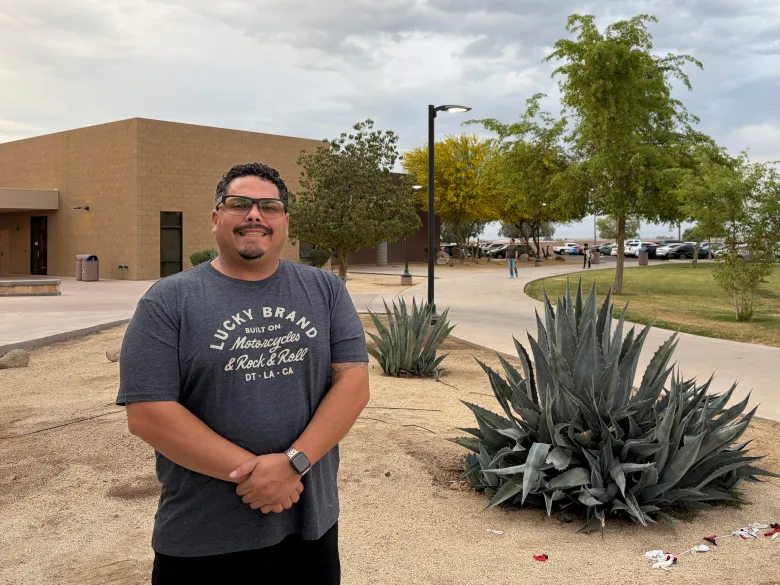

When Imperial Valley College launched a new program training students to become plant operators and technicians in the emerging lithium industry, Corban Dillon enrolled in the inaugural class.
He’d spent the first part of his career working for his family’s courier business in this part of southeastern California, but it faltered after the pandemic and the death of his father. Dillon hoped the new certificate program would give him a leg up as the industry grew to meet demand for lithium, a key mineral in the country’s clean energy transition.
But when he completed his certificate in spring 2024, lithium jobs weren’t available yet. So when the community college launched a second certificate option the following year, Dillon joined the first class of that program too. He finished that certificate last year — but the lithium industry still hadn’t caught up. Now, he’s enrolled in his third lithium certificate and will finish in December. Hundreds of anticipated jobs related to lithium extraction likely still won’t be available by then.
“A lot of us already have jobs or have families and are trying to juggle all that and trying to get a certification,” said Dillon, 41. “And not having actual potential employment as of right now, it’s hard for one person to sit there and say, ‘You know what? Let’s continue with this.’”
The situation speaks to a conundrum faced by local colleges when a new industry promises to come to town: Local residents want the new jobs. Companies say they want to hire local residents, but they’d need additional skills and training. In the middle are schools like Imperial Valley College, left to figure out the best timing to launch a new program that will prepare students for the new industry: soon enough that they can apply for jobs before they’re filled by skilled out-of-towners, but not so soon that students are left waiting for jobs.
Imperial Valley College — which says it is now temporarily scaling back its lithium programs because of the job market uncertainty — offers a case study in the pitfalls of trying to prepare students for emerging fields. It’s an “incredibly common” challenge, said Betony Jones, a senior researcher in the University of California, Berkeley Labor Center’s green economy program and a former Biden administration official. Other fields that have faced similar uncertainty because of political and economic factors include solar and manufacturing.
“There’s this fine calibration required where employers need the workers for the projects, they can’t start training the workers when they need them,” said Jones. “But workers can’t train and then wait around.”
Related: Apprenticeships are bringing new workers to heritage industries
In Imperial County, an agricultural area that has among the highest poverty and unemployment rates in the state, the stakes are particularly high. In March, its unemployment rate was 16.9 percent, more than triple that of neighboring counties.
Priscilla Lopez, the county’s director of workforce and economic development, sums up the need for jobs with a single anecdote: Last year, a new hotel opened in the county, creating 50 positions. The hotel offered in-person applications at the workforce development office, and in a single day, nearly 1,500 people arrived to apply.
“The mentality that we see today here is: If we want a future, we need to leave the valley,” said Lopez. “But wouldn’t it be great to have these opportunities so that your kids can see the opportunities here, and maybe we keep our talent.”
When three companies began eyeing the region for its lithium reserves, attention quickly turned to jobs. The region was rechristened “Lithium Valley”; California Gov. Gavin Newsom called it “the Saudi Arabia of lithium”; and Berkshire Hathaway Energy Renewables, one of the companies vying to extract lithium from the region, announced it could launch commercial operations by 2026.
The reality has been different. BHE Renewables only just completed construction on its demonstration plant, Christina Fleming, senior vice president of mineral development, wrote in an email.
Controlled Thermal Resources, another company active in the region, is in the “money-raising” stage, according to Jim Turner, the company’s president. Lithium extraction jobs are at least about two years away, he said.

Lithium batteries are currently the most common way to store wind and solar energy and power electric vehicles. An estimated 18 million metric tons of lithium carbonate is embedded in the hot brine deep beneath the Salton Sea, enough to power 375 million electric car batteries.
Calls for more education opportunities in Imperial Valley intensified as news of a potential lithium boom spread. The area’s two main higher education institutions — Imperial Valley College and a San Diego State University satellite campus acted fast.
San Diego State used $80 million in state funding to build a new STEM campus prioritizing science, technology, engineering and math.

This fall, the classrooms will open for students in the school’s new undergraduate degree programs in electrical engineering and chemistry, both chosen to support local industry needs in the geothermal and lithium sectors. As of mid-April, the campus had received nearly 100 eligible applications for the two programs, according to Daniella Rodiles, a media relations officer at the university.
Imperial Valley College received funding from the U.S. Department of Energy for its Lithium Industry Force Training program. The program’s three certificates — plant operator, chemical lab technician and instrumentation technician — can each be completed in two semesters, and courses include chemistry, math, hazmat training, water treatment plant operation and plant operation.
The community college has touted the certificate programs as a fast track into the lithium industry. “Are you ready to launch your career in the booming lithium industry? Imperial Valley College’s new chemical lab technician certificate program is your ticket in,” states a voiceover in a 2024 promotional video for one of the certificate programs.
And Imperial Valley residents, hungry for stable jobs close to home, have responded.

For George Prieto, the plant operator certificate is his first foray into higher education. On a recent Monday before class, he showed off his newly issued badge for an internship at the local water and power utility, which will fulfill the program’s work experience requirements. Prieto, 48, previously worked in retail merchandising and deejays on the weekends.
“Usually, when they have these jobs, people from all over the world come; this gives us a chance with this being our backyard,” said Prieto. “We don’t have to go and sacrifice and go somewhere else [for a job].”
Prieto’s classmate, Alberto Curiel, was initially looking into an electrician certificate when he heard “how much of a demand” there will be for plant operators. Curiel, 24, wants a job with benefits in Imperial Valley that pays better than roofing, which is what he’s done since high school for around $23 an hour, “while breaking my back in the heat.”

“I kind of want a better trade-off,” said Curiel.
Industry representatives and the county blame the delayed timelines on a 2024 lawsuit by environmental groups. The lawsuit alleges Imperial County officials underestimated future environmental impacts — such as water potential pollution and health effects — of a project proposed by Controlled Thermal Resources. A court rejected the legal challenge last year, and the environmental justice groups have appealed.
But there are other factors at play too. The Trump administration eliminated electric vehicle incentives last year, and both industry and the federal government have turned more attention to lithium projects in other parts of the country. In late 2024, the U.S. Geological Survey announced between 5 million and 19 million tons of lithium reserves located beneath southwestern Arkansas, rivaling the vast reserve near the Salton Sea.


One project in Arkansas received a $225 million Department of Energy grant, and Chevron opened up a pilot well in the area. In Nevada, the Trump administration has taken an equity stake in a different lithium project. Near the Salton Sea, one of the three main companies working on lithium recently shifted some of its attention to data centers.
In late 2024, a member of the California Energy Commission warned Imperial County residents that “the Lithium Valley is not a sure thing,” citing the trend of federal funding from the Department of Energy going toward other states.
Last August, SDSU President Adela de la Torre was more blunt, writing in a commentary piece that “unless progress in Lithium Valley accelerates rapidly, these students will graduate into an empty local job market.”
“The timing thing has been something that’s out of our control,” John McMillan, SDSU’s assistant vice president of economic development, said in an interview. “What we can control is two things: One is being collaborative with the companies, trying to see if we can cobuild opportunity.”
“The other thing that we can control is the students that we train,” said McMillan. “What we can guarantee is that the students will have a quality engineering and chemistry education that can make them effective in many of the industries out here.”
And, since SDSU is starting out with only freshmen in its first year offering new STEM degrees, it will be another four years before the campus starts producing graduates.

Imperial Valley College will soon graduate its third year of industry-trained students.
“The original plan was to time all of these programs sequential to once the industry comes up to speed,” said Lennor Johnson, who leads the Imperial Community College District. By now, he said, “we thought we would be 100% in full operation with Lithium Valley.”
A total of 173 students have enrolled in certification programs since fall 2023; 42 have completed their certificates and 57 are currently enrolled. As of Fall 2025, a total of 16 students had found jobs directly related to their certificates, Johnson said.
Imperial Valley College has reduced the number of students in each cohort and will not offer two of the certificates next year. The plan is to bring those programs back in the 2027-2028 academic year, if that timing lines up with the industry’s projections on jobs.
Related: States bet big on career education, but struggle to show it works
Prieto is hopeful that his certificate will be transferable to other industries, while Dillon believes the huge amount of lithium under Imperial County means the industry will come to full fruition eventually. In April, he started a new full-time job with a mining company, with good pay, benefits, room and board while on-site, and a company car.
There’s just one catch: The job isn’t in Imperial County.
Contact editor Caroline Preston at 212-870-8965, on Signal at CarolineP.83 or via email at preston@hechingerreport.org.
This story about Imperial Valley College was produced by The Hechinger Report, a nonprofit, independent news organization focused on inequality and innovation in education. Sign up for the Hechinger newsletter.
The post In California’s ‘Lithium Valley,’ students are training for jobs that haven’t yet materialized appeared first on The Hechinger Report.