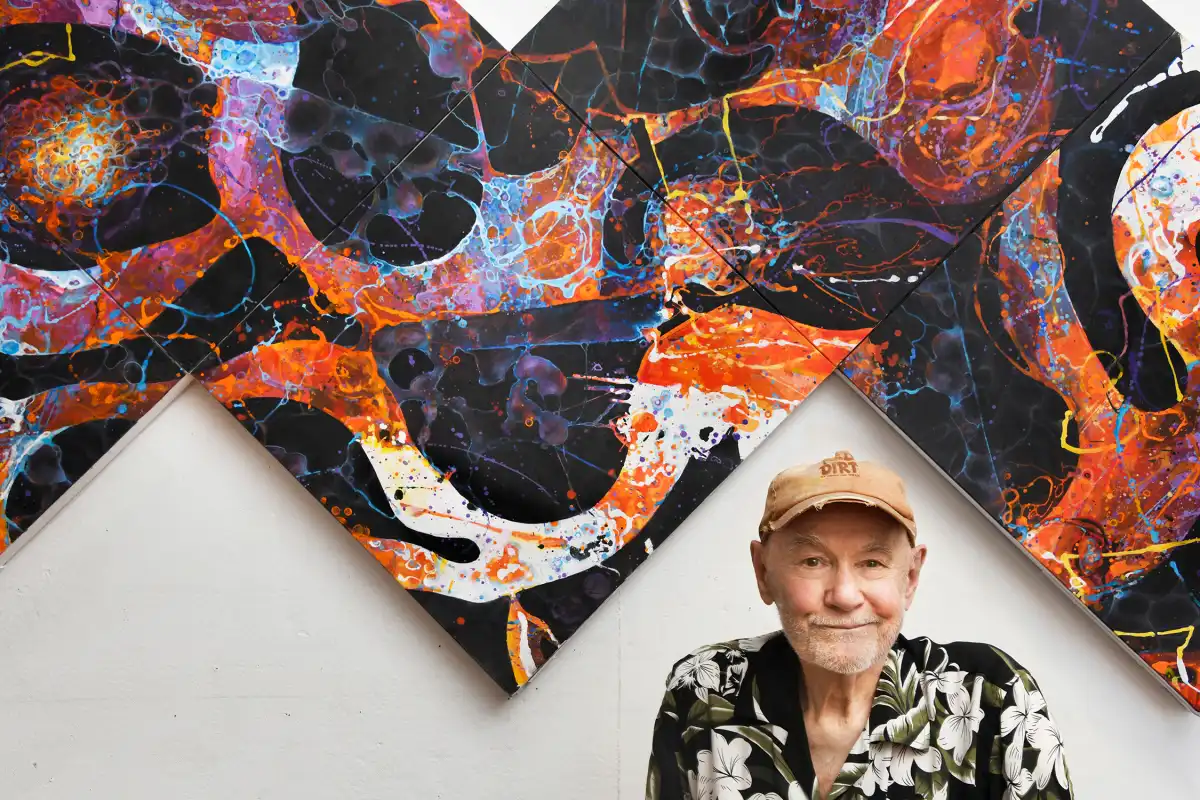
For a while, Clifford La Fontaine followed the path of an up-and-coming artist. After moving here from Canada in 1956, he found himself a job as a young man on Madison Avenue with a studio that serviced the advertising agencies of the classic “Mad Men” era (and that show was “nowhere near what was really going on,” he informs us).
He got his first gig after a clumsy attempt at applying for a job without any proof of his talent. It was the first thing in the morning when he was told, “Well, kid, come back when you got a portfolio.”
So, La Fontaine recalls, “I went to Woolworth’s on 44th Street and 6th Avenue. I got a notebook, pencil and paper and I went into Bryant Park. I filled the notebook in the afternoon. I came back to the studio said, ‘Is this a portfolio?’”
Apparently it was, and La Fontaine now had about $26 a week to support himself.
By the time he began showing at the Richard Castellane Gallery in the 1960s, he had studied in France, the Art Students League and Pratt. Castellane mounted a two-person exhibition with La Fontaine and Yayoi Kusama in 1965. La Fontaine also produced both large and small-scale sculpture.
But it was in 1975 that his career took a turn, one that would take him through the early 2000s as he worked as a museum and exhibition designer for major U.S. and international museums, including the Metropolitan Museum of Art, the Art Institute of Chicago and the San Antonio Museum of Art.
His work on the King Tut exhibit at the Met ushered in the era of the modern-day museum blockbuster. While his talents were utilized in faraway locales such as the Bible Lands Museum in Jerusalem and close by with “African Reflections: Art from Northeastern Zaire” at the American Museum of Natural History, La Fontaine never stopped making art — he just stopped showing it.


Looking through La Fontaine’s work through the decades, one sees some common threads as he grew closer to complete abstraction, but he doesn’t see it that way.
“I’m a realist painter”, he declares. “The work was never really totally abstract, because I never really divorced myself from the concept that reality is not just a reflection. It is also structural under these. So what people call abstract art, you keep redefining it. You will get to the point where it’s totally real, because there’s only the line, the shape, the form, the color. That’s real”.
On top of that, La Fontaine mentions that he “has a kind of very deep interest in mathematics.” His current works consist of a number of panels that can be reconfigured however the owner likes.
“A simple four-panel, you can rearrange it into 256 different iterations,” he explains. “So as you add panels to the system, you increase the possibility of change. So this painting over here on the wall, this is basically, it’s a rectangle. But because you can manipulate the configuration, you can get different iconic shapes, shapes that look like that was the original intention.”
“So,” he continues, “this is a number of panels. Six panels. The ninth power, 12 panels or 12th power. 4 times, 4 times, 4 times, 4 times 4 times, 4 times 4 times 4. So you can see the optional arrangements become enormous very quickly. So, the 16-panel painting, the blue one, will give you 4 billion variations of the same thing. So, in essence, the painting is there for you to be the intercessor between what I did and now what you can do. And you can do the arrangements.”


The paintings are, he notes, not meant to just hang on the wall. They are a constant collaboration between the work and the owner of the work, who is at liberty to hang it any way that he pleases.
“Because,” he says, “I have the confidence that what you’ve been given is a brain that’ll make those connections in a way that can be a formula for continuation of the same single thing.”
At 89, he paints almost every day in his Yonkers studio (“every day except… Sunday. Yeah, I gotta do the laundry.”) and he has begun to show his work on weekends in his East Village home, where he has lived since 1962.
Why, we wondered, had he not been showing his work until now?
“It has been a question my closest friends associated in the art community have asked me over the years,” he says. “I found that my efforts most recently in Yonkers have been very productive. There is an intriguing notion coming to me that this work is a summary of the many singular explorations that came before. I think there are some things I am currently doing that I feel warrant a bit of public visibility and scrutiny. The work has been quite challenging. I am becoming more and more assured by others that the works are distinctive and awaiting an audience.”
You can explore La Fontaine’s work at cliffordlafontaine.com and on Instagram at @clifford.lafontaine.
