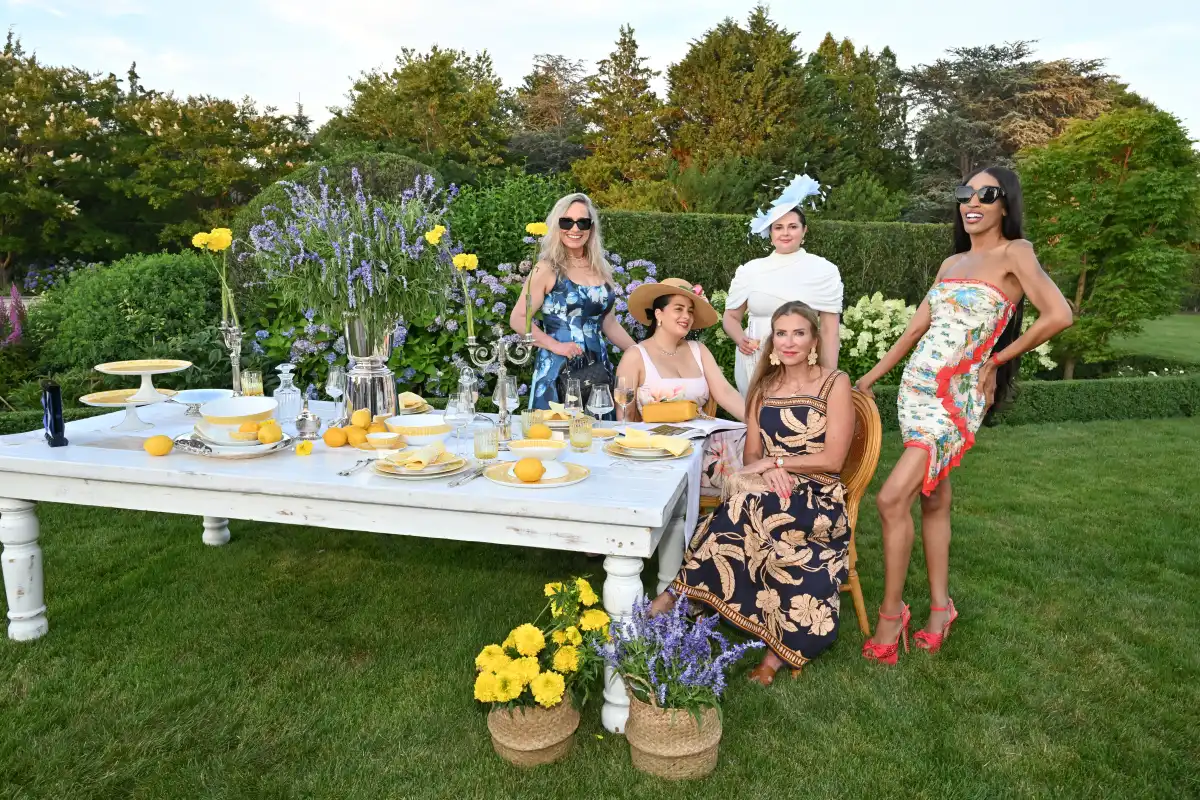
Bridgehampton had, by all appearances, surrendered to Provence before the first glass of Champagne was poured.
Across the home of Maria and Kenneth Fishel, nearly 240 guests gathered for the fourth annual French Heritage Society Summer Soirée, an evening shaped by warm light, gracious tables and the belief that beauty deserves both celebration and protection. The atmosphere felt polished without becoming stiff, generous without tipping into excess and wonderfully French in its refusal to separate seriousness from pleasure.
As an incorrigible Francophile, I am always enamored with the annual event.
French Heritage Society understands my devotion to easy afternoons, unapologetic foie gras, seasoned beef tartare and the conviction that lunch should never be treated as a scheduling inconvenience. More importantly, however, the organization recognizes that the French art of living is not simply decorative. It is historical, architectural and profoundly human. A beautiful room acquires greater meaning when someone is willing to preserve the craftsmanship and imagination that allowed it to exist.
Inspired by Provence in summer, the soirée unfolded with the ease of a long lunch that had sensibly decided to become an evening. Revel Rouge founder Hank Stampfl created the atmosphere, while Champagne EPC, Véronique Gabai, Maison Gabrielle, Société de la Rassi and JOG Editions lent their support. Christofle, Baccarat and SFERRA brought gleam to the tables, quietly confirming that refinement, in the French tradition, is never merely an accessory.

The evening was chaired by CeCe Black, Maria Fishel, Rosann Gutman and Ann Van Ness, who welcomed guests alongside Kenneth Fishel and FHS Executive Director Jennifer Herlein. Record attendance and fundraising made this the most successful Summer Soirée in the organization’s history, a triumph made more meaningful by the cause beneath the Champagne.
Founded in 1982, French Heritage Society has awarded more than $16.5 million through over 710 restoration and cultural grants in France and the United States. Nearly 600 university students have also crossed the Atlantic through its internship program, strengthening the cultural conversation between both countries.
Preservation, after all, is not nostalgia arranged beneath flattering light. It is continuity.
Historic architecture holds the hand of its maker, the ambition of its patron and the residue of generations who passed through its rooms. Once erased, such places cannot be meaningfully replaced, no matter how costly the stone or faithful the replica. French Heritage Society works within that fragile interval between inheritance and disappearance, ensuring that cultural memory remains visible, inhabitable and alive.
A portion of the proceeds will benefit the FHS New York Chapter and support three 2026 preservation grants: Lyndhurst in Tarrytown, Villa Albertine and St. Bartholomew’s Church in Manhattan. Together, they reflect the organization’s transatlantic mission and the enduring dialogue between French influence and American history.

The guest list carried its own glamorous momentum. Trustees, philanthropists, preservationists and cultural figures, including Jean Shafiroff, Candace Bushnell, Véronique Gabai, Sharon Bush, Bonnie Comley, Stewart F. Lane and Lucia Hwong Gordon, offered a welcome reminder that patronage, at its best, should leave behind more than a photograph and an excellent seating chart.
Still, the gathering never felt burdened by its own importance.
French-American vocalist Quentin Bruno, featured on The Voice: La plus belle voix, joined Danny Lipsitz & The Brass Tacks, drawing guests toward the dance floor as daylight softened over the estate. Conversation moved easily between architecture, travel, art and the urgent business of enjoying oneself properly. The mood suggested Provence without slipping into imitation: sun-warmed, cultivated and just mischievous enough.
Perhaps that balance explains the charm of French Heritage Society. The organization never asks supporters to choose between scholarship and sensuality. Great estates were built for ceremony, conversation, seduction and the occasional indiscretion over several courses. Gardens were designed to frame power and invite wandering. Dining rooms preserved family mythology, political alliances and, one suspects, far better gossip than most archives.

Culture survives through research, certainly, though it also endures because people fall in love with it.
French Heritage Society creates precisely that attachment. One may arrive for the Champagne, architecture, music or fantasy of Provence, then leave understanding that preservation is an act of faith in the future. A restored villa, church or garden is not simply returned to the past. It is offered forward.
For one luminous evening in Bridgehampton, France felt considerably closer. The company sparkled, the mission carried real weight and the afternoon unfolded with exactly the ease I am forever chasing.
Somewhere between the lemony light, a cold glass of Champagne and the knowledge that endangered beauty might yet be saved, French Heritage Society made me feel entirely at home. Perhaps I have been spiritually French all along.