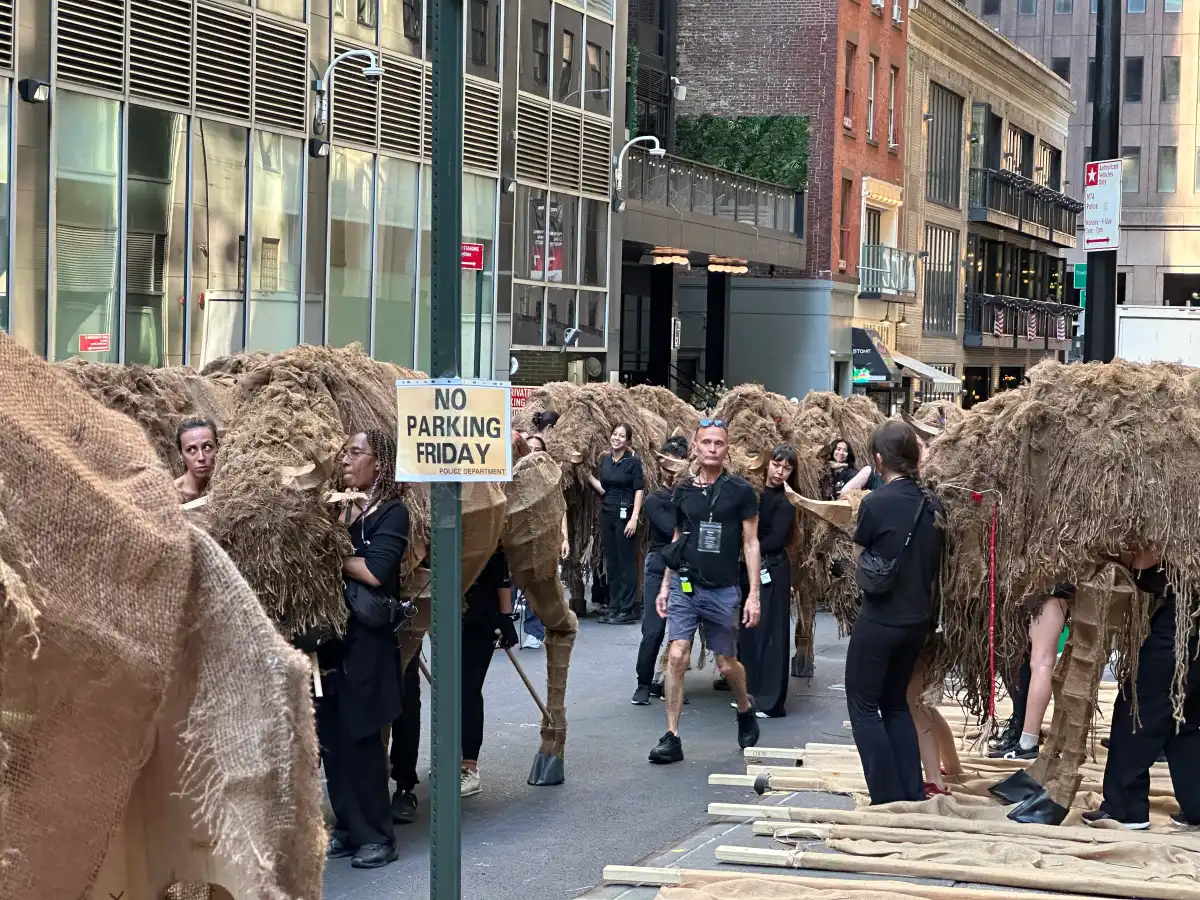
Thanks to buffalo activists and Native people, the North American bison revived after coming to the brink of extinction.
To acknowledge this achievement, Return of the Buffalo, Tatanka Owe Akupi, marched through Manhattan and Brooklyn with 40 life-size buffalo puppets.
The Manhattan march
The March was a two-day public art spectacle created by Amir Nizar Zuabi and Elders from Lenape and Lakota communities. On Sept. 18, the buffalo herd went through Lower Manhattan from Bowling Green Park all the way to Foley Square.
Made with entirely recycled or recyclable materials, these life-like buffalos were designed by Cape Town collective Ukwanda Puppers and directed by Craig Leo. Over 150 volunteer puppeteers from around the world commandeered the puppets and were specially trained for this art exhibit.
The march included many stops throughout the route. During these stops, the crowd and the buffalos halted for special performances of poetry, speeches, singing, and more. Elected official Jumaane Williams delivered a performance, standing in front of the Federal Hall to read an excerpt from Frederick Douglass’s landmark speech.


“The message of the bison, the message of Frederick Douglass, and the message that is being talked about is really important to where we are in this country today,” Williams said.
Caridad De La Luz delivered a spiritual offering through words that highlighted the importance of human connection with nature and reconciliation with the past. After the performance, she explained, “We don’t see the value of life itself, of the animals, of the land, of the river, and there are many things that have happened on this land. Right beneath our feet are our dead.”
According to one of the event’s producers, Karen Brooks Hopkins, there were 30 tribes involved in the effort and “over 400 people were involved in this project, between artists, puppeteers, the producing team, and the puppet makers—this is a massive effort, and we wanted the largest public art spectacle in America to be here in New York City.”
New York’s connection to the buffalo
Holding this event in New York went beyond the city’s popularity. Before European settlers arrived in North America, the Lenape people were native to New York City, Long Island, the Hudson Valley, New Jersey, Eastern Pennsylvania, and Northeastern Delaware.
New York was where the buffalo originally lived. Indigenous artist Joely Bigeagle Kequahtooway came all the way from Canada with the organization, International Buffalo Relations Institute, and explained that the buffalo “are our national keystone species; they are what helped us survive and thrive; they’re why we are resilient and still here as Native Americans.”
Moreover, this time of year carried historical significance because the march took place before the autumnal equinox, which marked the end of summer and the arrival of autumn. Historically, a period of time when Native people would hunt buffalo.
Anthropologist David Quintero attended the event, escorting members of the Lenape tribe through a company called Fractal Travel. Quintero explained, “More than 2 million indigenous people lived in this territory, and 70% of them were murdered. There was a genocide here, and now they get to come back for the first time to visit their ancestors’ land.”


As a result of colonization, the Lenape no longer live on their original lands, and as a sovereign nation, they do not live on reservations either. Instead, the tribes are currently spread across Canada and the United States and are federally recognized in Bartlesville and Anadarko, Oklahoma.
Similarly, the Lakota community was also forcibly removed from their lands primarily in Mississippi, Wisconsin, Iowa, and the Dakotas. Many live on reservations in the United States, and they were known as buffalo hunters who even fought wars with neighboring tribes over buffalo fur.
Nowadays, the Lakota founded the Wolakota Buffalo Range, a sanctuary for these sacred animals where 28,000 acres are home to over 1,000 protected buffalo.
The event was a success. Thanks to the Lenape, the Lakota, and Zuabi’s political art, New Yorkers experienced reverence for the buffalo and saw many artists and attractions along the way, reminding them of the importance of North American roots.
Quintero concluded that, “We have lost the connection and the relationship between men and nature, but for thousands of years that always existed, and what we are doing is trying to validate it so we can bring it back.”
