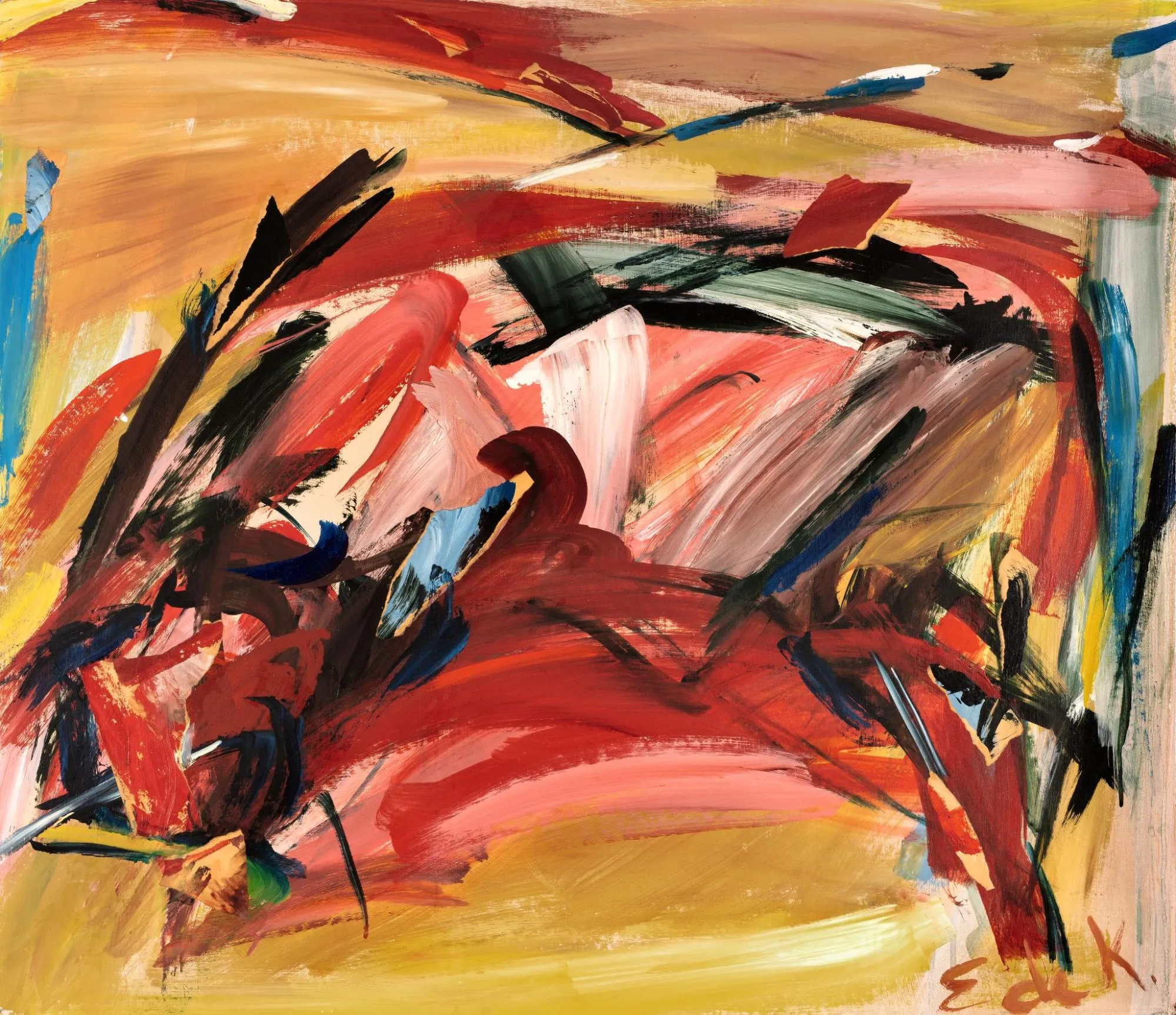
You may’t go to New York’s storied Cedar Bar anymore, famed for its 15-cent beers and the beginning of a brand new American model of portray. It closed years in the past. However guests to the American Federation of Arts’ touring exhibition “Summary Expressionists: The Girls” can see Grace Hartigan’s 1951 portray Cedar Bar. In it, they’ll discover lots of the hallmarks of the motion—nonrepresentational imagery, daring gestural strokes, vibrant vitality and emphasis on spontaneity and course of. However behind it, they’ll discover one thing extra. For many years framed because the work of lone male geniuses, Summary Expressionism’s story is increasing right into a fuller, extra full narrative, thanks partly to latest exhibitions in Denver, New York, Lengthy Island’s Hamptons, San Francisco, Washington, D.C., London and Paris, and books like Mary Gabriel’s bestseller Ninth Avenue Girls, which have returned the ladies of the motion to the general public eye.
“We’re not writing them again into historical past,” Katharine Wright, the exhibition’s curator on the AFA, advised Observer. “They had been there from the start.” Lots of the artists within the present had been profitable of their lifetimes, working and displaying alongside the towering names of the motion. All needed to cope with their twin roles as girls and artists.
Hartigan was some of the acknowledged artists within the early days of Summary Expressionism. She was the one girl included in “The New American Portray,” a 1958 worldwide touring present organized by the Museum of Trendy Artwork. She was one in all 5 girls artists featured in Life journal’s “Girls Artists in Ascendance,” with images by the famend Gordon Parks. By her personal evaluation, she was “a family title.” However none of that was sufficient to cement her title in artwork historical past.

Wright famous, “These girls had been taking completely different dangers than their male friends.” Hartigan’s Cedar Bar is a living proof. “She titled it that as a method of paying tribute to the truth that the ladies, herself included, spent a lot time on the Cedar Bar speaking by way of avant-garde artwork with all of those male poets and writers and painters. However when she first painted it, it was initially titled Aries, and it had a a lot softer palette of extra pastel colours. She labored actually exhausting to exorcise that from the canvas.” Wright defined, “She couldn’t abdomen the concept of somebody pondering of it as girly.”
The exhibition contains the work of 32 artists, with 47 work accomplished between the Thirties and the ’70s, with the bulk from the Nineteen Forties and ’50s, the peak of the motion’s prominence. It’s the primary time most American audiences could have heard about France’s Feminine Artists of the Mougins Museum (FAMM), which opened in 2024 with works from the Christian Levett Assortment. The present was organized by the AFA together with visitor curator Ellen Landau.

The American Federation of Arts launched greater than 100 years in the past with an Act of Congress, although it’s now a stand-alone nonprofit. Its mission, Wright defined, is to deliver world-class artwork to museums and venues past the most important metropolitan areas. “There are unbelievable communities all throughout the nation that love artwork. Oftentimes, by way of constraints of geography or budgeting or staffing, they aren’t in a position to handle these actually giant bold exhibits that we do.”
The works are giant and impressive, as effectively. Many are wall-sized and required progressive strategies that the ladies pioneered. For Summary Drive: Homage to Franz Kline, Audrey Flack threw her brush on the canvas. The deal with tore a gap. “At first I used to be upset,” she famous, “however then realized the outlet was very a lot part of the Summary Expressionist course of and an vital a part of the portray.” Vivian Springford merged the psychological preparation and calligraphic strategies of Jap brush portray in her softly liquid swimming pools of colour. Helen Frankenthaler’s Bending Blue, a monumental 9 x 7-foot canvas of orange tones melting right into a periwinkle discipline offset by zips of pink and white, shows the soak-stain methodology she created by pouring thinned paint onto unprimed canvas.
“The ladies within the present had been typically taking abstractions to new and, in my thoughts, extra various and thrilling heights,” Wright famous. “For example, you’ll see works by Elaine De Kooning or Grace Hartigan which can be experimenting with figuration in a method that now we perceive as what comes after, however on the time that was actually revolutionary.”
There’s no sense that these work had been made by girls, however there are variations between them and the work of their male counterparts. Wright factors to the usage of colour, singling out Sonia Gechtoff’s The Map for instance. “It’s exhausting to understand till you see it in individual. There’s an expanse virtually like a volcanic eruption of pink within the middle, and it’s sufficiently big that you simply begin to virtually fall into the composition,” she stated. “One of many issues we tried to speak about within the present is all of these visible scale dangers and supplies. She’s portray with a palette knife versus a paintbrush.”
The exhibition is damaged into 4 sections: “The New York Faculty,” “San Francisco Early Years,” “A Story of Two Cities: New York and Paris” and “Vocal Ladies and Past.” (Among the venues may also embody circumstances with paperwork and didactic supplies.) The titles are self-explanatory, save for the fourth, which we’ll get to quickly, and the works are introduced roughly chronologically inside every part. Lots of the artists have by now achieved renown, however some are nonetheless comparatively unknown. The exhibition, the Levett Assortment and FAMM intention to get these artists’ names again into the historical past from which they had been omitted.
“The New York Faculty” contains work by Mercedes Matter, Sonja Sekula, Perle Tremendous, Elaine de Kooning, Janet Sobel, Pat Passlof, Michael (Corinne) West and Joan Mitchell. “San Francisco Early Years” presents works by West Coast artists, a few of whom are usually not well-known outdoors the area, equivalent to Ruth Armer and Emiko Nakano, in addition to Claire Falkenstein, Lilly Fenichel, Deborah Remington, Sonia Gechtoff and Bernice Bing. “A Story of Two Cities: New York and Paris” brings collectively work by Helen Frankenthaler, Grace Hartigan, Ethel Schwabacher, Audrey Flack, Elaine de Kooning, Yvonne Thomas, Janice Biala, Charlotte Park, Lee Krasner, Miriam Schapiro, Betty Parsons, Perle Tremendous, Judith Godwin, Mary Abbott, Pat Passlof, Amaranth Ehrenhalt and Joan Mitchell.
“Vocal Ladies and Past” was named for a 1960 Time journal article that posited that whereas males of the motion typically stated the work spoke for itself, the ladies had been extra more likely to have interaction in dialogue and make it extra accessible to viewers. Elaine de Kooning, who wrote extensively for what would turn into ARTnews, did simply that, introducing the works of fellow artists. The group contains her, Frankenthaler, Deborah Remington, Alma Thomas, Bing, Howardena Pindell, nancy graves, Mitchell and Vivian Springford.
“The purpose was to speak about not solely the early improvement of the motion, its heyday, but additionally the persevering with crosscurrents that exit later within the twentieth Century and into different locations past New York,” Wright stated, noting that artists like Flack, Schapiro and Pindell took their roots in abstraction in very completely different instructions.

It’s one factor to current a set of works by top-notch artists. It’s one other to collect top-notch works by these artists, as “Summary Expressionists: The Girls” does. With Nancy Graves’ brilliant, colourful Untitled #2; Howardena Pindell’s considerate, evocative 1971 Untitled; Étude in Brown (Saint Cecilia on the Organ), a softly smoldering Alma Thomas portray; and Vivian Springford’s rainbow effervescence Scuba Collection, harmonies and variations enliven the present. Uncommon sightings embody an early piece by Janet Sobel, the Brooklyn artist whose drip work, by his personal admission, predated Jackson Pollock’s, and Lee Krasner’s Prophecy, a portray which proves that each image tells a narrative.
Krasner and her husband, Jackson Pollock, had been dealing with difficulties of their marriage when she painted this complicated configuration of flesh-toned shapes squeezed into the confines of the canvas. It was a piece in progress when she traveled to Europe in the summertime of 1956.
“That’s some of the vital items within the present,” stated Wright. Krasner mentioned her unease concerning the picture with Pollock, and it was nonetheless on her easel when she returned as a result of her husband’s loss of life in a automotive crash. “When he died, she got here again and completed the portray,” Wright defined. “She later realized that she began connecting it to her grandmother, who was rumored to have second sight. She felt that the piece was virtually prophetic.” It was the start of an vital new sequence.
After World Conflict II and its psychological impression, many artists, these girls included, felt a necessity for a distinct creative vocabulary. Summary Expressionism didn’t simply spring into being; it advanced from a search inside. “The portray I take into consideration,” Krasner as soon as stated, “portray wherein interior and outer are inseparable, transcends approach, transcends topics and strikes into the realm of the inevitable.”
Was it inevitable, although, that these girls discovered their method into vital museums, personal collections and artwork historical past textbooks? Sadly, no. However the benefit of the canon of artwork historical past is that it’s nonetheless being written. “Summary Expressionists: The Girls” is a vital chapter in that revision.
“Summary Expressionists: The Girls” is at present on view on the Muscarelle Museum of Artwork in Williamsburg, Virginia, by way of April 26, 2026. From there, it is going to journey to the Pace Artwork Museum in Kentucky, the Grinnell School Museum of Artwork in Iowa, the Cellular Museum of Artwork in Alabama and the Frick Pittsburgh Museums & Gardens in Pennsylvania.

Extra exhibition critiques
