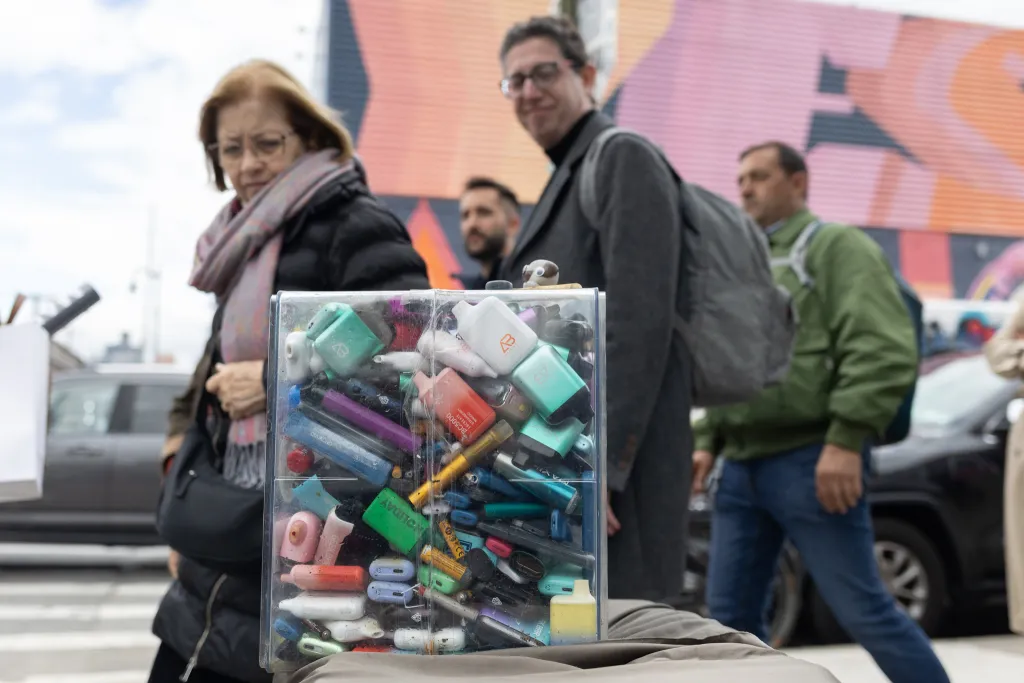
On a street corner in Bushwick, Brooklyn, a volunteer cuts a knife through a square container, releasing a flood of dead vapes in rainbow waves. The clear plastic box filled up over a three-day Earth Day festival at a performance nightclub across the street, where partygoers dropped off the eye-popping smoking devices rather than sending them to the trash or the bottom of a junk drawer.
The disposal box made up a tiny fraction of the 500 tons of vapes that New Yorkers throw out each year, but a small group of people in New York is trying to change that.
The vapes, which are frequently sold with tastes like “frozen white grape” or “orange creamsicle” despite a city ban on flavors, was counted as a new category of waste in New York City for the first time in 2023, when the sanitation department did its first “waste characterization study” since 2017.
Now, the addictive devices are everywhere — and causing headaches for waste managers. Vapes are considered hazardous waste under federal law due to the harmful chemicals in nicotine juice, which can be poisonous at high levels.
In addition, the rechargeable, lithium-ion battery used in vapes can be explosive if not cared for and disposed of correctly. These batteries, which are used in everything from laptops to cell phones, have been igniting in the back of garbage trucks, a spokesperson for the sanitation department, Joshua Goodman, told THE CITY.
“The fact is, they don’t go in your trash,” he said.

Like vaping itself, the staggering amount of waste generated by the devices is a new phenomenon. And so are the efforts of the people trying to keep them out of the city’s trash, which now includes a loose collection of people who spoke with THE CITY about how they try to teach users to recycle their vapes.
One of those volunteers, Nora — who declined to share her last name with THE CITY because of privacy concerns — created vape disposal boxes in 2022 because, she recalled, the number of vapes discarded on city streets made her “depressed.”
“I didn’t know what to do, so I just picked up one vape,” said Nora, a passionate environmentalist. “In six months, I had over 20 pounds I collected while walking all my regular routes.”
Unsure of how to dispose of them, she learned that the city has special disposal sites for harmful or hazardous products. There is one location in each borough, open three days a week.
But the vape users THE CITY spoke to said they were unaware that these sites exist, and didn’t know vapes were hazardous and unfit for the regular trash and recycling.
To make disposal easier, Nora created cardboard boxes to collect vapes and reached out to people who manage nightlife venues across Brooklyn to put them inside. She intended the boxes to be temporary until one club manager asked her to bring more. She built sturdier ones, decorated with Earth stickers and signs asking people to drop their vapes in it for recycling.
“My system is just a grassroots system, and it’s meant to increase awareness,” she said. “There are millions of disposable vapes that go to landfills all over the world.”

The boxes are primarily located at clubs and bars in Bushwick and Williamsburg in Brooklyn, and Ridgewood, Queens — placed near restrooms where patrons are likely to see them.
Managers notify Nora when a box is full, and she comes with a knife and worker gloves to break it open and collect the vapes. The gloves are necessary — dozens of mouths have touched the devices, which often leak vape juice at their end of lif. She estimated she’d deposited 500 pounds of vapes into sanitation’s special collection sites over two years as a “one-person operation”, before she began collaborating in 2024 with two like-minded people behind the Vape Waste Project.
Vape Meltdown
The abundance of people in their lives who vape inspired Liam Beirne, 25, and Hyung Mo Chun, 27, two friends who met at Stonybrook University, to start the Vape Waste Project.
“We knew a lot of friends who were heavy vapers, and we just wanted to understand where these went,” Beirne said. “We had assumed that someone was recycling them once they were disposed of, but we realized that they were effectively being burned by the city.”

So they took matters into their own hands, literally, to disassemble vapes for recycling.
“We would basically put on nitrile gloves, get a set of pliers, screwdrivers, wire cutters, and then just make sure that we were responsible and safe and broke them apart ourselves,” Beirne said.
Beirne and Mo Chun send the liquid nicotine juice and the coils that heat it to the city’s hazardous waste disposal, the plastics and PCBs to the city’s e-waste disposal and ship the lithium-ion batteries to a recycler in the Midwest.
The men collect bags bursting with dead vapes that they keep in their apartments — mostly from Nora’s collection boxes — to have enough to send off to the recycler.
When vapes are disposed of safely within the city — not in the trash or recycling, but at a special waste site or SAFE disposal event — sanitation workers take them to vendors that know how to “properly dispose” of them, Goodman said.
This includes melting them down in an incinerator to safely dispose of the devices, considered hazardous waste and a fire risk.

In addition to the vapes they get from those Nora collects, Beirne and Chun get vapes from in-person collection events hosted to spread awareness about the environmental impact of the devices. Recently, they’ve held those events in Washington Square Park and McCarren Park.
They also have 10 small collection boxes at smoke shops in Midtown and The Bronx, but since the sale of all flavored vapes has been illegal since 2020, these shops have opened and closed sporadically, and most store owners are unwilling to host the collection boxes that publicize the sale of the devices.
“Of course, individuals loved it, having a convenient place to drop off their devices,” Beirne said. “People aren’t going to do something that’s not convenient for them.”
Vape Graveyards
Unlike other items people throw out once they have no use for them — cigarette butts mindlessly flicked to the street or coffee cups chucked in the trash can — people who vape told THE CITY they often hold onto the disposable devices long after they are usable, letting dead vapes without enough juice or battery to use accumulate in what is colloquially known as a “vape graveyard.”
“I would basically collect a plastic bag,” Nash Luczny, 20, who passed by the vape disposal box in Bushwick, said. “It was kind of taboo to throw a vape in a trash can, I guess, so I tried to wait until I had enough to go bring it to a dumpster.”

Sasika Viñas, 23, also walked by the box and said she lets her dead vapes pile up without tossing them, describing the act of “chiefing” them to THE CITY — keeping the almost-dead devices around for when you run out.
“There’s some of the battery left in the other ones,” she explained, so you smoke whatever is left. “It’s so pathetic.”
Viñas said she tries to quit every three to four months, but struggles to avoid the devices “because everyone has one.”
“I’m so aware how terrible it is, and it’s just a gross habit,” she said. “I hate that I have it, and I hate that I rely on it so much.”
At the Vape Waste Project’s in-person events, Nora said people will stop by and drop off their “graveyards,” sometimes collected over years.
“One guy saw them, and he came back with like 10 pounds of vapes,” she said.
‘Somebody Has to Do It’
Some are trying to figure out ways to avoid the meltdown of vapes.
New York State launched a pilot program for vape waste management in Syracuse last year to study sustainable solutions for handling the massive amounts of waste generated by vapes, rather than simply burning the devices.
“Incineration has been and is still one of the most prevalent ways of managing those vapes at the end of life,” program assistant Irene Nganja Njende said. “Not because it’s the best way, but I think because it’s the easiest way and least expensive way.”

According to Njende, nicotine residues can leach into the soil and water, contaminating ecosystems and drinking water supplies.
But vapes are difficult to recycle, made of different components including the lithium-ion batteries, liquid nicotine, wicks and plastic cartridges that all need to be taken apart before recycling.
“The components are small,” Njende said. “Most of them are designed to be disposable, not recycled or reusable.”
Tackling the mountains of vape waste is neither Beirne nor Chun’s day jobs — both work full-time jobs in finance, and they lose money running the nonprofit by paying the recycler out of pocket. For Nora, it’s a totally volunteer activity.
But they are all passionate about the overlooked issue so common among their peers.
On the street corner in Bushwick beside the vape disposal box, a small group of people ambled into a smoke shop and left, one ripping open a crinkly pouch in their hands. By the time they made it to the street, a fresh, shiny new vape was already on their lips.
“Somebody has to do it,” Beirne said. “It’s important, and no one else seems to even know that it’s an issue.”
Our nonprofit newsroom relies on donations from readers to sustain our local reporting and keep it free for all New Yorkers. Donate to THE CITY today.
The post Don’t Trash Your Old Vapes. NYC’s Volunteer Recyclers Want Them. appeared first on THE CITY – NYC News.
