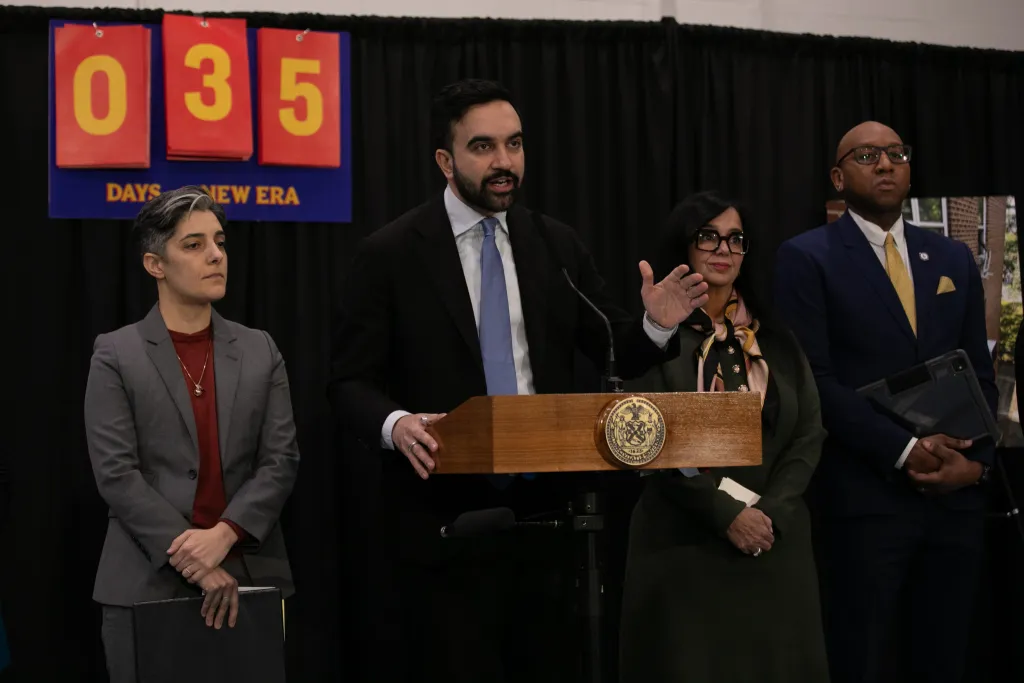
The death toll for New Yorkers found outside during the record cold stretch has climbed to 17, according to an update by Mayor Zohran Mamdani Wednesday morning.
Preliminary assessments indicate that 13 of those deaths were related to hypothermia, while three were related to substance overdose, the mayor said. The Office of Chief Medical Examiner has yet to determine the cause of one of the deaths.
The city continues to observe “Enhanced Code Blue” protocols, which involve more frequent homeless outreach efforts and an open-door policy at shelters that circumvents the normal intake process. That is likely to continue through the weekend, when temperatures are expected to dip into the single digits.
“As long as temperatures remain this low, the risk of fatal exposure endures,” Mamdani said. “We will continue to do everything in our power to get every New Yorker into a shelter where they will be safe and they will be warm.”
At least 10 of the 17 deaths involved people who’ve engaged with the city’s shelter system at some point, Mamdani said Monday, when 16 deaths had been recorded. He added on Wednesday, however, that none of the individuals had been living in homeless encampments at the time of their death.
Five deaths were recorded in Manhattan and Brooklyn each, while Queens recorded four and the Bronx recorded three.
The New York Police Department, which previously provided details about the time and location of the deaths, declined to do so Tuesday and Wednesday, and instead referred THE CITY to City Hall. City Hall did not respond to THE CITY’s inquiry about whether the latest death involved an individual previously known to the shelter system.
Between Jan. 19 and Wednesday morning, Mamdani noted, city workers and homeless outreach specialists have involuntarily transported 20 people to hospitals while making over 1,100 placements to shelters — a number that counts an individual for each night they’re placed into a shelter. The Department of Homeless Services did not respond to inquiries about the number of people in total placed in shelters over that period.
“We are continuing to follow up to make sure that these are the operations that are operating at the best possible level. What we know is this cold front is not leaving,” Mamdani added. “What it requires from us is a level of response — we’re pushing on every avenue to ensure that’s the case.”

Since Feb. 1, the Fire Department has been soliciting staff, including firefighters and emergency medical technicians, to participate in overtime and join the department’s task force to respond to cold-related calls, according to a memo obtained by THE CITY. That task force will run around the clock through at least Feb. 8, when temperatures are expected to feel like 0 degrees in the evening.
The Fire Department could not immediately provide the number of workers participating in the task force, or the number of cold-related calls it’s responded to since Jan. 23, as the city began to prepare for the impending cold spell.
However, the department’s Emergency Medical Services unit does not have nearly enough workers or ambulances to handle the influx of cold-related calls in the meantime, said Lt. Anthony Almojera, vice president of Local 3621, the union of Fire Department’s Emergency Medical Service officers.
“Obviously people will pick up overtime, but I’m sure the EMS portion of the cold team is not running like it’s supposed to,” said Almojera, who pointed to slower ambulance response times and growing staff attrition over the past several years. “There’s a crisis at EMS. There’s not enough staff, and now on top of that we don’t have enough equipment — and we’re busier than ever.”
The 17 deaths, Almojera added, “shows that there’s a breakdown of a lot of systems here, and EMS is one of them.”
“For all the programs City Hall wants to do, whether it’s cold or anything, they have to invest in EMS,” he said.
Mamdani, meanwhile, continues to encourage New Yorkers to report sightings of people in need on the streets to 311, though all requests for homeless person assistance are rerouted through 911 during Code Blue events. LinkNYC kiosks across the city will also display public service announcements to explain how to request help in addition to urging unsheltered New Yorkers to move indoors, Mamdani said Wednesday.
The efficacy of these emergency measures will come under a microscope next Tuesday, when the City Council’s general welfare and public safety committees will hold an oversight hearing to identify the gaps in Code Blue protocols, said Councilmember Crystal Hudson (D-Brooklyn), who chairs the general welfare committee.
Some unsheltered New Yorkers, for example, have been unaware of the warming buses dispatched across the city to provide relief from the cold, Gothamist reported.
“Part of what we hope to glean from the hearing is what this process should actually look like in this type of cold snap and extreme weather,” Hudson said. “This is likely just the beginning in terms of changes to our climate, with extreme winters and extreme summers becoming even more brutal as time goes on.”
Additional reporting by Samantha Maldonado.
Correction: A previous version of this story misstated how long the city has experienced below-freezing temperatures.
Our nonprofit newsroom relies on donations from readers to sustain our local reporting and keep it free for all New Yorkers. Donate to THE CITY today.
The post Cold Death Toll Hits 17 as Deep Freeze Continues appeared first on THE CITY – NYC News.