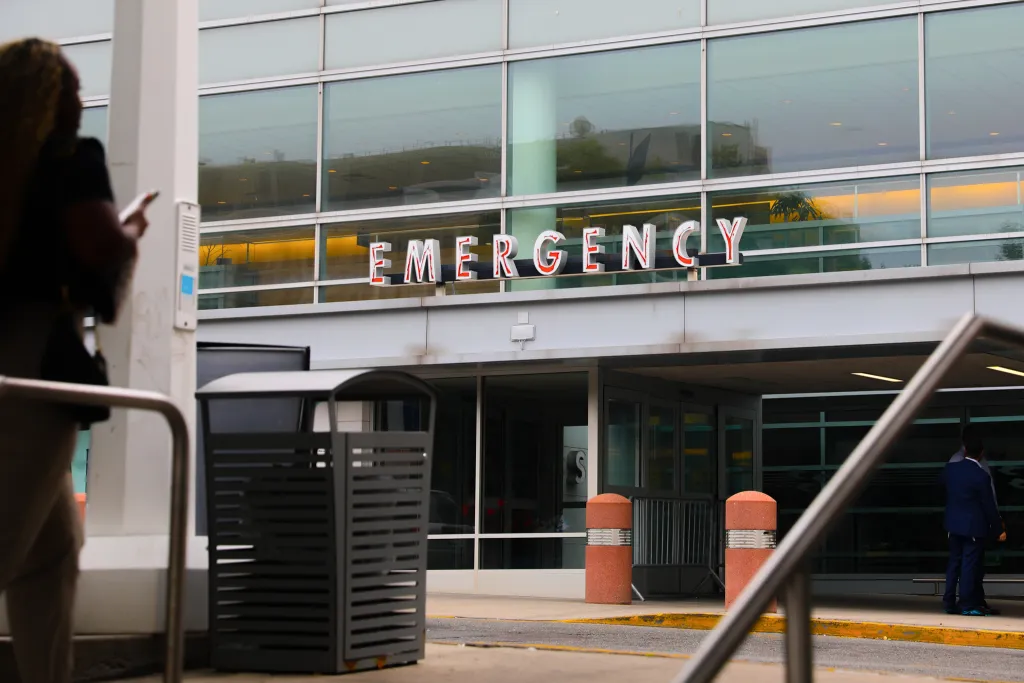
How long does it take to go from the emergency room to a hospital bed at the city’s public hospitals?
It depends on where you go looking for help.
At Kings County Hospital Center in East Flatbush, patients waited an average of 27 hours. At Elmhurst Hospital in Queens, the wait was nearly 24 hours from January through May, according to data obtained by The City Reporter.
Patients fared better at Bellevue in Manhattan, where the average wait was nearly 10 hours, followed by Harlem Hospital at 8.9 hours and Metropolitan Hospital in East Harlem at 6.4 hours.
Overall, it has taken patients an average of 12.8 hours to transfer from the emergency room to a hospital bed from 2022 until 2025 at medical centers owned by NYC Health + Hospitals, according to data obtained through a Freedom of Information request.
(function(){function e(){window.addEventListener(`message`,function(e){if(e.data[`datawrapper-height`]!==void 0){var t=document.querySelectorAll(`iframe`);for(var n in e.data[`datawrapper-height`])for(var r=0,i;i=t[r];r++)if(i.contentWindow===e.source){var a=e.data[`datawrapper-height`][n]+`px`;i.style.height=a}}})}e()})();
It should take no longer than four hours from the decision to admit a patient to their transfer to an inpatient bed, with the total time in the ER not exceeding eight hours, according to the new Emergency Care Access and Timeliness standard established by the federal Centers for Medicare & Medicaid Services.
‘Hallway Duty’ and ‘Pissed Off’ Patients
The day-long delays at some city public hospitals are driven by a combination of staff shortages, a steady spike in the number of patients thanks to the closures of nearby hospitals, and a growing number of patients with complex medical needs, according to experts.
Brooklyn has lost 1,600 hospital beds since 2010 from the closure and consolidation of hospitals and medical centers, according to an analysis by the New York State Nurses Association.
At Kings County, the onboarding process has gotten so acute that some ER staff are now assigned to “hallway duty,” caring for patients who are awaiting admission but who no longer require emergency attention, according to two veteran nurses at the hospital.
MORE: Read The City Reporter’s NYC health coverage.
Approximately 30% to 40% of the emergency department is typically filled with patients waiting to be transferred to a bed, Harinee Suthakar, a nurse at Kings County, told The City Reporter.
“The ER is such a busy place, they’re surrounded by noise, monitors beeping, constantly going off, and lights being so bright,” she said. “It’s a very challenging circumstance for a patient to be in.”
Another nurse, who spoke on condition of anonymity, added: “Patients are really pissed off because they are still waiting.”

At the 639-bed medical facility, the average wait for a bed upstairs was 18.6 hours in 2022; 26.7 hours in 2023; 28.9 hours in 2024; 20 hours in 2025; and 27.3 hours from January through May of this year, according to the data.
Experts say the extensive wait times at Kings County are part of a national onboarding crisis driven by a shortage of hospital beds and an overreliance on ERs for routine care by patients without private health insurance.
A Surge in 2026 Flu Cases
“I don’t blame anybody for hearing those numbers and thinking, ‘Wow, what is going on?’” Alexander Janke, a clinical assistant professor of emergency medicine at the University of Michigan Medical School, told The City Reporter.
“But I want you to know that if you come to many hospitals in the United States right now, you can expect to wait 27 hours for a bed to open up upstairs,” he added. “That is, in fact, the status quo that we find ourselves in.”
Adam Shrier, a NYC Health + Hospital spokesperson, urged The City Reporter not to highlight the latest data from January to May at Kings County because it includes “the height of respiratory virus season,” which creates a “surge in ED volume every year,” a reference to the hospital’s emergency department.
“We are happy to answer your questions, but they should not use this comparison,” he said.

The winter of 2025-26 saw a severe flu surge, with over 146,000 lab-confirmed cases and record-high hospitalizations across the state, Shrier said. Over half of the city’s reported cases affected children younger than 18.
Amid the increase in onboarding times at several medical centers, the city’s public hospital system saw improvements in other emergency department categories.
The “Left Without Being Seen” rates of patients who abandon the emergency room before seeing a doctor decreased from 4% to 5% of patients to 2% to 3%, Shrier noted. That indicates the system has improved its “front-end ED processes and its doctors are seeing patients faster,” he added.
Additionally, NYC H+H has seen systemwide improvements in door-to-provider metrics, the data shows. The share of patients seen in under 29 minutes rose from 42.0% in 2022 to 49.4% so far this year, while waiting times for emergency care longer than 89 minutes fell from 20% to 15%.
A ‘Public Health Crisis’?
Still, Dr. Frances Quee, president of the Doctors Council SEIU, the union that represents physicians in the city’s public hospital system, said the inability to place patients in beds within a reasonable timeframe shows a larger problem.
“When nearly one in five emergency visits across H+H now lasts nine or more hours, we have moved well past the threshold of an inconvenience and into the territory of a public health crisis,” Quee said.
She described “a boarding crisis driven by a shortage of inpatient beds,” in which patients are held in the ER “because there is simply nowhere to put them.”
Kings County Hospital has seen a spike in ER patients over the past several years, from 92,450 in 2022, to 99,200 in 2023, to over 102,000 in 2024, according to H+H data.
(function(){function e(){window.addEventListener(`message`,function(e){if(e.data[`datawrapper-height`]!==void 0){var t=document.querySelectorAll(`iframe`);for(var n in e.data[`datawrapper-height`])for(var r=0,i;i=t[r];r++)if(i.contentWindow===e.source){var a=e.data[`datawrapper-height`][n]+`px`;i.style.height=a}}})}e()})();
That’s a bigger patient load than before and even during the COVID-19 pandemic.
One Million Patients
H+H officials blamed the citywide patient increase on the shuttering of other hospitals over the past decade, including Beth Israel Medical Center on Union Square in 2025; Long Island College Hospital in Cobble Hill in 2014; Interfaith Medical Center in Bedford-Stuyvesant in 2013; and St. Vincent’s Hospital in Greenwich Village in 2010.
Since 2010, Brooklyn has lost more than 1,600 hospital beds, with the majority coming from Long Island College, Lutheran Medical Center in Sunset Park and Kingsbrook Jewish Medical Center in East Flatbush, according to the nurses union.
An estimated one million New Yorkers get medical care through the city’s public hospital system, the largest in the U.S.
Many do not have any private insurance and rely on hospitals like Kings County and Elmhurst for routine care. The city hospital system accepts patients regardless of their immigration status or their ability to pay.

Shrier, the HHC spokesperson, said delays for beds at some major hospitals aren’t related to a lack of staff, noting that systemwide, the emergency department physician vacancy rate is just 4.2%.
The Kings County emergency department is fully staffed with doctors and nurses. Of the 229 budgeted registered nurse positions, only three are vacant, he said.
Over the past four years, Kings County has added approximately 10 full-time physician positions to maximize staff in its main observation unit, according to Shrier, and approximately 60 additional nurses were hired to deal with the spike in patients. Staffing at Elmhurst — which has a 70-bed ER and 545 inpatient beds — is similarly robust, he added.
Biggest Increase at Woodhull
But one national expert, who declined to discuss specific hospitals, said long onboarding times indicate a major lack of resources — and capacity.
“Boarding is not an ED problem, it’s a hospital problem because there’s a hospital-wide capacity issue that is driven by a variety of things,” Dustin Bass, president of the Emergency Nurses Association, told The City Reporter.
When a hospital is swamped and under-resourced, “the ED, unfortunately, ends up being the one that has to deal with that problem,” he said.
H+H officials said the long boarding times don’t give the full picture.
(function(){function e(){window.addEventListener(`message`,function(e){if(e.data[`datawrapper-height`]!==void 0){var t=document.querySelectorAll(`iframe`);for(var n in e.data[`datawrapper-height`])for(var r=0,i;i=t[r];r++)if(i.contentWindow===e.source){var a=e.data[`datawrapper-height`][n]+`px`;i.style.height=a}}})}e()})();
At Kings County, door-to-doctor times have improved 19% since 2022 and 26% since 2024, falling from an average of 91.5 minutes in 2024 to 68 minutes in 2025 and 2026, according to H+H.
How does the public system’s average boarding time compare with other New York hospitals, and with the rest of the country?
Across New York City’s private and public hospitals, the combined average wait time for hospital admission after an emergency room visit is 3 hours and 27 minutes, according to data from the U.S. Centers for Medicaid and Medicare Services. By contrast, in Houston the average wait time is roughly 2 hours and 32 minutes. Los Angeles residents wait about 3 hours and 29 minutes, while Chicago residents wait about 3 hours and 21 minutes.
Supporters of the city public hospital system note that the New York City population dwarfs other big metropolitan areas.
Still, the wait time across the 11 city-managed hospitals was almost 14 hours between January and May, according to the data. (NYC Health + Hospitals omitted data for North Central Bronx Hospital from its response to The City Reporter’s public records request.)
The onboarding wait times have exceeded the national standard for the past five years.

Patients who visit Kings County Hospital’s emergency room, for example, waited an average of 23.5 hours from the ER to a bed in a regular unit from 2022 through 2025, the data show. At Elmhurst, they waited roughly 18.8 hours over that same period, the figures show.
Those public hospitals are the worst but far from an outlier.
Of the 10 hospitals for which data was provided, the biggest increase occurred at Woodhull Medical Center in Bushwick, where wait times have jumped by 12 hours since 2022, according to an analysis by The City Reporter. That year, Woodhull reported an average wait time of 10 hours, while 2026 numbers show roughly 22 hours.
Similarly, Elmhurst Hospital Center saw an almost 7-hour wait time jump since 2022.
Elmhurst’s adult emergency department has been handling more than 90,000 visits a year since 2023. That’s way higher than the roughly 70,000 to 72,000 visits it was designed to handle in the early 2000s, according to H+H.
MORE: These NYC Communities Will Be Hit The Hardest by New Medicaid Work Rules
Patients generally receive some treatment while they wait in the ER, including tests such as CT scans and other diagnostic work.
But the length of the wait for an inpatient bed still matters, experts explained.
Long ER waits can lead to missed medications and delays in more comprehensive treatment, said Janke and other medical experts. “You may find yourself asking five or 10 times for some help getting up to go to the bathroom,” Janke said.
Emergency and inpatient care “work on two different clocks,” Janke said. In the ER, doctors are focused on identifying and treating potentially serious problems that need immediate attention.
There’s likely more congestion to come.
‘Getting Ridiculous’
In July, more than 200,000 New York City residents lost their health insurance following the Trump administration’s cuts to the state Essential Plan. The mass loss of health coverage could send more New Yorkers to the emergency room — and possible hospital admission — as they put off primary and preventive care, experts said.

“The waiting in the hospital is getting ridiculous,” City Councilmember Mercedes Narcisse (D-Brooklyn), a former nurse at Elmhurst Hospital Center who chairs the committee on hospitals, told The City Reporter. “Medicaid is the state, but if the federal government doesn’t give the money, then we’re not getting anything even in the city. The federal government has cut $8 billion; that’s a big cut we’re talking about from our structure.”
The lack of bed space is all too real for Kai G., who was stabbed in the leg during a fight near Prospect Park in July. The 28-year-old also broke his right hand and suffered scrapes on his arms and legs while jumping a fence as he fled the melee.
Kai told The City Reporter he walked for 30 minutes to Kings County’s emergency room with a bleeding leg. Within hours, nurses were checking his vital signs and doctors had performed surgery on his hand.

But the next morning, he said, doctors walked into his room with discharge papers.
“They told me I looked like I was well enough to leave, but I couldn’t walk,” Kai told The City Reporter. “They discharged me early and they just left me on the street. It was f–king ridiculous.”
After Kai begged staff to let him stay, he said the hospital gave him a cane and arranged a taxi to Bellevue Hospital Center in Manhattan, where he was admitted.
“I told them, ‘First of all I can’t walk; I need recovery. Are y’all going to help me?’” Kai said. “They’re like, ‘No, just come back to rewrap this arm.’ They handled the surgery good, but it was messed up.”
Our nonprofit newsroom relies on donations from readers to sustain our local reporting and keep it free for all New Yorkers. Donate to THE CITY today.
The post A 27-Hour Wait for a Hospital Bed? Why Delays Are Growing at New York Hospitals appeared first on The City Reporter.
