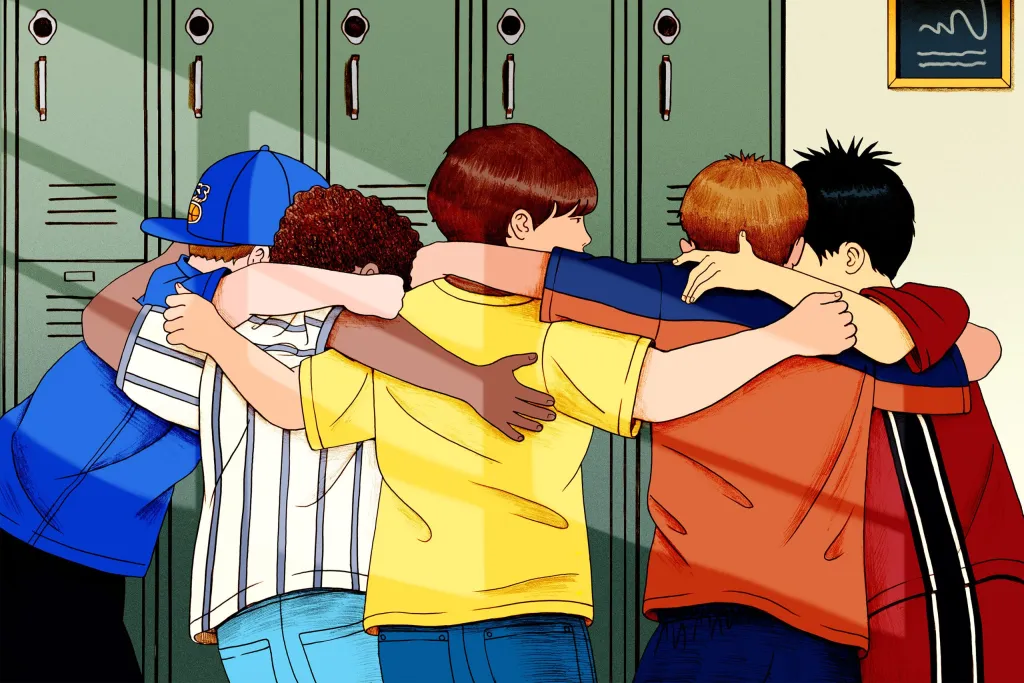
OAKLAND, Calif. — It’s a Friday morning at Oakland Unity Middle School, a public charter school nestled between residential buildings in East Oakland, and Austin Razavi is announcing the morning advisory prompt.
“I’ll give you 10, 15 seconds to think about it,” Razavi said to the group of 15 mixed-grade middle school boys who had arranged desks into a messy circle. “Then each of you share something most people don’t know about you.”
There was some shuffling and silence. Several boys asked for more time, then one piped up.
“I like to play videos,” he said.
Then another: “I like to play with my little siblings.”
And then: “A little-known fact about me is that half of my lung is missing.”
In other classrooms on campus, girls-only and all-gender advisories are meeting too; students choose which type they are assigned to. During these trust circles, students can’t opt out of sharing, because this first period sets the tone for the day. Students will rely on each other for support to complete missing assignments by the end of the day, and teachers and administrators like Razavi want students to feel safe being vulnerable with each other.
Immediately after sharing time, each boy tells the group about class assignments he needs to finish. Their classmates offer advice, encouragement or just acknowledgement.
“That’s where growth happens,” said Razavi, a humanities teacher and assistant principal of the school. “Growth happens through risk. That’s where kids feel like they’re in community and an indicator of kids feeling a sense of belonging.”
Related: A lot goes on in classrooms from kindergarten to high school. Keep up with our free weekly newsletter on K-12 education.
Experts agree that a sense of belonging — meaning that students feel accepted, respected and supported in school — is crucial for academic success. This is perhaps even more true for boys, who are more likely than girls to repeat kindergarten and lag in reading and writing skills and less likely to graduate from high school.
But this safety eludes many boys who get the message early in life that they’re not good students.
“Something happens over time so by the time they get to high school, boys don’t feel like they belong in academic settings,” said Ioakim Boutakidis, a professor of child and adolescent studies at California State University, Fullerton, and a research fellow at the American Institute for Boys and Men, a nonprofit research and policy group. “And then that hurts academic belonging, the sense that you’re good enough to be successful in these academic spaces.” (Rise Together, a fund established by American Institute for Boys and Men founder Richard Reeves, is one of The Hechinger Report’s many donors.)
At Oakland Unity Middle School, teachers are trying to break that cycle through the relationship-building program, which is designed to normalize male vulnerability and support boys to be themselves, instead of what they feel is expected of them. Just over 140 sixth, seventh and eighth graders attend the school, nearly all of them from East Oakland — one of the most ethnically diverse and socioeconomically disadvantaged neighborhoods in the Bay Area.
The program, Ever Forward, was founded in 2004 by Ashanti Branch, then a first-year teacher in nearby San Lorenzo, to embrace a philosophy of “radical positivity.” Since 2021, according to Branch, it has led more than 300 workshops, mostly in Northern California, reaching upwards of 30,000 teachers and educators.
“I feel like this school is kind of my second home,” said Unity eighth grader Adrian Polanco, who wants to study business in college. “We always have someone we can look up to, who has our back, which I think is really good and really important for school to have.”
No one claims that social-emotional support for boys alone will help them do better academically, but experts say that programming to boost belonging may be key to closing the academic gender gap.
Warmth and connection matter a lot to boys, even if they don’t always demonstrate these needs by being responsive to questions and expectations the way girls often do, Boutakidis said. Boys may appear not to care about what adults think of them, but that doesn’t mean they don’t crave connection.

This can make it hard for some teachers to connect with boys in the classroom and even read boys’ behavior as so disengaged as to be antagonistic, said Matt Englar-Carlson, a professor of counseling and the co-director of the Center for Boys and Men at Cal State Fullerton. This may be particularly true with adolescent boys.
“When you think what’s happening is disrespect in the classroom, the reality is that it typically isn’t, because they’re not performing for you,” Englar-Carlson said. “They’re performing for their peers around them. He can ridicule you and save face in front of his friends and act like he doesn’t care.”
Once teachers begin to realize when this is happening, they can make adaptations to their teaching, he said, like asking boys questions in a different way. Instead of calling out a male student in front of the class, teachers might come up next to him while walking around the classroom and talk to him softly, at his level.
“So now it’s actually a private conversation between the two of you,” he said, “and you don’t actually have to call out bad behavior.”
Related: Many boys aren’t interested in school. Can opening more career-focused high schools help?
Ashanti Branch learned early the challenges faced by male students. A wrestler and football player while attending East Oakland public schools, he now wears his hair in long braids and has an easy, warm smile and laugh. After graduating from Cal Poly San Luis Obispo, Branch worked as a civil engineer before going into teaching.
As one of just a few male teachers at San Lorenzo High School about 20 miles south of Oakland, Branch soon discovered that male students vented their anger and frustration at him.
“I saw young men who were brilliant, but the way they were acting in front of class was really difficult,” he said. “I would tell them, ‘Young man, you want to fight with me because it looks good with your peers? I’m not here to fight you. I’m not your enemy. You’re a high schooler. I’m an adult with a job. What are we arguing about? I want you to succeed.’”
He invited some male students to have lunch with him once a week and asked them how he could be a better teacher. What they told him was that their lives were too difficult for school to be a priority. Students described “crashing out” — sudden outbursts of rage and emotion — after dealing with one emotional “land mine” after another.
“A kid getting pushed down the hall, he ignores it, ignores it, and then all of a sudden he turns around and boom,” Branch said, making an explosion gesture with both hands. “And then he gets in trouble, right?”
Branch recalled that as a teacher he was encouraged to leave his own problems “in the glove compartment” before coming to work.
“I tried to do that, but I realized I was so fake,” he said. Instead, he was honest with his students about how he was doing. “I would tell them, ‘I had a rough weekend. A lot of drama happened in my life. Today’s not a good day.” He calls this approach “normalizing vulnerability” — an essential step for young men to be themselves as people and as students.
Branch turned the weekly lunches with students into a club, the Ever Forward Club, where young men could gather to process emotions. He spent a decade developing the program and expanding to more schools, eventually leaving his job to build the program and provide professional development for educators.
At the heart of the Ever Forward Club is a project-based tool Branch calls Masks, Emotions and Math. During workshops, Branch guides young men to explore the ways they present themselves to the world while hiding their difficult emotions from view.
Since the club started in 2004, every participating student has graduated from high school and 93 percent have transitioned to college, the military or a trade school, Branch said. He expanded the work to include professional development for educators, calling it the Million Mask Movement.
Tony Farrell, head of Stuart Hall High School — the boys’ segment of a Jesuit school in San Francisco — recalls an event Branch led at his school ten years ago. Two hundred male high school students sat in a big circle in the school’s gymnasium, Farrell said, and Branch handed out pens and paper. He instructed students to write on one side of the paper how they appear to the world. On the other side, he said, write the stuff the world doesn’t know about them.
Then they crumpled the papers up and threw them at each other.
“It was a snowball fight,” Farrrell said. “We had a perfectly, wonderfully randomized pile of crumpled paper.”
Then each boy picked a paper ball, smoothed it out and, one at a time, read what another boy had written.
Farrell recalled boys reading, “You wouldn’t know from looking at me that my parents are getting a divorce’’ and “You wouldn’t know from looking at me that my grandma’s really sick.”
“Not to get woo-woo, but it was like an electric field,” he said. “It was really powerful.”
Two years ago, Branch led a Masks, Emotions and Math event at Oakland Unity Middle School. Since then, teachers at the school have integrated elements of Branch’s work into routine practices, including how the school manages disciplinary issues. That’s also where Razavi got the idea to offer single-sex advisory periods.
Some boys need a space where they can open up to other boys, he said, without the social dynamics that can come with all-gender groups.
“If you know that belonging matters, and you know that there’s this very evident drop in sense of belonging over time for boys, then we need to work on making boys feel like they belong,” he said. “And we need to work on that earlier.”
Related: Women far outnumber men in law school, med school, vet school, and other professional programs
Eighth grader Fierre Hill transferred to Oakland Unity after his old middle school closed. He wants to go to college and study something health-related. He describes the support he gets from his teachers at the school as “warming.”
“You’re able to tell them stuff that you couldn’t tell other people,” he said, “and they just have this different energy that makes you comfortable.”
“I get with that,” seventh grader Jubran Sulaiman agreed. “We can all, what’s the word? Express ourselves.”
On Wednesdays, Hill and other students go to the school’s Learning Lab, where they get help completing any work they haven’t turned in. Chris Bibbens Williams is the teacher in charge of the Learning Lab. He said that the Masks, Emotions and Math event that Branch led at the school helped otherwise shy students engage more deeply with their peers.
“You’re gonna have some kids who are more confident in talking in front of everyone, but even the kids who weren’t confident, it just seemed like because the space was positive, it was a chance for them to say how they felt in the moment,” he said. “That’s one thing that I love about this school is that we really allow kids to be themselves, and we build those deep relationships.”
When he isn’t in the Learning Lab, Williams can be found all over campus — playing basketball with students and hanging out with them in the cafeteria.
”When you build those relationships, kids come to you,” he said.
Recently, Williams approached an eighth grader who hadn’t been completing his language arts assignments. Was he not doing the work because it was too hard, or because he lacked confidence?
“I had him come over and read the passage to me,” Williams said, “and I discovered it was truly just him not being confident in his reading.”
With Williams sitting with him, the student made his way through the passage and read words he wasn’t familiar with. Since then, Williams has noticed a change in the boy’s confidence level.
“He’s attempting more,” he said, “and that’s all I could ask for.”
Contact editor Christina Samuels at (212) 678-3635 or samuels@hechingerreport.org.
This story about the gender gap was produced by The Hechinger Report, a nonprofit, independent news organization focused on inequality and innovation in education. Sign up for the Hechinger newsletter.
The post Key to helping boys in school: Make them feel safe to be themselves appeared first on The Hechinger Report.
