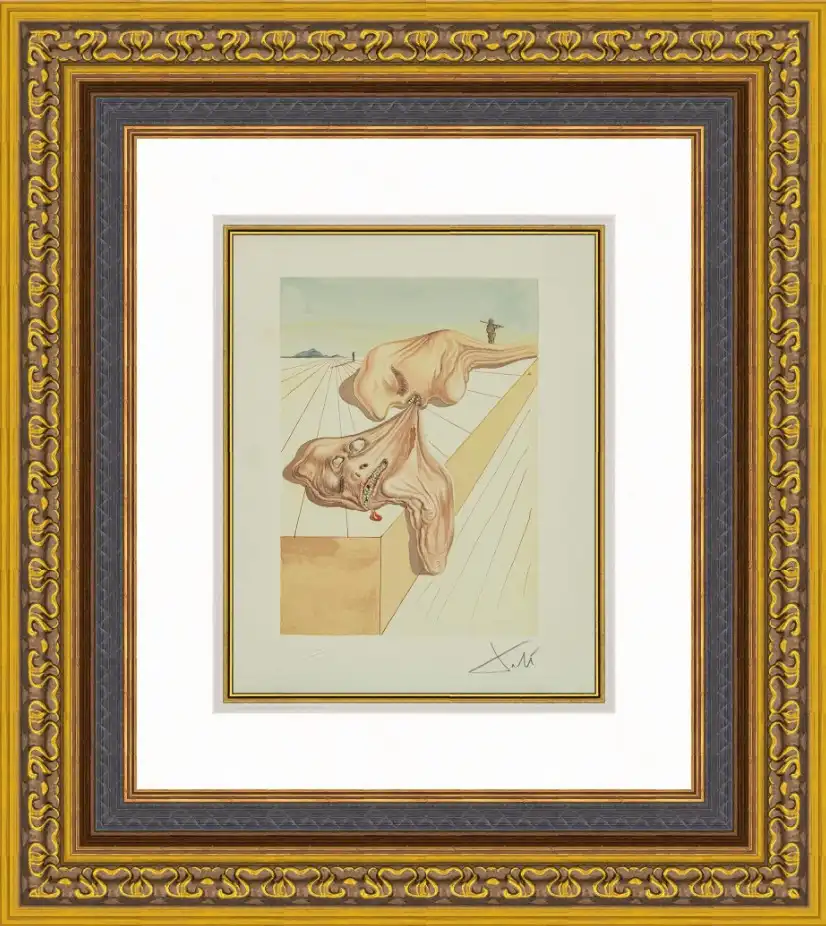
Salvador Dalí was not the man to knock politely at Dante’s door.
He would arrive, rather, dressed for judgment, flirting with damnation, carrying the nerve of a heretic and the discipline of a Renaissance obsessive. Of course, that is precisely why his encounter with *The Divine Comedy* feels so charged. Heaven and hell, in Dalí’s hands, are not simply distant religious addresses. They become moods, temptations, punishments, humiliations, and private little tribunals we continue building for ourselves in modern life.
Dante gave Western literature its great map of consequence. Dalí, several centuries later, made that map sweat.
That is, perhaps, the only proper way to meet *The Divine Comedy*.
Written in the early fourteenth century after Dante Alighieri was exiled from Florence, the *Commedia* remains one of literature’s strangest acts of revenge and salvation. It is, in many ways, a love poem, political reckoning, spiritual confession, and cosmic itinerary all at once. Dante chose to write in the vernacular rather than Latin, which was no small gesture. He gave Italian poetic authority to ordinary speech while allowing an immense vision of the afterlife to enter human language. Judgment became legible. Mercy felt intimate. Terror acquired a voice.
The poem begins, famously, with disorientation. Midway through life, the poet finds himself lost in a dark wood, unable to understand where he has gone wrong or how far he has fallen. From that crisis, he descends through *Inferno*, climbs *Purgatorio*, and rises into *Paradiso*, guided first by Virgil, the figure of reason, then by Beatrice, who becomes revelation and sacred love. The design is exact: 100 cantos arranged across damnation, purification, and celestial vision. The emotional charge, however, remains gloriously unruly. It carries fear, longing, pride, grief, devotion, and the terrible human need to know what the soul deserves.
Naturally, Dalí understood the assignment by refusing to behave.

Commissioned in connection with the 700th anniversary of Dante’s birth, the Catalan Surrealist began creating the watercolors that would become his *Divine Comedy* suite. The final cycle corresponds to the poem’s 100 cantos: 34 images for Hell, 33 for Purgatory, and 33 for Paradise. Later translated into color wood engravings, the project required astonishing technical labor, with thousands of carved blocks used to preserve the delicacy, tonal range, and vaporous strangeness of the original compositions.
A more obedient artist might have offered solemn scenes and tasteful reverence. Dalí, mercifully, gave Dante something riskier: fevered theology.
His figures bend, drift, collapse, and reappear as though the body itself has become unreliable. Color does not simply describe. It trembles, bruises, flares, and seduces. The images feel unstable in the best possible sense, as if each page has been caught between confession and dream. Dante’s universe was never meant to be pretty. It was meant to expose. Dalí seemed to understand, almost instinctively, that exposure requires danger.
That is where the pairing becomes so powerful. Dante makes the invisible unavoidable. Hell reveals what a life has chosen. Purgatory demands the brutal labor of change. Paradise offers clarity so intense it can feel almost violent. Dalí takes those moral territories and gives them flesh, distortion, atmosphere, and theatrical nerve. The result is not illustration as decoration. It is interpretation as possession.
This is also why *The Divine Comedy* refuses to become antique. We remain, in many ways, lost in the wood. That condition feels painfully modern: the self unable to locate itself, the world loud with judgment, the hunger for meaning sharpened by confusion. Dante endures, arguably, because he understood consequence. Dalí intensifies that truth by making the afterlife feel less like doctrine than recognition.
His answer is never calm. It is luminous, excessive, strange, and often far more honest than restraint.

In *Inferno*, the forms appear altered by punishment, as though sin has rewritten the body. In *Purgatorio*, the mood grows lighter yet still uneasy, filled with the strain of becoming less damaged. By *Paradiso*, radiance arrives, though never as soft consolation. Dalí’s heaven is brilliant, certainly, yet also dizzying. Grace, here, is not a pillow. It is an ordeal of light.
That refusal of sweetness gives the suite its bite. Dalí does not flatten Dante into piety. He understands that transformation can terrify. To be remade, even toward salvation, requires surrendering the old self. In this cycle, redemption is not gentle. It is, perhaps, a shock to perception.
Seen in SoHo, amid commerce, appetite, velocity, and self-invention, the works feel oddly at home. Dalí knew modern life’s pageantry better than almost anyone. He understood fame, scandal, desire, money, faith, and fantasy as overlapping currencies. His *Divine Comedy* is not, therefore, an escape from contemporary culture. It is a glamorous autopsy of it.
The series also helps rescue Dalí from his own caricature. Yes, there were melting clocks, wild interviews, and that immortal mustache. There was also, more importantly, a formidable draftsman, a student of Renaissance technique, and a painter obsessed with Catholic mysticism, psychoanalysis, science, eroticism, decay, and unstable matter. Dante gave him a subject large enough to hold the entire circus and still demand seriousness.
Dalí entered Dante’s universe and left fingerprints on eternity. Hell became psychological theater. Purgatory became suspended metamorphosis. Paradise became radiant instability.
The power of the suite rests there. It reminds us that the afterlife, in art as in belief, is rarely only elsewhere. It is already unfolding inside the mind: every private punishment, every climb toward repair, every impossible longing for grace.
Dalí’s *Divine Comedy* is now on display at Park West Fine Art Museum & Gallery, located at 411 West Broadway in SoHo. For gallery tours, pricing, and availability, contact Park West Gallery.
