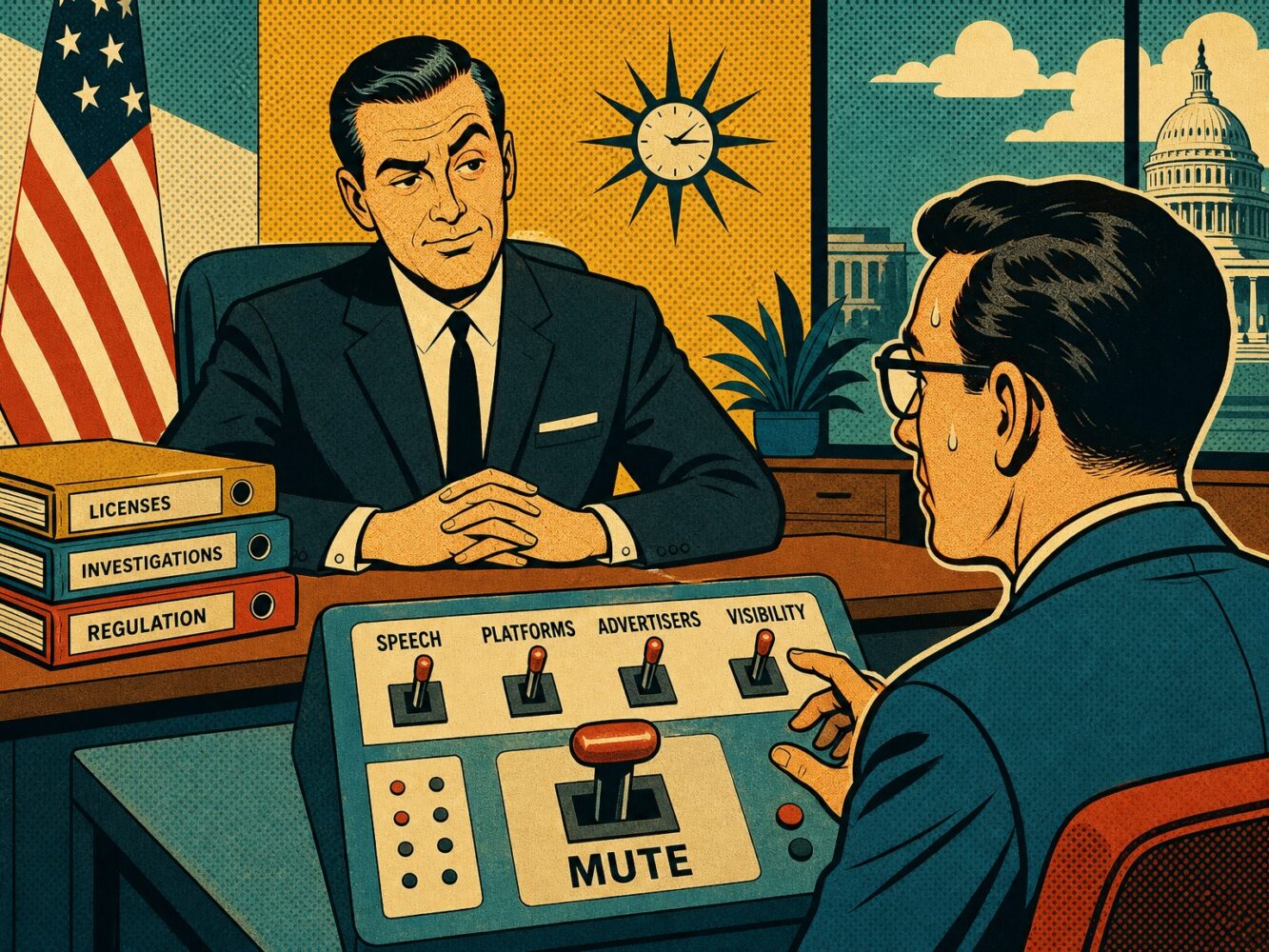
The easiest way for the government to censor speech is not always to ban it. Sometimes, it is to find someone else with a hand on the switch.
That is the problem at the center of the current debate over free speech in the digital age. For years, the public argument focused on whether private technology companies were moderating too much content. A different concern has now moved to the forefront: “jawboning,” the practice of government officials using informal pressure, implicit threats, or regulatory leverage to induce private intermediaries to suppress speech on the government’s behalf.
Late last week, Sens. Ted Cruz (R-Texas) and Ron Wyden (D-Ore.) introduced the Justice Against Weaponized Bureaucratic Overreach to Networked Expression Act, or JAWBONE Act. The bipartisan legislation seeks to bring jawboning into the open and provide Americans with a legal mechanism to challenge government efforts to coerce private actors into censoring lawful speech.
The proposal has much to recommend it. At the same time, it should be viewed as only a first step toward curbing the federal government’s ability to conduct coercive speech-suppression campaigns. To be fully effective, it should be paired with structural reforms that limit government officials’ discretion to pressure online platforms over speech decisions.
How to Censor Without Looking Like It
What the JAWBONE Act gets right is its recognition that modern censorship rarely takes the form of a direct government order to stop speaking. More often, it operates through censorship by proxy.
As I argued in a recent paper on jawboning, much of today’s speech ecosystem depends on multisided platforms—businesses that connect content creators, audiences, advertisers, payment providers, and other participants. Because these platforms often depend on government licenses, regulatory approvals, or antitrust clearance, they can be particularly vulnerable to government pressure.
When officials exert pressure on one part of that ecosystem, the effects can spread throughout the network. If the Federal Communications Commission (FCC) hints that a broadcaster’s license may be at risk, or if the Federal Trade Commission (FTC) opens an investigation into an advertising agency or fact-checking organization, the consequences can extend well beyond the immediate target. Those actions can alter incentives across the platform and, in turn, affect what speech reaches the public.
The result is a marketplace of ideas shaped less by voluntary choices and more by the preferences of those who hold government power. Because these interventions often occur indirectly, they can evade meaningful First Amendment scrutiny and leave the public unaware of the government’s role in influencing speech outcomes.
Everyone Loves a Shortcut
The JAWBONE Act’s bipartisan sponsorship reflects an important reality: jawboning is a tool of institutional power, not a uniquely partisan tactic. Without stronger accountability mechanisms, whichever party controls the executive branch will have incentives to use government leverage to influence speech indirectly.
The statements Sens. Cruz and Wyden issued alongside the bill underscore this point. Republicans have argued that the Biden administration used the Cybersecurity and Infrastructure Security Agency (CISA) and other federal agencies to pressure major technology platforms to suppress content related to COVID-19 and election integrity. Democrats, meanwhile, have criticized actions by the Trump administration and FCC Chairman Brendan Carr, alleging that threats of regulatory scrutiny were used to pressure broadcasters over disfavored late-night programming and political candidates appearing on programs such as The View.
My paper identifies additional examples. When the FTC investigates fact-checking organizations such as NewsGuard or pressures Apple over editorial decisions in news curation, the underlying mechanism resembles earlier efforts by the Obama and Biden administrations to encourage banks and payment processors to cut ties with disfavored businesses or political causes. The targets may differ, but the basic dynamic remains the same: government officials pressure private intermediaries, which then shape what speech, information, or viewpoints reach the public.
That dynamic can produce a form of backdoor censorship that distorts the marketplace of ideas while obscuring the government’s role in the process.
Giving the First Amendment a Remedy
The JAWBONE Act is designed to target the legal barriers that have historically allowed jawboning claims to evade judicial review. In cases like Murthy v. Missouri, plaintiffs have faced significant hurdles in proving standing, and courts often dismiss cases as moot when policies change or officials leave office.
The bill addresses those structural barriers in several ways. First, it creates a federal cause of action that allows individual Americans to sue government agencies or employees who coerce platforms into suppressing protected speech. It also permits plaintiffs to seek monetary damages, which may help address some of the standing problems presented in Murthy.
Second, the bill would impose liability for attempted coercion. A violation occurs regardless of whether the censorship succeeds. That feature directly addresses the chilling effect of backdoor censorship efforts: once an official exerts coercive pressure, the legal line is crossed, even if the platform refuses to comply.
Finally, the bill would require federal agencies to submit disclosures to Congress regarding certain communications with private platforms. By bringing those communications into the open, the bill targets one of jawboning’s central advantages: secrecy.
You Can’t Sue Away Discretion
While the JAWBONE Act would represent a major step forward for accountability, transparency, and judicial review, lawsuits alone cannot fully protect the marketplace of ideas. As long as government agencies retain broad discretion over speech intermediaries, opportunities for jawboning will remain.
The bill includes an exception for government action “taken pursuant to a lawful investigation under, or the enforcement of, Federal or State law” that “does not violate the First Amendment to the Constitution of the United States.” That carveout may be necessary to preserve agencies’ ability to perform legitimate regulatory functions. At the same time, it creates a potentially significant loophole whose boundaries courts would need to define.
The FCC, for example, would likely argue that investigations of broadcast licensees fall squarely within its statutory authority to determine whether broadcasters serve the “public interest.” The FTC could similarly contend that investigations of speech platforms merely reflect its responsibility to police “unfair or deceptive” practices.
The key legal question would be whether such actions cross the line into coercion under the standard articulated in Bantam Books v. Sullivan and reaffirmed by the Supreme Court in NRA v. Vullo. As I noted previously in evaluating the Jimmy Kimmel controversy:
The problem for Jimmy Kimmel here is that the FCC has very broad authority over broadcasters because they can review the use (and transfer) of licenses under the “public interest” standard. Caselaw suggests the FCC can revoke licenses, deny their transfer, and issue fines for things like not giving political candidates the right to respond, news distortion, and broadcasting obscenity. As will be discussed below, the Supreme Court has allowed the FCC to be the cop on the beat, so to speak, in policing whether licensed broadcasters are acting “in the public interest” with little restriction on how the FCC defines those terms.
This makes the situation very different than the Rhode Island commission [in Bantam Books], which could, at best, merely recommend prosecution for obscenity. Here, the FCC is more like the cop who is giving a warning to stop breaking the law. The import of this difference would be the source of debate in a case brought by Kimmel against the FCC…
In this case, Kimmel could argue that Carr’s statements “went far beyond advising… [on] legal rights and liability” to a “scheme of state censorship.” For its part, the FCC could respond that Carr was merely “aiding” local broadcasters to comply with the FCC’s regulations, which the FCC has authority to enforce. A court would need to determine whether the comments crossed the line into coercion aimed at censorship, or whether they were merely advising broadcasters of their responsibilities. It isn’t clear which way this would go.
That uncertainty points to a broader problem. When an agency possesses licensing authority, investigative powers, or other forms of regulatory leverage, even a polite suggestion about how the law might apply can carry an implicit threat. Such conduct may influence speech without necessarily rising to the level of unconstitutional coercion under existing First Amendment doctrine.
To get at the heart of the issue, the JAWBONE Act would need to be paired with broader structural reforms. One option would be to narrow the expansive discretionary authority granted to agencies like the FCC and FTC. Vague mandates—such as policing the “public interest” or “unfair or deceptive” practices—create opportunities for regulators to blur the line between legitimate oversight and pressure campaigns directed at speech.
Congress, and ultimately the Supreme Court, might also reconsider legacy decisions such as Red Lion Broadcasting Co. v. FCC and FCC v. Pacifica Foundation. Those cases afforded broadcasters reduced First Amendment protection based on assumptions about media scarcity that are increasingly difficult to justify in today’s communications environment. Strengthening the constitutional protections available to speech intermediaries would make them less vulnerable to government pressure and reduce opportunities for future jawboning.
The Cure Is Not the Prevention
The JAWBONE Act reflects a serious attempt to address a real constitutional problem. By allowing citizens to sue government actors directly for monetary damages, it would give those harmed by backdoor censorship a potential avenue for accountability, even when speech platforms decline to challenge government pressure themselves.
The bill would also help bring government coercion into public view and deter the most serious abuses. But transparency and liability address only part of the problem. To safeguard the marketplace of ideas over the long term, policymakers should also confront the vague, expansive powers that allow federal agencies to pressure speech platforms in the first place.
Jawboning thrives in the shadows of discretion. Shrink those shadows, and the First Amendment has room to breathe.