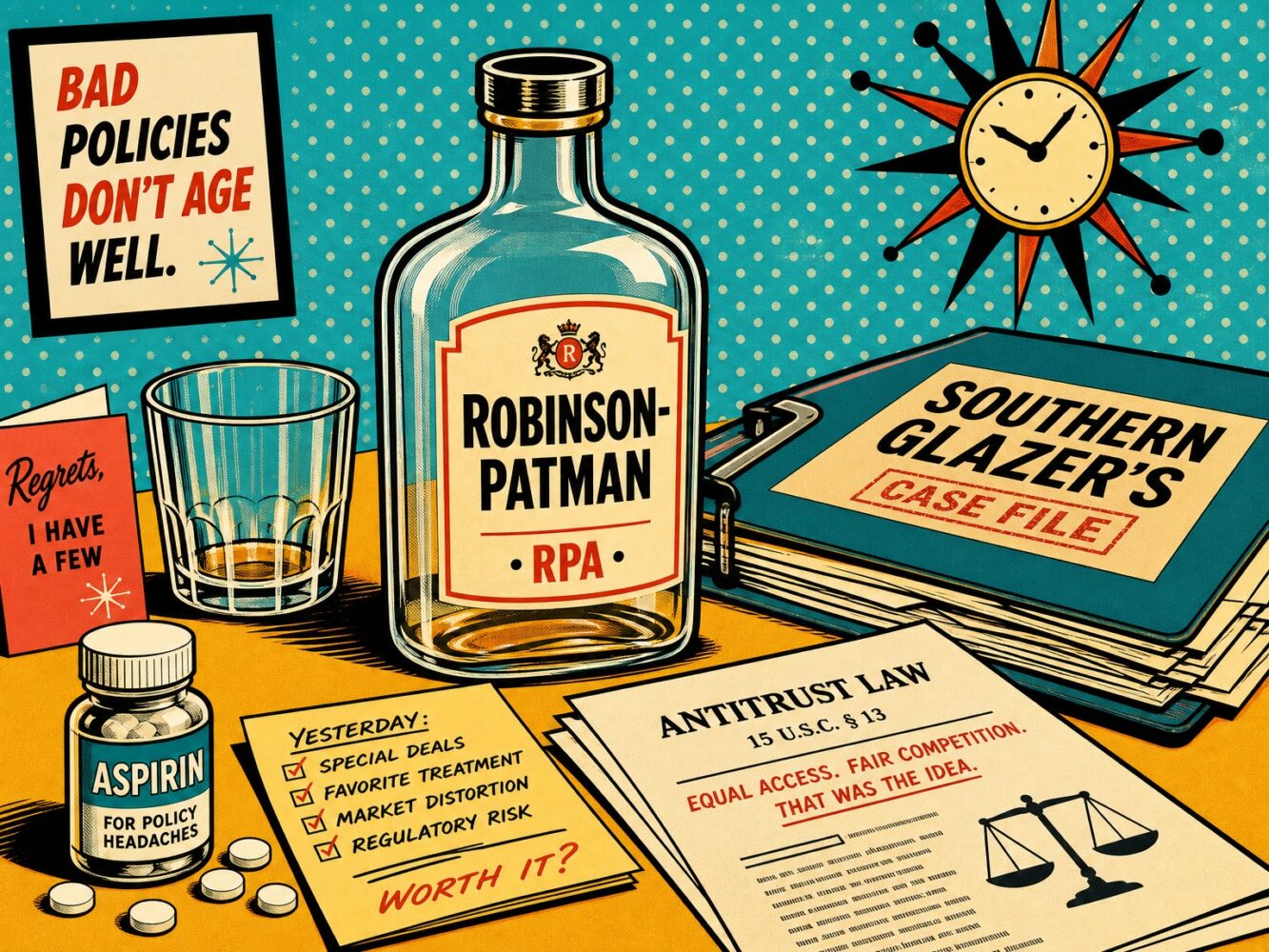
There is no special virtue in seeing a bad case through to the bitter end. At some point, persistence looks less like principle and more like a sunk cost with a docket number.
Last week, I wrote about the Federal Trade Commission’s (FTC’s) appeal in FTC v. Meta Platforms. The appeal seems to me a bad idea.
I quarreled with several points raised by the commission in its opening brief. My main concerns, however, were these: The FTC failed to show that the conduct at issue—two long-ago consummated mergers—caused ongoing harm to competition or consumers. It was also hard to envision a remedy that would benefit competition or consumers if the FTC ultimately prevailed on liability (contingent, of course, on reversal and remand and, then, a new liability decision).
More broadly, it seemed a serious waste of limited agency resources to appear before the U.S. Court of Appeals for the D.C. Circuit in late 2026 to argue for reversal and remand, so that the U.S. District Court for the District of Columbia could reconsider its finding against liability for acquisitions that the FTC investigated, reviewed, and allowed to close without complaint in 2012 and 2014.
In brief, I argued that the FTC exercised its enforcement discretion poorly at several decision points, and perhaps in between them: in 2020, when it rushed to file a weak complaint in the waning days of the first Trump administration; in 2021, when it filed amended complaints following dismissal of the 2020 complaint; in 2025, when it took a flawed case to trial; and now, in 2026, with this appeal.
This post is not about that case. It does, however, share some background concerns with my recent little (or exceedingly long) missive.
The First Rule of Holes
This continues the theme of rational quitting. It’s about the productive application of the sunk-cost fallacy—or, to be precise, the productive application of knowledge of the sunk-cost fallacy. It’s about … enough already. Dayenu!
If you are digging yourself deeper and deeper into a hole, stop digging. Climb out and find another hobby. If you are howling in pain, having shot yourself in the foot, don’t point the gun at your other foot. Head hurts? Stop beating it against the wall. Walk away from your “investment.”
In times of yore—May 2025—I had a post about the Robinson-Patman Act (RPA) with the questioning, if not questionable, title, “RIP RPA?” Did I inquire hopefully? Rhetorically? Does it matter?
The post was prompted by an eminently sensible exercise of enforcement discretion by the FTC under Chairman Andrew Ferguson’s leadership: the May 2025 vote to withdraw one of the two RPA cases the agency had launched, hurriedly, in the waning days of Lina M. Khan’s time at the helm.
To recap, on Jan. 17, 2025, the FTC announced that it had:
sued PepsiCo, Inc. (Pepsi) alleging that the second-largest food company in the world has engaged in illegal price discrimination by providing one customer—a large, big box retailer—with unfair pricing advantages, while raising prices for competing retailers and customers.
The vote took place three days before President Donald Trump’s second inauguration and, as it happened, three days before the new-again president would designate Andrew Ferguson chair of the FTC.
Dissenting from the complaint—or, technically, from the vote to authorize FTC staff to file the complaint—then-Commissioner Melissa Holyoak, now U.S. Attorney for the District of Utah, called it “the worst case” she had seen as a member of the commission:
Today’s Complaint against Pepsi is wholly deficient, not only because the pleadings fail to state a claim, but because the Majority rushed the case out the door before it had evidence to support the allegations. I am astounded that the Majority has such little regard for our staff that it is willing to send them to court like a lamb to the slaughter.
Ferguson was no kinder to his colleagues’ vote to proceed:
The gaping holes in the evidence that Commission staff collected in its limited investigation make it impossible to determine whether the defendant, PepsiCo, Inc. (“Pepsi”), has broken the law. The Commission majority sues Pepsi nonetheless. The paucity of evidence is not a problem for the majority, because the law is beside the point.
Other than that, Mr. Ferguson, how did you like the complaint?
Still Digging
The FTC did not, however, vote to drop the other RPA case, FTC v. Southern Glazer’s Wine and Spirits. Why not?
It’s not that Ferguson thought it was a good case. Like Pepsi, Southern Glazer’s was brought on a party-line vote, with both Ferguson and Holyoak dissenting. (By the way, I recommend both dissents, but especially Holyoak’s thoughtful and scholarly 83-page opinion, at least for readers who want a deeper dive into both the RPA and the FTC’s case. For more from her perspective, see the excellent article she co-authored with Christopher Mufarrige in this year’s Antitrust Law Journal: “From Protecting Competitors to Protecting Competition: The Past, Present, and Future of the Robinson-Patman Act.”)
What was the case about, you ask, having been blessed with the power of forgetting? It’s right there at the top of the complaint:
For years, Southern has violated the Robinson-Patman Act by selling wine and spirits to small, independent “mom and pop” businesses at prices that are drastically higher than the prices Southern charges large national and regional chains. Southern’s discriminatory pricing practices have victimized independent and family-owned neighborhood grocery stores, local convenience stores, and other independent retailers across the country.
Volume discounts? And tigers and bears? Oh my!
For the economists in the audience, “drastically higher” and “victimized” are spin, not legal terms of art. Here, “drastically higher” means higher (plus spin), and “victimized” means relatively disadvantaged (plus spin).
The allegation of higher prices was probably true. There were instances in which large chains received discounts unavailable to smaller buyers making smaller and/or less frequent purchases. The allegation that smaller competitors were thereby harmed? Debatable.
How about harm to competition and consumers? Nope. Not obviously, and not on the face of the complaint, even assuming the allegations to be true and construing them in the light most favorable to the FTC. The complaint included some conclusory mumbling about consumer benefits flowing from enhanced choice through the ad hoc protection of certain smaller retailers, but that gets it nowhere.
Neither Ferguson nor Holyoak was generally opposed to the idea that the FTC might bring an RPA case under the right facts and circumstances. To the contrary, when the FTC first brought the Southern Glazer’s case, Ferguson argued that “[t]he Executive Branch should not categorically and publicly refuse to enforce laws that Congress has passed and the President has signed.” Holyoak made a similar point in her own dissent. Fair enough, in the abstract.
Neither, however, suggested that the commission should bring bad RPA cases, and both were clear that this was one. Ferguson’s dissent identified both legal and factual infirmities. In short, he did “not believe the Commission is likely to prevail even under the traditional, protectionist understanding of the Robinson-Patman Act.”
In other words, the facts alleged seemed a poor fit for the complaint’s theory of liability for “second-line” price discrimination, and that theory itself might prove controversial. He also raised constitutional concerns.
More than that, while Ferguson argued strenuously that the FTC should, as a general matter, enforce the laws Congress has charged it with enforcing—RPA included—he also argued that “the Commission must soundly exercise discretion about when to enforce a law,” and that, in bringing the Southern Glazer’s case, the FTC “exercise[d] its discretion poorly.”
Ferguson argued that the case:
may protect the disfavored retailers who allegedly paid higher input prices than their competitors, but it may do so by raising prices for millions of hardworking Americans.
As Holyoak explained:
Forcing Southern Glazer’s to discontinue supplier discounts—without evidence of harm to competition and consumers—for high-volume retailers may actually harm both intrabrand and interbrand competition. Without volume discounts, retailers supplied by Southern Glazer’s will have less incentive to compete against each other for sales of the same product (i.e., intrabrand competition). And at the same time, wine and spirit suppliers would cut back promotional efforts that drive competition with other wine and spirit suppliers (i.e., interbrand competition). Taken together, by condemning Southern Glazer’s pricing practices without evidence of harm to competition, the Commission ignores the Supreme Court’s most recent Robinson-Patman Act holding in Volvo, along with Supreme Court precedent that cautions against interpretations of the Act that “extend beyond the prohibitions of the Act and, in doing so, help give rise to a price uniformity and rigidity in open conflict with the purposes of other antitrust legislation.” (internal citations omitted)
So much for consumer welfare. And for competition.
As for whether meaningful head-to-head competition among retailers is really at stake … look. I’m sorry. I don’t know who posted this deposition clip, but it’s so cringe—Curb Your Enthusiasm-level cringe—that I’m not entirely comfortable even posting the link. It does not inspire confidence in the expert enforcement agency at which I long, and proudly, toiled.
The Bipartisan Case for Letting Go
Would Congress do well to repeal the RPA? Yes, I say, as do many, many others.
Geoffrey Manne discussed “misguided calls to reinvigorate the Robinson-Patman Act” in congressional testimony in 2022; and here’s Brian Albrecht at Truth on the Market last year. But this isn’t just about the International Center for Law & Economics’ (ICLE) or my own idiosyncratic views. Not remotely.
See, for example, this paper by Bruce Kobayashi, former director of the FTC’s Bureau of Economics, and Tim Muris, former FTC chairman; two papers, among others, by Herbert Hovenkamp—this one, arguing that Congress “fell to interest group politics” when enacting “the Robinson-Patman Act, which subsidizes smaller businesses at consumers’ expense,” and this one, calling the RPA “irritating to almost anyone who is serious about antitrust”; this article by D. Daniel Sokol; this one by Judge Richard Posner; and this l’il old 320-page report issued by the U.S. Justice Department (DOJ) way back in 1977.
And if I might quote the 2007 report of the bipartisan and congressionally mandated Antitrust Modernization Commission:
The Commission recommends that Congress finally repeal the Robinson-Patman Act (RPA). This law, enacted in 1936, appears antithetical to core antitrust principles. Its repeal or substantial overhaul has been recommended in three prior reports, in 1955, 1969, and 1977. That is because the RPA protects competitors over competition and punishes the very price discounting and innovation in distribution methods that the antitrust laws otherwise encourage. At the same time, it is not clear that the RPA actually effectively protects the small business constituents that it was meant to benefit.
Price discrimination—or “price differentiation,” “differential pricing,” etc.—has been studied at least since A.C. Pigou’s and Frank Ramsey’s landmark work in the 1920s, and more recently by Richard Schmalensee, Hal Varian, and Varian and Allesandro Acquisti, among others.
On the one hand, it is well understood that, under certain circumstances, price discrimination can be anticompetitive. But that is not to say that it must be. It need not. Or that it tends to be. Nope.
It is also well understood that price discrimination can increase welfare and, moreover, that it can—and often does—reduce prices for price-sensitive or budget-constrained consumers. For a recent, accessible discussion of when price discrimination might or might not increase the gains from trade, see this piece by my ICLE colleague Brian Albrecht.
The case for repeal never turned on a claim that price discrimination could not possibly be anticompetitive. The questions, rather, concerned the mismatch between the RPA and the cases in which price differentiation might be anticompetitive, rather than procompetitive or benign.
That mismatch has been especially conspicuous in some lower courts, and especially in RPA cases brought by private plaintiffs. Consequently, we have been stuck with excessive incentives for plaintiffs—and the plaintiffs’ bar—to bring bad RPA cases and, at best, an excess of false positives.
Add to that a pointed question: Where are the demonstrable cases of anticompetitive price discrimination that could not be addressed through other provisions of the antitrust laws, including Section 1 or Section 2 of the Sherman Act? For most of us in antitrust law and economics, that is enough to recommend repeal. More than enough.
In brief, the RPA is unnecessary in principle, and it tends to be detrimental in practice.
Where’s the Good Case?
OK, the RPA has not been repealed, so there’s that.
As Holyoak and Ferguson noted in their dissents in Southern Glazer’s, there remains the question of where, exactly, we might find a good RPA case. That is partly a question of facts. It is also partly a question of law, including the Supreme Court’s RPA jurisprudence.
Ferguson and Holyoak found both the facts and the law wanting in the FTC’s Southern Glazer’s case. They were right about that.
Part of the problem is that the RPA’s “progressive” cheerleaders sometimes—or often—prefer to ignore the Supreme Court’s holding in Volvo, while selectively embracing dicta from the same opinion. They are similarly inclined to overlook Brooke Group, where the Court cautioned against interpretations and enforcement of the RPA that are inconsistent “with broader policies of the antitrust laws,” to the detriment of competition and consumers.
Step Away from the Shovel
The Southern Glazer’s case is a case, not a statute or binding precedent. It involves particular allegations under particular facts and circumstances. If it is a bad case—and it is, and they know it—the FTC can drop it without any general repudiation of the RPA or the agency’s statutory mission.
That leaves the proper exercise of the FTC’s enforcement discretion. The puzzle here is that Chairman Ferguson has been right about this case from the beginning. He was right that the FTC is unlikely to “prevail even under the traditional, protectionist understanding of the Robinson-Patman Act,” and he was right that the FTC “exercises its discretion poorly” in bringing the Southern Glazer’s case.
He has also been right—in Pepsi and elsewhere—that the proper exercise of the commission’s enforcement discretion really matters. It matters to avoiding harmful results. It matters to maintaining the agency’s integrity and reputation. It matters to the agency’s ability to marshal its limited resources in service of competition and consumers. Not incidentally, it matters to the district courts, whose dockets are crowded enough without expert enforcement agencies bringing obviously bad cases.
So why didn’t the commission vote to drop Southern Glazer’s when it voted to drop Pepsi? The vote to drop the Pepsi case was 3-0: Ferguson, Holyoak, and Meador against nobody. Presumably, a motion to drop Southern Glazer’s would have prevailed 3-0 or, at worst, 2-1.
The answer: Beats me. I could guess at this or that, but I really don’t know.
One more thing: An old saw says hard cases make bad law. This is not a hard case. Or it shouldn’t be. And there’s the rub: Easy cases can make bad law, too.
But there’s still time. You, FTC, can drop it. You’ve shown that you can drop a bad case. It is not too late to save a perfectly good foot.
Better to limp away than fall on your face. Don’t ask me how I know.
