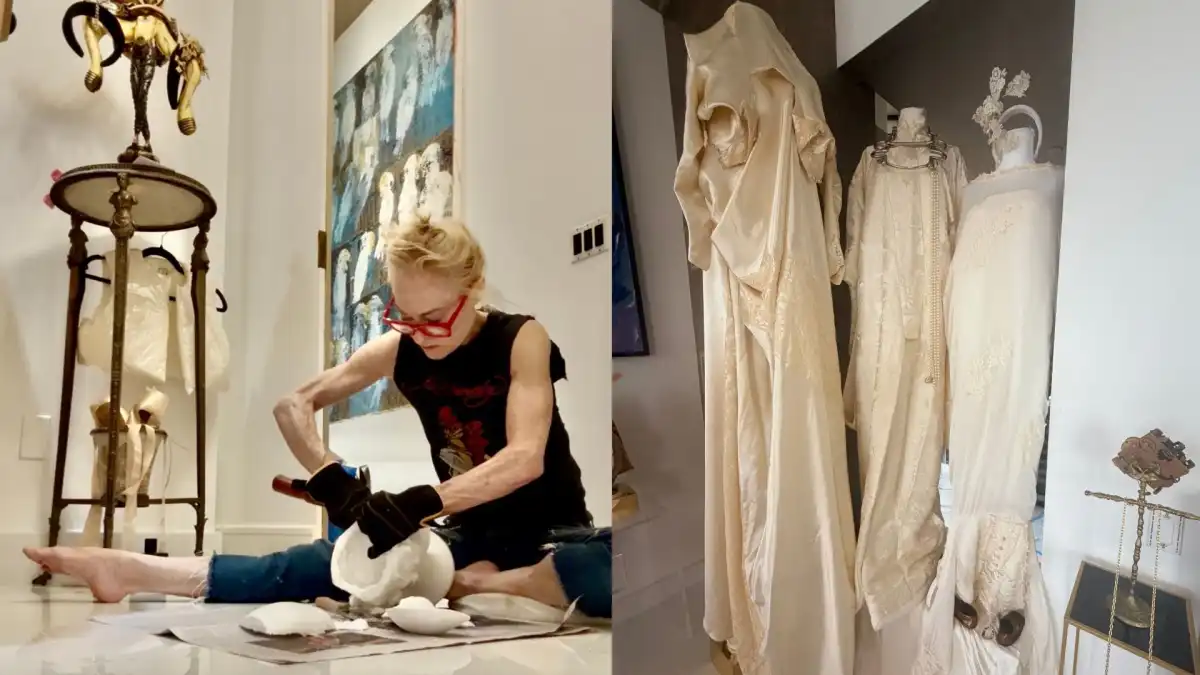
To enter Robin Cofer’s studio is to step into a fever dream of cultural inheritance, feminist reckoning, sacred theater, and strange, glittering devotion. It does not feel like a conventional artist’s workspace so much as a magical traipse through history, where relics, garments, artifacts, and fragments hum with their own private liturgy. There are objects from the Qing dynasty, ancestral pieces passed down through generations, and remnants from great-grandparents who clearly understood that taste, when sharpened by care, becomes its own moral language.
Cofer’s world is not arranged for passive viewing. It is built as a field of encounter. Vintage wedding gowns hang upside down, pale and spectral, their fabric cascading with waif-like vulnerability. At first, they appear romantic, even ethereal. With a second glance, the spell darkens. These suspended bridal forms become symbols of the patriarchal demand for wistful ignorance, the centuries-old insistence that women float through ritual beautifully, obediently, and without full knowledge of the bargain being made around their bodies.
Her masks will stop you in your tracks. Some sparkle with dangerous delicacy, bare and stunningly beautiful, while others arrive disorienting, crimson-drenched, and psychologically loaded, layered with odes to Jesus of Nazareth, his sacrifice, feminist power, and the exposed nerve of vulnerability. They are not masks in the decorative sense. They are thresholds, concealing and revealing at once, asking what the face has been forced to perform and what kind of holiness might still emerge from rupture.
Her headpieces, now made only on a commission basis, extend this language of adornment into another realm entirely. They are marvels of texture, shine, and power, equal parts ceremonial object, sculptural crown, and private mythology. Unsurprisingly, they possess the kind of magnetism that makes one want to own one immediately. They transform the body into an event, a vessel, a figure of command.
Within these works, Cofer collapses the distance between martyrdom and womanhood, between religious sacrifice and the historical demands placed upon the female body. The crimson surfaces suggest offering, violence, devotion, inheritance, and consequence. Their beauty is immediate, yet never easy. It pulls the viewer close before making clear that looking itself is implicated. To stand before them is to feel the strange power of adornment after suffering, the possibility that ornament can become armor.
There is something deeply unsettling, and inarguably powerful, about the way Cofer understands beauty. She does not reject it. She weaponizes it. In her hands, beauty is neither ornament nor escape. It becomes testimony, residue, and the thing that survives after violence has tried to make language impossible.
Originally trained as a classical ballet dancer, Cofer brings to her interdisciplinary practice a rare fluency in discipline, endurance, and physical grace. Ballet, after all, is one of the most exquisite lies ever staged: an art form that asks the body to look weightless while enduring pain, to appear effortless while laboring through control, exhaustion, and near-impossible physical refinement. Cofer understands this contradiction from within the body itself. Her work extends from performance into sculpture, installation, photography, video, and material construction, yet the body remains the central altar: witness, vessel, archive, and site where history leaves its bruises.
Her biography reads almost like a pilgrimage through sacred and artistic intensities. She has performed a 20-minute solo en pointe based on the Peacock Myth of India for the Royal Family of Jodhpur at Mehrangarh Fort, collaborated during Miami Art Basel with Onishi Gallery, Altuzarra, and artist Ichiro Tsuruta, completed a residency at Sara K Gallery in New York exploring the male gaze, and presented work internationally from Iceland to Miami to New York. In 2024, two of her headpieces were selected for the Power of Pink exhibition at the Phoenix Art Museum. In 2025, a sculpture and headpiece entered the permanent collection of the Yuan Quan Museum in Anhui, China.
Cofer is also a seminary graduate, ordained priest, and chaplain, a fact that gives her work rare spiritual architecture. Religious iconography appears not as quotation, nor as mere aesthetic flourish, but as a psychological and symbolic vocabulary through which suffering, devotion, mortality, transcendence, and mystery are examined. Her studio feels charged by this double consciousness: the sacred and the wounded held in the same room.

Textiles, paint, organic matter, found objects, historical artifacts, sculptural surfaces, and ephemeral materials become carriers of touch and disappearance. Cofer is drawn to what fades, what decays, what remains only in fragments, and what refuses to vanish entirely. She is not simply collecting old things. She is listening to them, allowing material to hold the pressure of hands, families, rituals, belief systems, and inherited trauma.
Her feminism is neither polite nor rhetorical. It is embedded in the work’s very structure. Cofer is concerned with the control, erasure, sanctification, exploitation, and ritualization of women’s bodies across cultures and throughout history. She examines the ways women have been dressed, displayed, silenced, worshipped, punished, desired, and sacrificed, often in the name of beauty, holiness, family, or tradition. Conversely, she also insists on women’s endurance, psychic force, and capacity to transform suffering into witness, and witness into art.
With this in mind, her upcoming 2027 exhibition at AP Art Space in Chelsea feels not only fitting, but inevitable. The scale, force, and monumental psychological energy of Cofer’s work require a setting capable of holding both its beauty and its rupture, its theatricality and its spiritual severity. AP Art Space offers precisely that kind of contemporary stage, strong enough to meet a practice that moves between relic, body, myth, and indictment. Further details will follow, though this is certainly one to watch.
Robin Cofer does not make work that merely asks to be looked at. She makes work that asks to be survived. Within her universe, beauty persists not as softness, but as proof of spiritual stamina. Ruin does not erase the sacred. It reveals it.
ROBINCOFER.COM
