There is a particular kind of New York hunger that arrives when summer is only beginning to show its teeth, when the weather has warmed just enough to make the city restless, yet not enough to fully satisfy the body’s craving for heat, color, and release. At the New York Botanical Garden, that belated arrival of summer feels especially charged: the air, the grounds, the flowers, and the visitors all seem equally thirsty for frivolity, sunlight, sensuality, and the delicious outside-ness of it all. After months of gray restraint, everything suddenly coalesces — weather, environment, memory, pleasure — into a reason to wander again. We are not quite in the full fever of the season yet, which arguably makes the promise of it more intoxicating: the first humid afternoons, the first bare arms in the sun, the first collective permission to step into the garden and let beauty return us to ourselves while, perhaps more importantly, reminding us what still needs protecting.
Unsurprisingly, Flower Power arrives like a gorgeous answer to that seasonal craving. Running from May 23 through October 18, 2026, the exhibition transforms NYBG into a garden-wide meditation on flowers as symbols of peace, love, resistance, pleasure, and environmental consciousness. It is part art exhibition, part horticultural immersion, part historical revisiting, part psychedelic summer dream. The result is an experience that asks visitors to step back in time while, quite pointedly, returning them to the present reality of our relationship with the natural world.
Inside the Art Gallery of NYBG’s Mertz Library Building, the exhibition revisits the creative and social convulsions of the 1960s and ’70s, when flowers became more than pretty motifs. They became emblems of protest, softness, rebellion, and spiritual hunger. Andy Warhol’s Flowers appears alongside the Patricia Caulfield photograph that served as its source material, offering a fascinating reminder that Pop Art, for all its cool remove, was still in conversation with the living world it repeated, transformed, and made newly iconic. Works by Milton Glaser, Joe Brainard, Carlos Irizarry, Corita Kent, and others expand that conversation, placing floral imagery in dialogue with feminism, environmentalism, fashion, music, and the movements that reshaped American consciousness.
There is something deeply impactful about encountering these works not in a sterile white cube, but within the living intelligence of the Botanical Garden. Flowers become political signs, sensual invitations, ecological warnings, and, inarguably, one of civilization’s oldest emotional technologies. Long before we had slogans, branding, or cultural campaigns, we had flowers: carried to graves, pressed into books, exchanged between lovers, painted into altarpieces, woven into hair, raised in protest, and planted in defiance of despair.
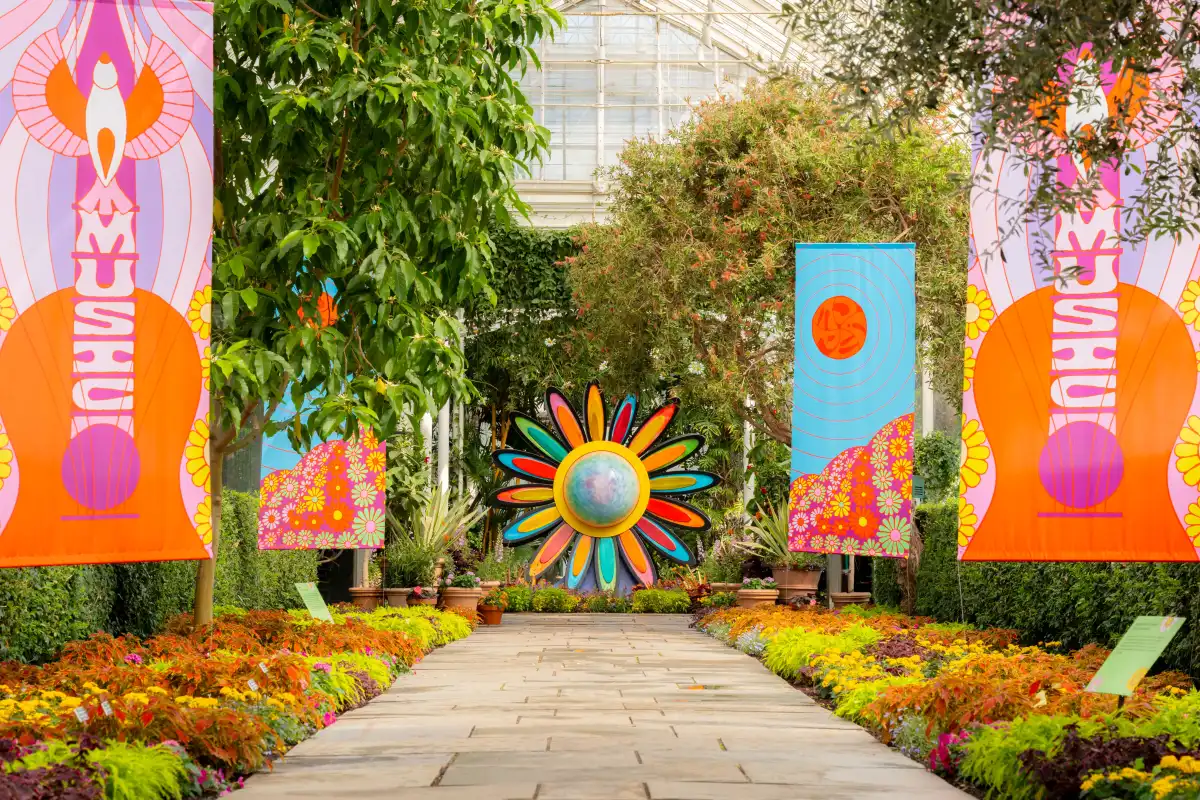
Across NYBG’s historic grounds, the exhibition extends into a glorious outdoor encounter with the era’s visual spirit. A fifteen-foot peace sign filled with live plants welcomes visitors at the Leon Levy Visitor Center, while artist-designed buses inspired by the festively adorned vehicles of the Woodstock generation appear throughout the Garden. Mushuman’s hand-painted fabric canopies on the Conservatory Lawn bring a dreamlike, light-reactive energy to the landscape, while an interactive art fence invites visitors to contribute to an evolving textile work. The effect feels communal without becoming gimmicky, nostalgic without becoming trapped in costume.

Inside the Enid A. Haupt Conservatory, Amie Jacobsen’s monumental daisy sculptures bloom in vivid color among NYBG’s horticultural splendor, creating the rare installation that feels both theatrical and tender. Nearby, the Hardy Pool Courtyard offers water lilies and lotuses as a quieter counterpoint, gesturing toward the 1960s fascination with spirituality, enlightenment, and expanded consciousness. Admittedly, this may be the best kind of summer programming: art that does not ask you to stand still beneath fluorescent light, but instead invites you to wander, breathe, linger, and remember that the body is part of the viewing experience.
With this in mind, Flower Power arrives right on time. In an age of environmental acceleration, cultural fatigue, and digital overexposure, the exhibition offers beauty with a conscience. It seductively reminds us that flowers have always carried the strange double force of fragility and endurance. They wilt, return, seed, bloom, and insist. Perhaps that is why they remain such potent symbols for movements built on hope.

The summer fight, after all, is not merely about getting outside. It is about getting back into proportion. It is about remembering that the world is larger than our inboxes, that history is not dead material behind glass, and that pleasure, when properly understood, can sharpen rather than dull our attention. At NYBG, Flower Power gives us permission to walk through gardens, look closely, listen backward, think forward, and let the natural world remind us what still requires devotion.
For those who want the experience after dark, Flower Power Nights adds live music, Liquid Light Shows, maker’s markets, food, and drink on select evenings, channeling the communal pulse of the late 1960s through a contemporary lens. It sounds, quite frankly, like the kind of evening New York summer promises before humidity and cynicism get involved: music in the air, color on the walls, flowers underfoot, and the temporary belief that beauty might still be a form of revolution.
NYBG.ORG
