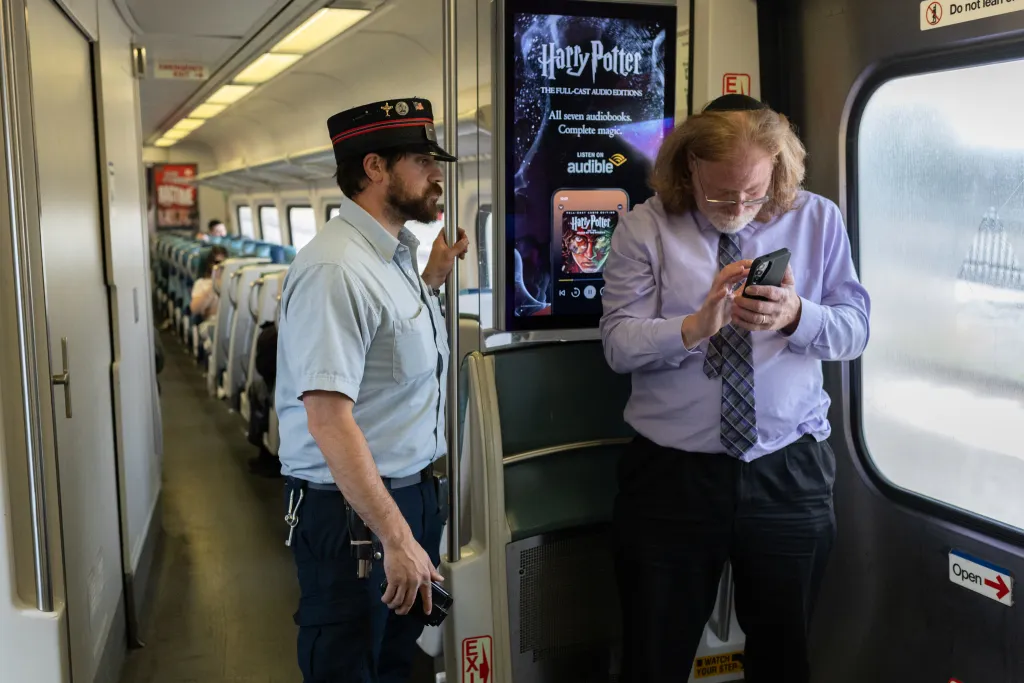
With the Long Island Rail Road on the brink of its first strike in more than 30 years, Gov. Kathy Hochul warned Wednesday that the MTA and riders on the country’s largest commuter railroad “have to be ready for whatever happens.”
Leaders from the MTA and a coalition of five LIRR unions resumed labor negotiations Wednesday in advance of the 12:01 a.m. Saturday strike deadline that could leave close to 300,000 riders from Long Island, Queens, Brooklyn and Manhattan working from home or in search of alternative commutes.
Those could include driving, carpooling or taking shuttle buses between six LIRR stations and a pair of subway stops in eastern Queens: Jamaica-179 Street on the F line and Howard Beach JFK Airport on the A.
“It’s probably going to take me two and a half hours to get to work, so I’m dreading it,” Rossella Mitolo, a legal assistant who commutes between Midwood, Brooklyn and Mineola, said Wednesday morning while waiting for an eastbound LIRR train at Jamaica. “I’m praying that it does not occur — please, please, please, I’ve been so stressed all week.”
At the core of the labor standoff is the unions’ push for 5% worker pay raises to counter inflation and the increased cost of living, with Hochul saying she is committed to keeping the trains running and sparing riders from “unnecessary fare hikes or higher taxes.”
“Yes, workers deserve to be paid fairly for their work, but at the same time, we must be responsible with public funds and the fares paid by Long Island residents,” Hochul said Wednesday at an unrelated event at Jones Beach. “I believe that a deal can be reached here and I’ll continue to urge both sides to work together to avoid a strike.”

Union leaders described Hochul’s recent remarks on avoiding a strike as “encouraging,” but countered that there is still a gap in labor talks between the two sides. Meanwhile, Gary Dellaverson, labor counsel for the MTA, said the latest round of talks marked “the first time that [the unions] actually made a move.”
“To say that we’re close is far-fetched,” said Kevin Sexton, a spokesperson for the LIRR union coalition and a vice president of the Brotherhood of Locomotive Engineers & Trainmen.
LIRR workers last went on strike in June 1994, shutting down service for two days. More recently, New Jersey Transit workers struck for three days last May.
Rob Free, president of the LIRR, said at a Wednesday afternoon briefing that a strike is “the last thing we want.”
“We are trying to negotiate in good faith … we’re making offers, that’s what this is about — negotiations,” Free said. “You may not like the initial offer, but that’s why there’s give and take, alternate proposals.”
Caught in the middle are employers in the city and on Long Island, commuters and businesses that depend on them — especially on the eve of Memorial Day weekend.

“Having no railroad available — which would exacerbate our traffic congestion problem on Long Island — would just be a confluence of many factors that would really be damaging to our economy in the tone of like tens of millions of dollars per day,” said Stacey Sikes, acting president of the Long Island Association, which represents the island’s business community.
According to the MTA, Nassau County accounted for approximately 37% of LIRR ridership in the first four months of 2026, with another 15% from Suffolk County. In the city, Manhattan made up 26% of the ridership, compared with 20% from Queens and 3% from stations in Brooklyn.
If the strike goes through and lasts more than a few days, it could run up against another big to-do directly upstairs from Penn Station: the Knicks playing in the NBA Conference Finals at Madison Square Garden.
Maulin Mehta, New York director of the Regional Plan Association, said a short-term shutdown would be less likely to have “major repercussions” across the regional economy, but warned of the potential fallout of an extended walkout.
“The challenge is more so felt if this drags on for any long period of time,” Mehta said. “That could put jobs in jeopardy if people are starting to spend more time calling out of work because they don’t want to deal with the commute or are unable to get to work because the options that are in place are not sufficient.”
At the commuter railroad’s Locust Manor stop in southeast Queens, rail commuter Maurice Moore said that should a strike happen, he will likely drive his van to overnight shifts as a patient care technician at NYU Langone Health in Manhattan.
“I take the train to save on the cost of fuel,” he said. “If there’s a strike, I still have to go to work, so I will have to take my ride.”
Everyl McMorris, who commutes on the LIRR between her home in Suffolk County and her job in Manhattan, said she was taking some comfort in past labor battles that went down to the wire but didn’t result in a strike.

“We sort of plan for the worst and hope for the best,” said McMorris, who works as a physician’s assistant. “I’ve seen discussions in the past about potential strikes and it hasn’t happened, so I’m hoping that this is just one of those things.”
At the newsstand he operates inside Jamaica Station, Mandeep Talwar said he’s dreading the potential for a subdued Monday morning rush in the transit hub that also features connections to the subway and the JFK AirTrain.
“The strike must not happen, it would be like hell, no person in the station,” said Talwar, who estimated that 70% of his customers take the LIRR. “It will be maybe me alone in the station and no customers.”
“And if there are no customers, what will I do, sit in the station the whole day long? I’d have to close the store.”
Our nonprofit newsroom relies on donations from readers to sustain our local reporting and keep it free for all New Yorkers. Donate to THE CITY today.
The post LIRR Strike Threat Riles Up Commuters Ahead of Weekend Deadline appeared first on THE CITY – NYC News.
