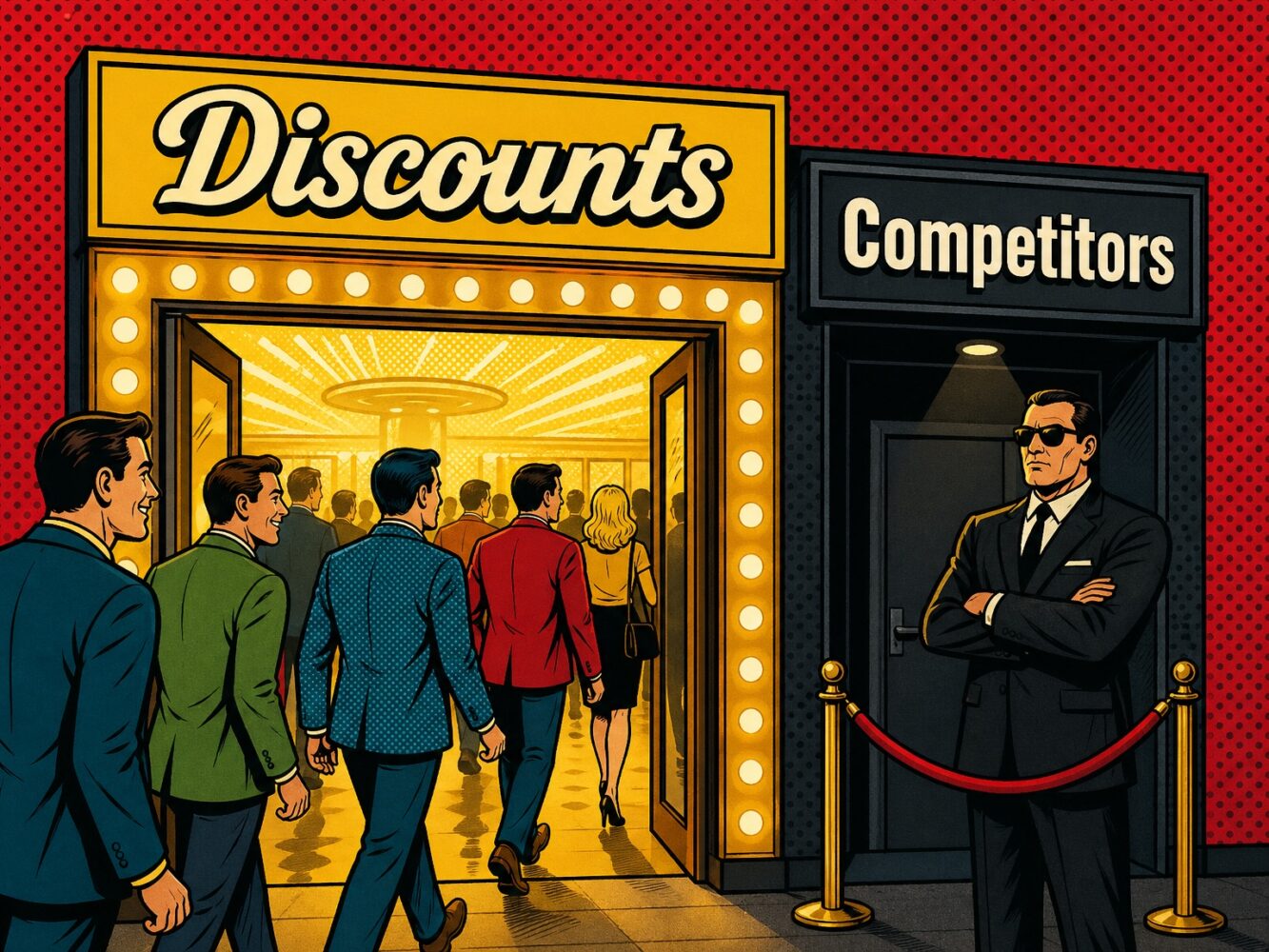
When does a discount cross the line from competition to exclusion? That question now sits before a federal district court weighing the U.S. Justice Department’s (DOJ) antitrust case against Visa Inc. and its debit-card business, where Visa holds a 60% share. In the waning days of the Biden administration, on Sept. 24, 2024, the DOJ filed a complaint in the Southern District of New York alleging violations of Sections 1 and 2 of the Sherman Act under two primary theories of harm.
First, the DOJ claims Visa imposes “de facto exclusivity” on merchants. The theory: merchants route nearly all debit transactions through Visa to hit volume thresholds that unlock loyalty discounts on transaction fees. That, in turn, deprives rival debit networks of the scale they need to compete.
Second, the DOJ alleges Visa neutralizes potential competitors—such as Apple—by sharing monopoly profits through agreements that turn would-be entrants into partners, rather than threats in fintech (i.e., using online technology to deliver financial services).
As to the first theory, the complaint zeroes in on Visa’s use of loyalty discounts, or rebates, to steer transaction routing. Merchants receive these discounts only after hitting volume thresholds—often 90% or more of total debit transactions. Route more to Visa, pay less. Route less, lose the discount. The DOJ argues this structure operates as a de facto exclusive-dealing arrangement that deters merchants from sending transactions to rival networks.
Step back for a moment. Why do merchants have any routing choice at all? If a consumer uses a Visa debit card at the point of sale, doesn’t the consumer decide the network?
Not quite.
In 2010, Congress enacted the Durbin Amendment as part of the Dodd-Frank Wall Street Reform and Consumer Protection Act; it took effect in 2012. The amendment requires that each debit card connect to at least two unaffiliated networks capable of processing transactions. Typically, one network appears on the “front of the card”—Visa, Mastercard, American Express, or Discover—and another on the “back of the card.” That second option usually involves a PIN-debit network with roots in ATM transactions, such as STAR, NYCE, Accel, Pulse, or Shazam. At the point of sale, the merchant—not the consumer—chooses how to route the transaction.
This post advances three considerations for assessing the legality of loyalty discounts.
First, antitrust law generally resists punishing firms for offering lower prices. As a result, claims of predatory pricing (prices so low they force rivals to exit) or exclusionary discounting (pricing structures that induce buyers to concentrate purchases with a single supplier) face well-defined legal and economic hurdles.
Second, the legality of loyalty discounts often turns on two factors: whether the discounts span multiple products, and how much of a buyer’s demand remains “contestable” versus “non-contestable.” For example, if a merchant processes 100 debit transactions per period but only 20 can be routed to a PIN network, the contestable share is 20%.
Third, the DOJ’s emphasis on harm through denying rivals “scale” raises a threshold problem. The complaint never defines scale, specifies the level required for competition, or ties the concept to market-specific evidence.
The High Bar for Attacking Low Prices
As a general principle, theories of harm premised on giving too much of a good thing—e.g., low prices or generous discounting—face an uphill battle in court. Courts hesitate for good reason. Aggressive pricing often reflects the very competition antitrust law seeks to protect, not punish.
Herbert Hovenkamp puts it plainly:
The great majority of discounting practices are procompetitive. Discounts are the age-old way that merchants induce customers to purchase from them and not from someone else or to purchase more than they otherwise would.
To be sure, discounting can harm consumers in narrow circumstances, as the next section explains. The harder problem lies in identifying those cases with any confidence. That task carries real administrative costs. Worse, mistaken enforcement—false positives—can impose significant “error costs” by chilling pricing practices that benefit consumers.
Courts have responded by setting a high bar for claims built on low prices. Predatory-pricing claims, for example, require proof that a firm priced below cost to drive out rivals and later monopolize the market. That standard reflects a broader skepticism: low prices, standing alone, rarely signal anticompetitive conduct.
The same logic applies to rebates. Firms design rebates to induce buyers to purchase more of their product—that is their purpose, whether or not the firm has market power. As a result, analyzing aggressive discounting often mirrors the predatory-pricing inquiry. Discounting may make life harder for rivals, but difficulty for competitors does not equal harm to competition.
As long as the net price remains above cost, the case for liability weakens considerably. As Hovenkamp notes, “above-cost discounts on single products should be regarded as lawful.” (See the section below on why the single-product versus multiple-product distinction matters.) At a minimum, courts should apply a strong presumption of legality and place the burden squarely on the plaintiff to demonstrate anticompetitive harm.
Not All Discounts Are Created Equal
Put simply, loyalty discounts offer lower prices to buyers who meet a purchase threshold. More precisely, Bruce Kobayashi describes them as “a particular form of non-linear pricing in which the unit price of a good declines when the buyer’s purchases meet a buyer-specific minimum threshold requirement.” A 5% discount triggered when a customer sources 80% or more of its requirements from a single seller fits the bill.
These discounts take different forms. When tied to a single product, they are “single-product” discounts. When they span multiple products, they become “multi-product” discounts. For example, a 5% discount that applies only if a buyer sources 80% of both Product A and Product B from the same seller qualifies as a multi-product loyalty discount.
Structure matters, too. Some programs use “all-units” discounts, where the lower price applies retroactively to all units once the threshold is met. Others use “incremental” discounts, where the lower price applies only to units purchased above the threshold. For instance, an incremental schedule might price the first 100 units at $10, the next 100 at $9, and all additional units at $8. An all-units version would apply the $8 price to all units once the buyer exceeds 200.
Under certain conditions, Kobayashi explains, all-units discounts can exclude an equally effective competitor. A key condition is capacity. If a rival cannot match the incumbent’s output, it may struggle to compete for the marginal units that determine whether the buyer hits the threshold. That challenge intensifies with multi-product discounts, where rivals must match capacity across several markets, not just one. Capacity constraints matter most in industries with high fixed and variable expansion costs—e.g., adding production lines or building new plants. They matter less where marginal costs remain low after large upfront investments.
That raises a threshold question for debit-card markets: can rival networks handle significantly more transactions, or do capacity constraints meaningfully limit expansion?
A related issue—and a central feature of the DOJ’s theory—is the distinction between “contestable” and “non-contestable” transactions. The complaint asserts that PIN-debit networks cannot process a meaningful share of transactions for various reasons—e.g., merchants may avoid routing higher-dollar transactions to those networks. From that premise, the DOJ argues that any price-cost test should apply only to the contestable share. If a large portion of transactions is deemed non-contestable, allocating discounts solely to the contestable portion increases the likelihood that the test will show below-cost pricing.
That framing raises its own question: is the DOJ analyzing the right level of competition? Even if certain PIN networks cannot process specific transactions, larger “front-of-card” networks—such as Mastercard, Discover, and American Express—can. The primary competitive battleground may therefore sit at the front-of-card level. If so, that is where contestability should be assessed.
Courts generally evaluate loyalty discounts along one of two paths. If the program reflects legitimate price competition—call it “genuine discounting”—courts apply a price-cost test, which provides a safe harbor when prices exceed an appropriate measure of cost. The details matter, including whether the discounts involve single or multiple products and how courts treat contestable versus non-contestable sales.
If, instead, the program reflects “exclusionary pricing,” courts analyze it under the rule of reason, much like an exclusive-dealing claim. On June 23, 2025, the district court denied Visa’s motion to dismiss. In doing so, the court signaled its approach, finding that “the Government has alleged a plausible exclusive dealing claim.” That does not render the price-cost test irrelevant. It does, however, confirm that the court will evaluate Visa’s pricing in a broader competitive context.
If Everything Is About Scale, Nothing Is
An integral piece of the DOJ’s loyalty-discount theory is the claim that discounting deprives rivals of “scale.” The complaint leans on the concept heavily, alleging—“[p]erniciously”—that Visa’s program “prevents its current and potential rivals from gaining the scale, share, and data necessary to erode Visa’s existing dominance.” The word “scale” appears 40 times.
That emphasis exposes two problems.
First, denying rivals scale—or sales—often reflects ordinary competition. Firms win business; rivals lose it. That is the point. Hovenkamp underscores the issue:
Indeed, one of the problems with the theory that discounts deprive rivals of economies of scale is that the theory does not require a discount at all. The seller who simply sold all of its product at the fully discounted price, without requiring any purchase commitment, would also be depriving rivals of economies of scale.
Put differently, conduct that reduces rivals’ sales may be entirely legitimate. The theory does not distinguish well between hard competition and exclusion.
Second, if “scale” does real work in the analysis—whether as a mechanism of harm or a barrier to entry—the plaintiff must define it and prove it. That requires, at a minimum: (a) specifying the relevant concept of scale (economies of scale, minimum-viable scale, or something else), (b) identifying the level of scale needed to compete or enter, and (c) showing that rivals fall below that threshold.
The DOJ does none of this. Despite invoking “scale” repeatedly, the complaint never defines the term or identifies how much scale competition requires. That omission matters. Replace “scale” with “sales,” and the theory reduces to a familiar—and largely uninformative—claim: discounting “denies rivals sales.” That tells a court little about whether the conduct violates the antitrust laws.
This rhetorical move has become common. Recent complaints from the DOJ and the Federal Trade Commission (FTC) rely heavily on “scale” while leaving it undefined. In the DOJ’s challenge to Google’s search-distribution agreements, “scale” appears 36 times, without definition or supporting evidence. In the DOJ’s Google AdTech complaint, the count rises to 70. The FTC follows the same template. Its complaint against Amazon uses “scale” 76 times, again to argue that the company’s conduct “denies scale” to rivals. The FTC’s Facebook complaint uses the term 24 times—without specifying what level of scale “meaningful” competition requires. Brian Albrecht has noted the same trend in platform cases.
Courts should treat these claims with skepticism. Without a market-specific, evidence-based account of scale, the concept does little analytical work. Hovenkamp makes the point directly:
[The] measurement of scale economies across the full range of a firm’s activities is extraordinarily difficult. A federal court could never apply such theories, particularly in a jury trial, without creating the ‘intolerable risk’ that the Supreme Court feared in Brooke Group, of chilling procompetitive behavior.
Even setting aside the definitional gap, the DOJ’s theory sits uneasily with market realities. Visa’s rivals—Mastercard, American Express, and Discover—process trillions of dollars in transactions each year across debit and credit networks. Calling that a lack of “scale” stretches the concept beyond recognition.
A Test Case for Modern Antitrust
The DOJ’s case against Visa’s debit-card business tees up a central question for modern antitrust: how far courts should go in policing loyalty discounts and scale-based theories of harm. The answer will not stop with Visa. It will shape how enforcers—and courts—approach large, multisided platforms across the economy.
If “scale” remains undefined and discounts remain suspect simply because they work, the risk is clear: antitrust drifts from protecting competition to second-guessing it.
