The first experience of ballet often arrives as a kind of illusion—weightless, effortless, almost untethered from the body itself. One sees grace without strain, precision without calculation, a world that appears to exist outside of time. What remains unseen, at least initially, is the discipline beneath it, the intricate architecture of collaboration that makes such magic possible.
The relationship between music and dance, upon closer consideration, reveals itself as something far more exacting. It is not simply harmony. It is, more precisely, a negotiation. The composer imagines, the conductor shapes, the musician translates, and the dancer embodies. Each exists independently, yet none can fully exist without the others. What emerges is not hierarchy, but trust—delicate, responsive, and, at its best, almost imperceptible.
Backstage at New York City Center, Youth America Grand Prix offered a rare and quietly powerful glimpse into that living architecture. Founded in 1999, YAGP has become the world’s largest ballet scholarship organization, identifying and cultivating young dancers from across the globe and ushering them into the highest ranks of the international ballet world. More than 300,000 dancers have passed through its system, with alumni now performing at institutions such as American Ballet Theatre, New York City Ballet, Paris Opera Ballet, and The Royal Ballet. Its true impact lies not only in placement, but in its cultivation of artists who understand that excellence is inherently relational.
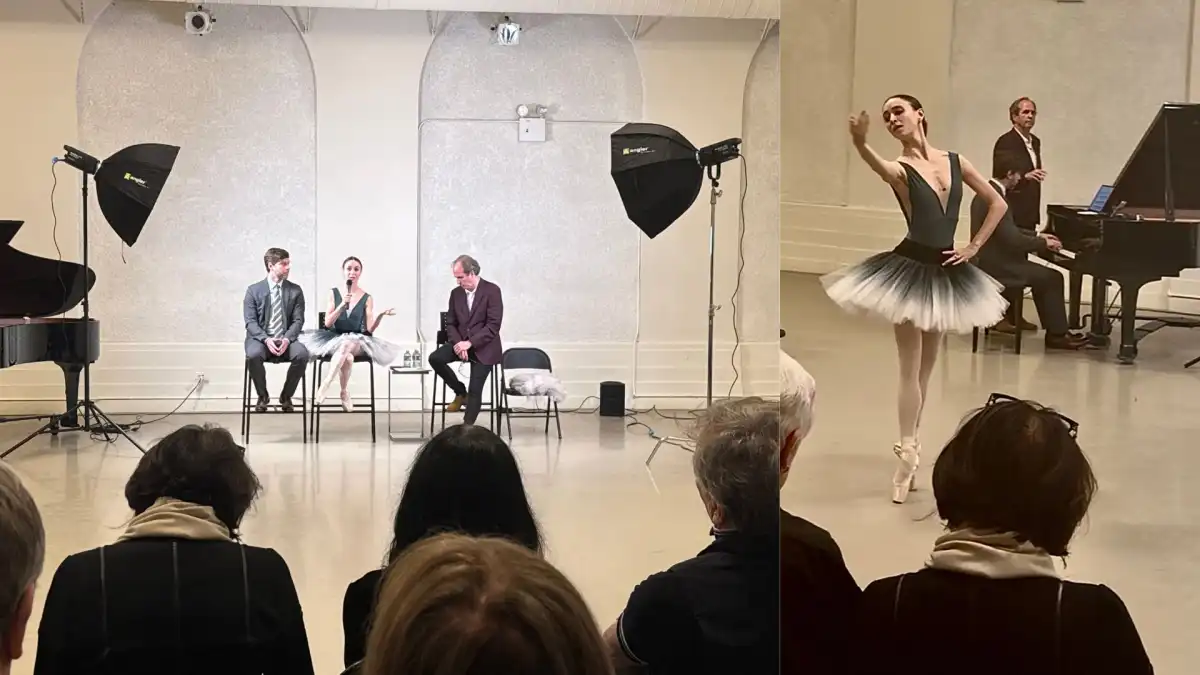
Under the direction of Charles Barker, whose work with American Ballet Theatre has positioned him as a vital force within ballet’s musical ecosystem, the afternoon moved from discussion into demonstration. A metronome was introduced—unyielding, precise, authoritative. The music followed. The dancer followed. Everything was correct, almost impeccably so.
The metronome was then removed.
What remained was something altogether different. The music began to breathe. The body responded. Time loosened, almost imperceptibly at first, then with growing confidence. Emotion entered. The shift was immediate, though perhaps more importantly, it was felt before it was understood.
“Rhythm is within us,” Barker remarked, a line delivered with quiet clarity that lingered long after.
That distinction—between imposed structure and internal rhythm—reveals the deeper philosophy of performance. Technique is essential, though it is only the beginning. What follows is far more elusive: the ability to feel, to listen, to trust that the body and the ear will meet without force, without overcorrection, without fear.
To watch Skylar Brandt, one of the most compelling principal dancers of her generation, is to witness that trust fully realized. Her movement is remarkably precise—arguably even perfect in its execution—yet never rigid. There is an uncanny relationship to music that reads less as interpretation and more as inevitability, as though each phrase originates from within her rather than being placed upon her.

Beside her, Vladimir Rumyantsev revealed an equal intensity at the piano, his playing carrying a depth of emotion that seemed to emanate directly from the keys—disciplined, yet never constrained. A certain sensitivity in his phrasing allows the music to unfold rather than be imposed.
His upcoming performance offers an opportunity to experience that sensitivity more fully. On May 16, 2026, at Stern Auditorium / Perelman Stage at Carnegie Hall, Rumyantsev appears as a Steinway Artist alongside Daniel Zinn for an evening of Romantic piano music inspired by the moon. The program includes Moonlight Sonata and Clair de lune, among other works that occupy that luminous space between structure and feeling, paired with the stories that so often remain absent from formal program notes.
What becomes evident is that this entire system depends on something more fragile than precision. It depends on empathy. Each participant must listen, adjust, yield, and assert in equal measure. Control must exist, though it must also be relinquished at the right moment.
YAGP’s role in cultivating this understanding cannot be overstated. It does not merely train dancers in technique. It introduces them to a language of responsiveness, of connection, of artistic intelligence that extends far beyond the studio.
What appears effortless on stage is, in truth, the result of a constant, living exchange—one that resists rigidity in favor of responsiveness, one that replaces control with trust at precisely the right moment.
The metronome may guide, at least initially.
The music, ultimately, must be felt.
Yagp.org
