Gail Slater has left the building. And that’s a shame, I think.
On Feb. 12, Slater posted the following on X:
It is with great sadness and abiding hope that I leave my role as AAG for Antitrust today. It was indeed the honor of a lifetime to serve in this role. Huge thanks to all who supported me this past year, most especially the men and women of @justiceatr
That was a short tenure. The Senate had confirmed her only 11 months earlier. Some reports said she resigned or “stepped down” (here and here). Others suggested she had been fired (here and here).
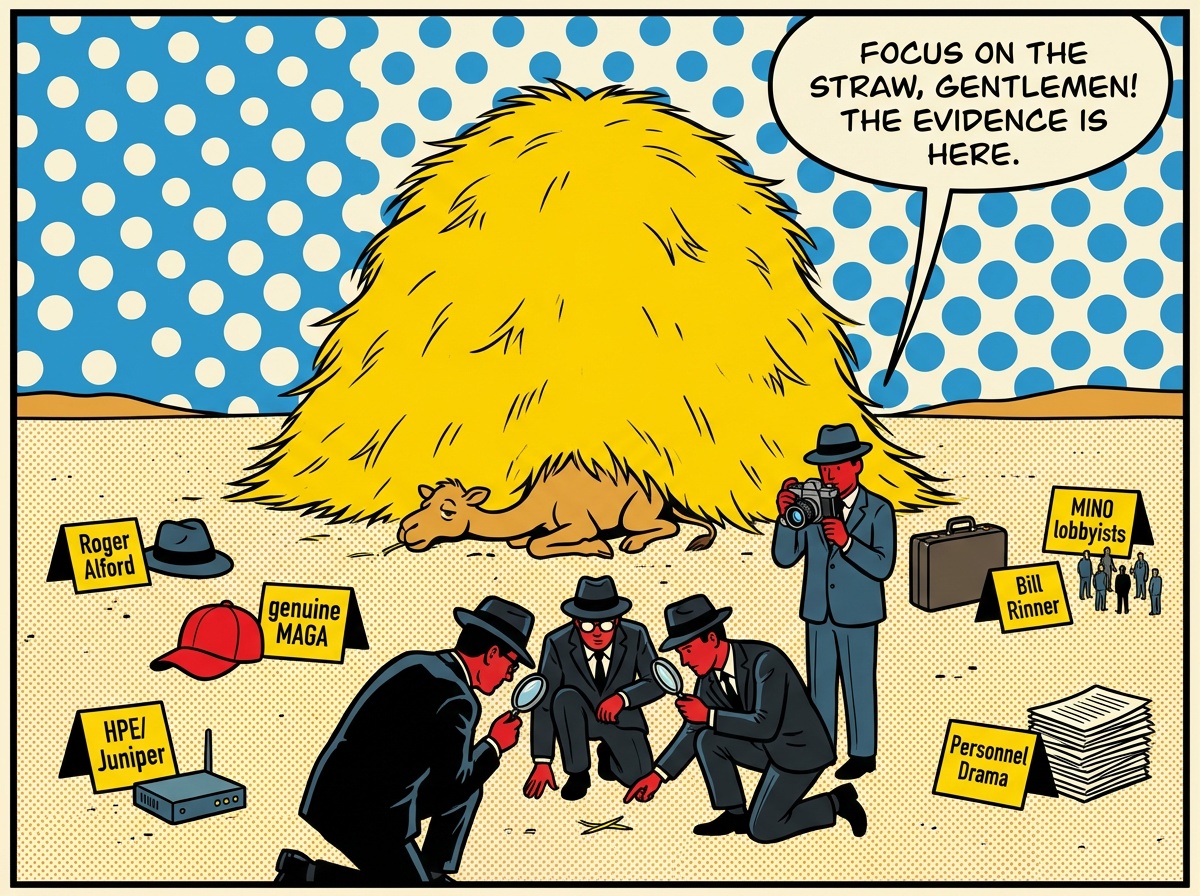
If you want inside details, you’ll have to look elsewhere. I don’t have them. But tension between the Antitrust Division and U.S. Justice Department (DOJ) leadership has been public since at least late July 2025, when reports said two senior division officials—Roger Alford and Bill Rinner—had “been fired for insubordination,” and not by Slater (see here and here).
Alford then complained about what he called the “HPE/Juniper merger scandal” and undue interference from “MAGA-In-Name-Only lobbyists and DOJ officials enabling them.” The episode was puzzling. Merger decisions traditionally sit with the division. On the other hand, no one seemed to know what “genuine MAGA” antitrust meant, and the case itself never appeared especially strong.
I covered the dispute here and here. For those keeping score at home, the division’s complaint is available, along with analyses of the now-settled case by my former Federal Trade Commission (FTC) colleague John Yun (here and here), and commentary by Alden Abbott, another former FTC colleague and former FTC general counsel.
Things did not settle down after that. Coverage has appeared here, there, and everywhere, but I cannot tell which straw broke which camel’s back.
I knew Gail from our time at the FTC. She was smart, thoughtful, and unfailingly collegial. I have been more puzzled by her later embrace of the big-is-bad, anti-tech posture associated with the neo-Brandeisian turn. Large firms can, of course, violate the antitrust laws. The generalized crusade against large tech companies, however, has been overbroad and thinly evidenced, and by not a little bit. The effort to articulate an “America First Antitrust” has remained a muddle, and the effort to implement it has been costly.
Still, as I wrote in September, the conflict between the division and senior DOJ leadership was both worrisome and confusing.
On the one hand:
As a formal matter, the U.S. attorney general is head of the department and does have administrative authority over the division. It’s not obvious that this authority should never be used.
On the other:
…there are at least strong pragmatic reasons to think that such authority should be used sparingly—indeed, rarely, when it comes to decisions about specific investigations, cases, and settlements. High-level policy may be the realm of the AG and, ultimately, the president, but high-level policy can only say just so much about the proper outcome in a matter subject to the rule of reason (something agency leadership under the Biden administration sometimes forgot).
That is the real concern. An administration gets to appoint the assistant attorney general for antitrust, and it gets to remove her. But if the AAG is no longer Gail Slater, who will it be—and how, exactly, is the division supposed to do its work?
Hope Springs Eternal (in the Appellate Courts)
Recently, I noted that the FTC plans to appeal its loss in FTC v. Meta to the U.S. Court of Appeals for the D.C. Circuit. That still strikes me as futile and a questionable use of agency resources, but I won’t relitigate the point here. As I said at the time, “[t]he appeal itself is not yet public, but I look forward to reading it—with interest, if not amazement.”
Since then, the agency has taken another hit in federal court.
On Feb. 12, Judge Jeremy D. Kernodle of the U.S. District Court for the Eastern District of Texas ruled against the FTC in Chamber of Commerce of the United States v. FTC. The parties had filed cross-motions for summary judgment. The Chamber argued that the FTC’s new Hart-Scott-Rodino (HSR) form resulted from “arbitrary and capricious” rulemaking under the Administrative Procedure Act and exceeded the commission’s statutory authority because the required information was not “necessary and appropriate.” Judge Kernodle agreed, vacated the final rule, and stayed his order for seven days to allow the FTC to seek emergency relief from the U.S. Circuit Court of Appeals for the 5th Circuit.
The FTC has asked for a stay, pending appeal. And the response has been… colorful.
Reuters reported that an FTC spokesperson described the Chamber as “a left-wing, open borders supporting activist group,” a statement confirmed on X by FTC Director of Public Affairs Joe Simonson. Odd. Some readers may recall Simonson’s ill-advised—and grossly inappropriate—attack on Judge James Boasberg after the Meta decision. At least this time the target is not a sitting federal judge (a Trump appointee, as it happens). The Chamber, famously, is a pro-business trade association. Left wing? Perhaps he was joking.
But I digress.
In June 2023, the FTC published a notice of proposed rulemaking announcing amendments to the premerger-notification rules implementing the Hart-Scott-Rodino Antitrust Improvements Act and to the premerger-notification and report form and instructions. Updating the form was not unusual. As I observed then:
As far as I know, nobody at the commission thought the prior form perfect. It had been amended many times before, although many (not all) of the changes were minor, and some have been required by statute.
The problems lay in the details—and there were many problematic details. Objections were plentiful. I am partial to the comments we at the International Center for Law & Economics (ICLE) submitted in September 2023. The proposed form required a great deal of information with no obvious connection to preliminary merger screening. For example, filing firms had to report:
…any penalties or findings issued against the filing person by the U.S. Department of Labor’s Wage and Hour Division (WHD), the National Labor Relations Board (NLRB), or the Occupational Safety and Health Administration (OSHA) in the last five years and/or any pending WHD, NLRB, or OSHA matters. For each identified penalty or finding, provide (1) the decision or issuance date, (2) the case number, (3) the JD number (for NLRB only), and (4) a description of the penalty and/or finding.
As I wrote at the time:
…the proposed revisions are controversial because they promise to make pre-merger filing more cumbersome and, not incidentally, more costly, and it’s not at all clear what the payoff is likely to be. The FTC estimates that the new information will impose “approximately $350,000,000 in labor costs” on filing parties. And even in Washington (and even at this late date), a few hundred million here, and a few hundred million there, and pretty soon you’re talking real money.
The FTC figure seemed, charitably, a guesstimate rather than a serious estimate. Further, as Douglas Melamed asked:
The agencies have pretty much free reign with 2d requests. Does the FTC identify any basis to think that the absence of the additional information they propose requiring with initial filings has in the past led to a failure to issue a second request on anticompetitive mergers?
Then-Commissioner Andrew Ferguson later called the original NPRM a “nonstarter” that could not have survived judicial review.
To be fair, the final rule issued in November 2024 was better–at least much less bad–than the initial proposal—but significant concerns remained. Commissioners Ferguson and Melissa Holyoak each noted reservations while accepting the compromise. Ferguson wrote:
Were I the lone decision maker, the rule I would have written would be different from today’s Final Rule. But it is a lawful improvement over the status quo. And although not required for the Final Rule’s lawfulness, the Commission wisely accompanies the Final Rule with a lifting of the ban on early termination. I therefore concur in its promulgation.
Holyoak’s concurrence cataloged numerous ways the final rule improved on the NPRM. And they were both right that the agreement to reinstate early termination was an added benefit, if orthogonal to the revised form and the challenge to the rule.
Ferguson’s apology notwithstanding, Judge Kernodle was not persuaded that the FTC had done the work required to make the rule lawful. Specifically, he found that the FTC had failed to justify the burdens the rule imposed:
Though the FTC asserts that the Rule will detect illegal mergers and save agency resources, the FTC fails to substantiate these assertions. The Final Rule is therefore not “necessary and appropriate,” and the statute “does not authorize [the FTC] to promulgate [the Final Rule].”
Quoting the 5th Circuit’s decision in Mexican Gulf Fishing Co. v. U.S. Dep’t of Commerce, he wrote that the FTC “failed to consider an important aspect of the problem,” namely whether the rule’s benefits bore a rational relationship to its costs. Among other things:
…although repeatedly asked, counsel for the FTC could not identify a single illegal merger in the forty-six- year history of the prior Form that the Final Rule’s new form would have prevented.
The opinion echoes Melamed’s concern, and those my colleagues at ICLE and I raised, along with many others.
Importantly, this was a procedural defeat. The court did not hold that FTC could not have justified the provisions of the final rule. It held the FTC had not done so, as required.
Will the FTC lose on appeal? I’m not sure.
Better process often produces better substance, but former Chair Khan’s effort to “streamline” agency procedures has yielded neither. That was even more clear in her amendments to Section 18 (Magnuson-Moss) rulemaking process (see the dissent from former Commissioners Christine Wilson and Noah Phillips), but it ran across investigations and the agency’s attempts to “expedite” Part 3 administrative hearings by sidelining administrative law judges. Expediency and enhancement of the Chair’s authority as first-among equals on the Commission seemed more the point, as we saw in the FTC’s rush toward the now-vacated and withdrawn noncompete rule (see Judge Ada E. Brown’s vacatur order).
As my colleague Gus Hurwitz recently put it: “Putting aside the Khan FTC’s (poor) enforcement win rate, it’s hard to imagine a worse admin law record than theirs.”
Ferguson and Holyoak agreed to the rule Kernodle vacated, but it was a compromise—and not their process. Rather than litigating, the commission might do better to determine which reporting requirements are actually cost-justified and then support them with a serious evidentiary record. Some surely could pass muster.
On the other hand, courts often forgive thin cost-benefit analysis in administrative law. The statutory framework here imposes a heavier burden on the FTC, and the 5th Circuit will notice, but this appeal seems less obviously futile than the Meta appeal. The real question is whether the FTC itself demands both sound process and sound substance.
And that’s not all. There have also been settlements (the Express Scripts matter is interesting), warning letters—including a curious note from Chairman Ferguson to Apple CEO Tim Cook—and the ongoing Robinson-Patman saga. Alden Abbott has written on the Southern Glazer’s case, which new leadership should have dropped, just as it withdrew the PepsiCo RPA case that Ferguson called “one final insult to the Commission, its staff, and the rule of law,” and Commissioner Holyoak called the “worst case I have seen in my time at the Commission.” Both dissented from bringing the Southern Glazer’s case in the first place, yet it continues. And that’s before we even get to the states (California—oy, don’t get me started).
I’ll take up some of that next week. For now, that’s enough agency drama.
