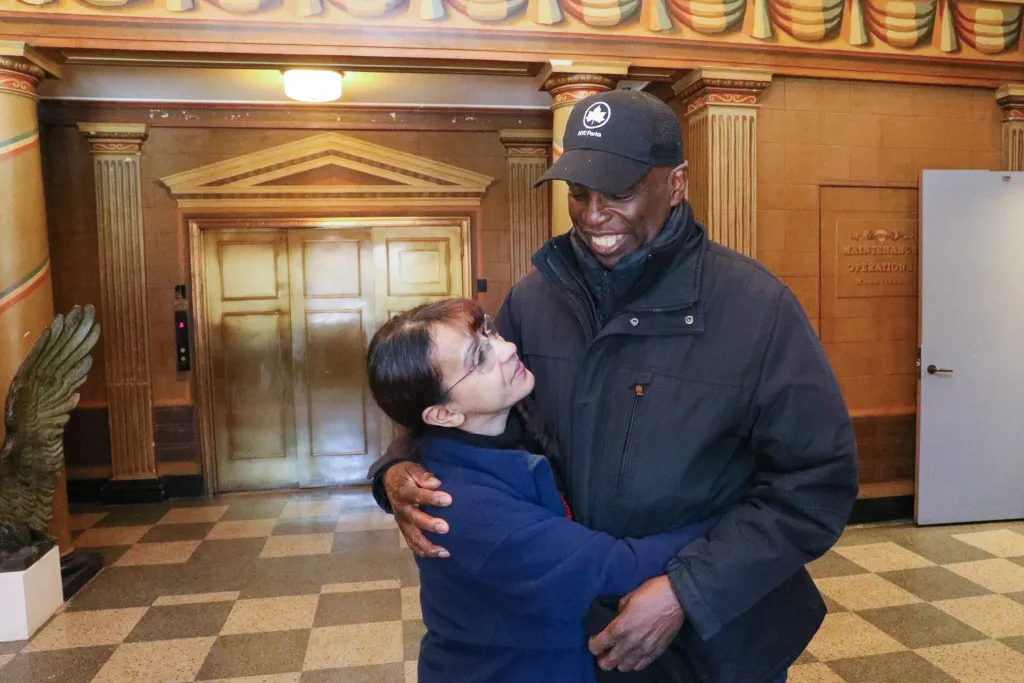
Malcolm Pinckney first turned fascinated by images as a child within the Bronx who questioned how a picture was captured.
That curiosity launched a 50-year profession with New York Metropolis’s Parks Division, capturing ribbon cuttings and live shows and a altering metropolis earlier than he retires subsequent month.
“I at all times had this curiosity of how a picture is placed on paper,” he stated. “I simply needed to discover out.”

The curiosity grew for Pinckney when he began taking images courses at Haaren Excessive Faculty in Manhattan, which closed within the late Seventies and now homes John Jay Faculty.
Every scholar created their very own pinhole digicam and was then instructed to exit, take photos, develop them, make a contact sheet after which create a print.
“It was a problem,” stated Pinckney, 71, who largely captured landscapes and buildings outdoors as a result of the pinhole digicam wanted plenty of mild. He later purchased his first digicam, a Cavalier, at Willoughby’s digicam retailer in Manhattan, which allowed his curiosity to develop, he stated.
Pinckney’s profession with the Parks Division started within the mid-Seventies educating primary images to senior residents on the newly-opened St. James Recreation Heart within the Bronx.
Across the similar time, he began taking courses at Bronx Group Faculty. “What I discovered on a Monday, I might educate them on a Wednesday,” he recalled with fun.
He would additionally {photograph} occasions contained in the rec heart, which was practically brand-new on the time and constructed via group advocacy.
“Once they got here, they noticed their image on the wall,” he stated of his college students and different older adults who got here via. “They felt like stars.”
Whereas working as a recreation assistant he was despatched all the way down to Parks Division headquarters inside The Arsenal, a hulking workplace constructed inside Central Park within the 1800s as a storage repository for munitions.

Pinckney was selecting up photographs of the Robert Moses period on the archives when he noticed his personal future.
“As soon as I got here down right here and I noticed the setup, I stated, ‘That is the place I gotta be, I’ve to get down right here some form of means,’’ he stated. “It took about 10 years earlier than I really ran it down right here.”
As soon as employed as a employees photographer, he started modernizing the division’s work, at a time after they had three darkish rooms and had been anticipated to traverse town capturing, creating, and distributing photographs, largely to information retailers.
He satisfied the parks commissioner on the time, Henry Stern, that purchasing a more recent, extra trendy machine to develop movie may assist them take extra photographs and distribute them sooner.
Stern was well-known for giving nicknames to Parks employees and others — greater than 9,700 by the point he retired in 2001. However Pinckney picked his personal “park title”: Cinema, brief for cinematographer.

“Lots of people had been afraid to face as much as him on that situation,” Pinckney stated of the previous commissioner. “However I wasn’t going to let him decide one for me.”
Within the many years since, he’s watched the expertise of images change. The Parks Division at all times made certain he had up to date tools, however a photographer’s innate capacity to seize a scene issues extra, he stated.
“The expertise form of makes the job simpler, however images is images,” he stated. “You possibly can be taught to function a number of various kinds of cameras, however you continue to must have an perception, and in addition a want to do the work. We reap the benefits of the instrument that’s put out.”
Whereas Pinckney counts W. Eugene Smith and Gordon Parks amongst his influences, he stated he spends extra time taking photographs than trying on the work of others.
“Once I exit, I get the fundamentals. I do know what the press workplace wants and what they’re going to be requested about,” he stated.
“What I attempt to do is put a inventive edge on it, attempt to current it in a extra inventive means.”
Along with his work with the Parks Division, Pinckney spent two years because the nights and weekends photographer for Mayor David Dinkins, clocking out from his work with Parks to work at Metropolis Corridor and Gracie Mansion.
It was how he had the chance to {photograph} one in every of his most memorable occasions: Nelson Mandela getting the important thing to town at Metropolis Corridor Park.

His favourite assignments had been pool and seashore openings, he stated. One memorable expertise was lastly capturing photographs of Excessive Bridge, which connects Manhattan and the Bronx and had been closed for 40 years earlier than reopening in 2015.
And he beloved the star-studded occasions and live shows, too.

“If it landed on Parks property, I’ve to get it,” he stated. His favourite was photographing Parliament Funkadelic’s 2006 efficiency at Summer season Stage, when the Mothership landed in Central Park.
He was there for difficult occasions, too, like after Hurricane Sandy wrecked numerous Parks Division properties in 2012.
“If you’re a profession Parkie, it hits you that so many individuals labored on getting this piece of land in a sure means for the residents to take pleasure in,” he stated.
“And then you definitely see it’s completely torn up, and you know the way lengthy it’s going to take to get it again.”

Pinckney hopes to proceed taking photos effectively into retirement, and in addition desires to be taught video enhancing.
However his years as a Parkie will at all times imply rather a lot to him, he stated.
“I’ll miss the entire thing.”
Our nonprofit newsroom depends on donations from readers to maintain our native reporting and hold it free for all New Yorkers. Donate to THE CITY at the moment.
The submit A ‘Parkie’ Photographer Appears to be like Again on 50 Years appeared first on THE CITY – NYC Information.
