
PARADISE, Calif. — Surveying the wreckage in the weeks after the Camp Fire — tens of thousands of people displaced, 85 percent of the town’s buildings destroyed and all but one campus of Paradise Unified School District damaged — it was hard for Jake Timm to imagine when or if the town’s population might recover. It could be 15 or 20 years before enough students returned to fill the schools in the Northern California community, thought Timm, the district’s director of facilities, maintenance and operations.
“I don’t think we knew exactly what we were stepping into,” said Timm. “Especially when we got up here after the fire to assess the damage, when part of the town was still smoldering.”
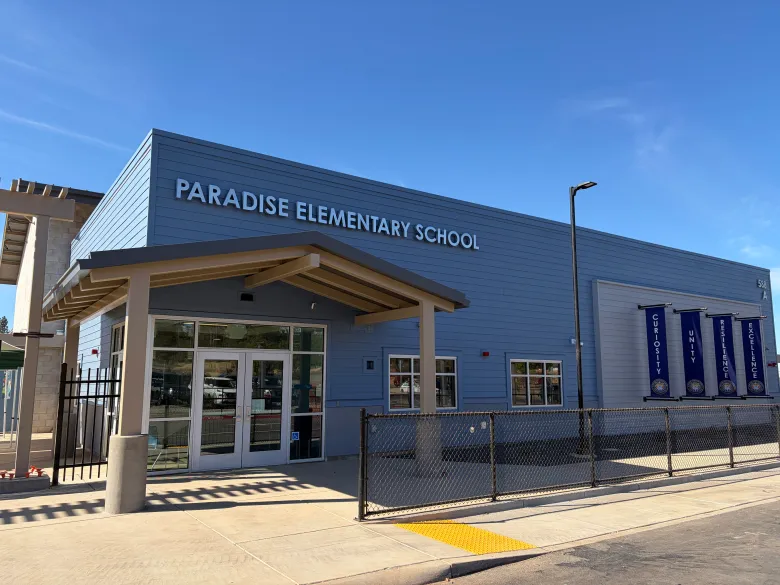
But after falling precipitously in the years after the 2018 wildfire, California’s deadliest on record, the district’s enrollment began to rebound. Today, it’s up to 1,817 students — still just 53 percent of enrollment pre-fire but enough for the district to speed up the timeline for rebuilding its second elementary school in Paradise to meet demand. This fall the school became the last of the district’s campuses to reopen post-fire, and there are already plans to add new classrooms. An average of just over 80 new students arrive each year.
School districts across the country are dealing with sharp enrollment declines brought about primarily because of falling birthrates, and California’s drop is among the most pronounced. But in Paradise, district officials are seeing an unexpected increase in younger students, as more young families relocate to the area, drawn by its relative affordability and new development.
Still, even as Paradise Unified School District completes the physical rebuilding process, lingering effects on academics show the long tail of post-disaster recovery.
Over a quarter of Paradise Unified’s students are chronically absent, a rate that’s more than 10 percentage points higher than the state average. Graduation rates and state test scores have also suffered.
That aligns with the growing body of research on the impact of wildfires and other disasters on education. In the short term, disasters and extreme weather can lead to increased absences and adverse learning outcomes. Longer term, research has linked experiencing a natural disaster to fewer years of total schooling completed, which in turn can correlate to reduced higher education outcomes and potential lifetime earnings.
And recovering from wildfires and other disasters is becoming an increasingly common challenge for school districts in California and elsewhere, as climate change drives more frequent extreme weather events and more severe disasters. Approximately 25 percent of public schools in the U.S. are located in census tracts designated as very high risk from at least one environmental hazard, including coastal flooding, hurricanes, heat waves and wildfires, according to research from Brown University’s SustainableED initiative. In the coming years, more of them will face difficult questions about if, and how, to rebuild.
Related: When natural disasters strike, these camps give kids a safe place to recover
When Southern California’s Pasadena Unified School District — which faced declining enrollment for over a decade before the January 2025 Eaton Fire destroyed more than 9,000 buildings — weighed consolidating its schools earlier this year, families were outraged. Students who lost their homes in the fire said their still-standing schools offered stability and community; in a local editorial, one parent questioned why the district would consider closing schools so soon after the fire, when rebuilding might draw more families.

And after the 110-year-old King Kamehameha III Elementary School was destroyed in the August 2023 Maui wildfires, the majority of community members wanted the historic campus rebuilt in the same location. But state education officials said the campus couldn’t be rebuilt there because of limited space, flood risk and other factors, and instead chose a different site about a half-mile away and outside of the tsunami inundation zone.
Near Paradise, the tiny Golden Feather Union Elementary School District was also affected by the Camp Fire. The water system at the district’s only school, Concow Elementary, was severely damaged, and overall recovery in the more rural and lower-income community of Concow has been slower than in Paradise. The district relocated students to an elementary campus it had closed back in 2010, where they remain today. The new site is about 8 miles from Concow Elementary and closer to the town of Oroville, where many families relocated.
Only two Paradise Unified schools reopened in their original locations shortly after the fire: Pine Ridge Elementary and Cedarwood Elementary, both located in Magalia, which is just northeast of Paradise. Students from other schools spent the months after the fire scattered across Butte County. The junior high operated out of a hardware store, while the two high schools moved to independent study with drop-in hours at a mall. Paradise Elementary and Ponderosa Elementary, which was also destroyed in the fire, both used classrooms provided by other districts, each 20 miles away from Paradise.
Among the town’s boosters, whether Paradise would rebuild wasn’t really a question. The city started on a long-term recovery plan right after the fire and set goals of making the community more fire-resilient and welcoming to new and returning residents.
“My son was a freshman in high school here in town when this all happened, and he said, ‘I won’t go anywhere but Paradise,’” said Timm. “We’re a very strong-headed community, the ones of us that are left here.”
Two days before the fire, residents had passed a $61 million bond to modernize schools and complete a list of maintenance projects. “We passed the bond, we were all, ‘Woo-hoo,’ and then we’re all evacuating,” said Timm.
In April 2020, the school board approved a revised master plan that outlined how the bond money and other funds would rebuild and repair Paradise schools. Initially, that plan didn’t include rebuilding Paradise Elementary — at least not until more students returned.

The district initially combined the two destroyed elementary schools into a single school that opened in 2021. But by the 2024-25 school year, the elementary school population had grown from just over 300 to nearly 500 students — including 100 kindergartners.
Paradise previously was “more of a senior citizen town,” said Bill Sharrett, a member of the district’s Board of Trustees. But as older residents and others who lost homes in the fire chose not to — or couldn’t — rebuild, lots went up for sale, drawing young families who could buy bigger properties and newer homes for less than in nearby communities.
The city and the Paradise Ridge Chamber of Commerce launched marketing campaigns focused on attracting new residents, which tout attainable homeownership, fire preparedness and brand-new schools.
And new families are buying in. By 2021, most new homes in Paradise were built for households moving there for the first time. Many new residents feel excited about participating in the recovery process and inhabiting a “blank slate,” according to one survey of over 30 people who moved to Paradise after the fire. They also see the area as less likely to burn after the Camp Fire destroyed so much vegetation, the survey found.
Meanwhile, the community is still visibly marked by the Camp Fire, especially for returning residents, who are quick to point out that rebuilt homes, now clearly visible along the road, used to be shrouded in thick trees. On the Paradise High School campus alone, over 1,000 trees were lost, according to Timm, and more than 97,200 total trees were removed from the burn scar.
Over half of the town’s land area is still vacant, and only about one-third of destroyed homes have been replaced. Still, the pace of rebuilding has ranked Paradise as California’s fastest-growing city in recent years. And school enrollment numbers are recovering even faster than overall population growth.
Nicole Reimer is among these new residents. She grew up in Paradise before moving to Chico, Butte County’s major job center. Last September, she moved back to be closer to family. Her two children now attend transitional kindergarten and first grade at the new Paradise Elementary.
“It was exciting to be able to come and be the first year at the school. It’s kind of a historical moment almost,” said Reimer.
Anna Logan also moved to Paradise from Chico after the fire, in part because her husband works in construction and in recent years his work has been concentrated on rebuilding in Paradise. “It’s a very close, tight-knit community, and we wanted to be part of the growth,” said Logan.
The family moved to town about four years ago, and this year Logan’s third grade daughter moved to Paradise Elementary when it reopened.
Meanwhile, Paradise students who were in elementary school at the time of the fire are approaching college age — and grappling with how the fire marked their education.
Kaydence Mosher, now 18, was a fifth grader at Ponderosa Elementary at the time of the fire, which destroyed both her school and her home. She enrolled in Cedarwood, an elementary school in nearby Magalia still standing after the fire, and struggled socially around classmates from that community who hadn’t lost their homes.

“It was very difficult during, like, a show-and-tell moment where I didn’t have anything that’s of significance to me besides my pets and my family,” she said. “It was something that I kept to myself, that I lost everything.”
Related: Teaching among the ashes: ‘It’s not just your home that’s burned, it’s everyone’s’
Then, about a year later, the coronavirus closed schools again.
By her freshman year in 2022, she felt behind in school, which she “fully blames on my lack of education from the previous years.” She spent her junior and senior years alternating between a semester of in-person instruction at Paradise High School and then a semester from the district’s e-learning option, which she graduated from last year.
The district and other parts of Butte County have struggled overall with attendance and academic outcomes since the fire, although it can be difficult to pinpoint one specific cause, said Michelle Zevely, deputy superintendent of Butte County Office of Education.
In addition to a high rate of chronic absenteeism, graduation rates dipped in the years after the fire but have since crept back up to just above the state average. But the district has fallen further behind the state average on some academic indicators, including math, where Paradise students rank 65.9 points below proficient levels on standardized tests compared to 38.9 points below proficient for the state’s students overall.
“When we think about students losing their schools [in a wildfire], it’s one component of so many pieces of loss in their life at that time, including just the sense of normalcy,” said Lindsey Nenadal, an associate professor of child development at California State University, Chico, and a former Paradise Elementary student in the 1990s. Nenadal worked on a guide for how schools and nonprofit organizations can support youth after a wildfire.
Mosher, meanwhile, is now a student at Butte College and works for the local Boys & Girls Club, whose after-school programming brings her back to Paradise schools. Her own old elementary school was renamed from Ponderosa (an homage to the region’s once tree-filled landscape) to Paradise Ridge when it reopened, which felt like another erasure of the community she remembered.
She often works with students who moved to Paradise after the fire. Others weren’t born yet or are too young to remember — but sometimes they ask questions. “All they know is that it was really big and scary,” said Mosher.
Contact editor Caroline Preston at 212-870-8965, on Signal at CarolineP.83 or via email at preston@hechingerreport.org.
This story about the Camp Fire was produced by The Hechinger Report, a nonprofit, independent news organization focused on inequality and innovation in education. Sign up for the Hechinger newsletter.
The post After a deadly wildfire, this school district wasn’t sure if families would return. Eight years later, it’s seeing an influx of students appeared first on The Hechinger Report.