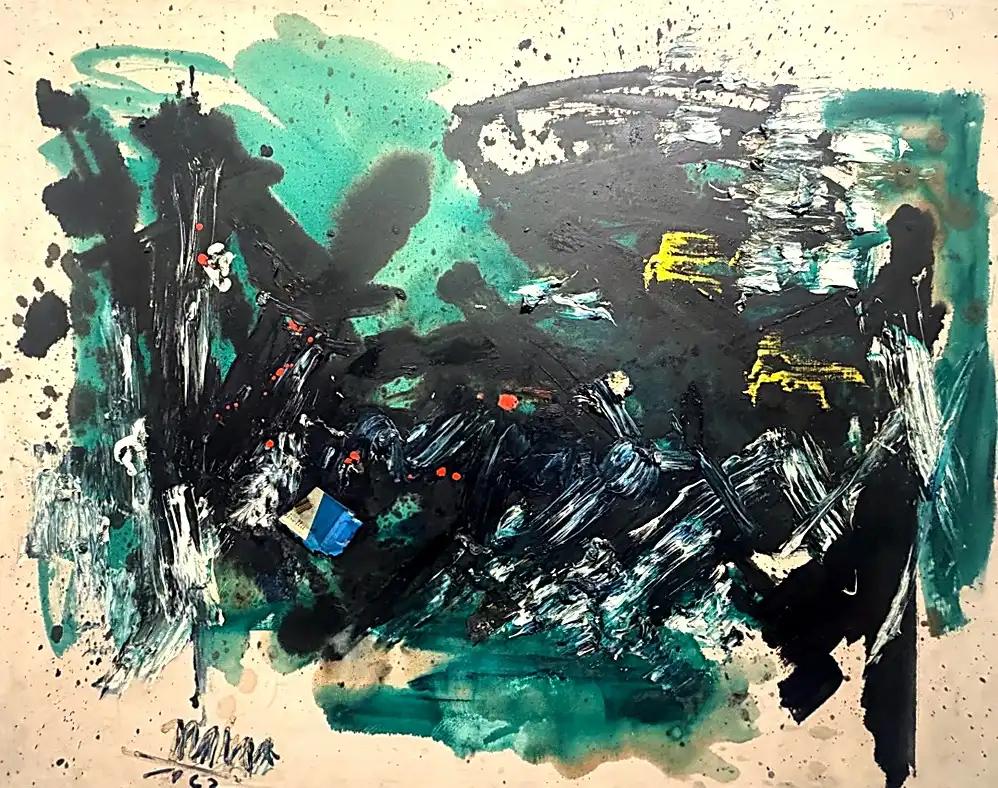
Before there was a $15.1 million auction record, there was an exhibition label. Yayoi Kusama’s No. 3P.B., painted in 1960 and sold at Sotheby’s on November 16, had appeared in the Whitney Museum’s 1961 annual exhibition. Days earlier, the ADAA Fair held its gala in support of that same museum. It is a connection I keep returning to, perhaps because it brings something almost tender into the arithmetic: someone looked closely long before recognition became expensive.
At the Park Avenue Armory, ADAA’s 63 galleries offered ample reason to consider how such recognition takes shape. What interests me about the abstraction presented there is the way it keeps emotion and judgment in productive tension. Working across criticism and collecting, I have a weakness for a painting that first unsettles the body and only gradually gives the mind its explanation.
Perhaps it helps to remember how radical that pleasure once was. With Mountains and Sea (1952), Helen Frankenthaler let thinned paint soak into unprimed canvas, making pigment and support inseparable. Morris Louis and Kenneth Noland’s 1953 visit to her studio helped carry those experiments toward Color Field painting. Rothko’s hovering rectangles and Newman’s vertical divisions, meanwhile, made scale and the viewer’s bodily presence central to the experience. These were related but distinct approaches to postwar abstraction, alongside the charged gestures associated with Pollock and de Kooning. A painting could envelop the person before it; color could become something one seemed to inhabit. For me, that remains an astonishingly intimate proposition.

That history acquires a sharper edge at Hollis Taggart, which paired Michael (Corinne) West with Teruko Yokoi. West, a student of Hans Hofmann, adopted a masculine name while seeking recognition in a world more readily persuaded by male authority. She declined Arshile Gorky’s marriage proposals, determined to protect a career of her own. In Space Poetry (1951–53), oil, enamel and sand give abstraction a physical insistence that feels, to me, deeply moving beside that struggle to be seen. The work asks us to reconsider how the movement’s history was written.
After West’s death, Stuart and Roberta Friedman purchased her unclaimed estate, preserving paintings, works on paper and archives. Their interest had begun with a thrift-shop discovery. I find the language of rediscovery rather polite when the work was there all along. Still, there is something profoundly affecting about two collectors caring enough to keep an artistic life from being scattered. In such a case, stewardship becomes part of the history the market eventually inherits.
Those earlier experiments with color come to mind at Berggruen, where Heather Day presented eight new paintings. Her pigmented washes are cut and sewn into color fields; in Whisper Shifting Light (2026), the canvas’s construction belongs to the painting’s atmospheric proposition. To my eye, the seams make that apparent freedom more poignant: an atmosphere has been patiently assembled. The comparison with Frankenthaler opens a conversation about what contemporary painting can do with its inheritance. I want a painting to be capable of seducing me before I have finished explaining it.

Michael Rosenfeld Gallery’s Alfonso Ossorio presentation, meanwhile, complicated any tidy national account of abstraction. The Victorias Drawings were made in the Philippines in 1950; Dancer, from that year, uses torn and shaped Tiffany stationery. These particularities matter, especially when a movement’s history has hardened into a familiar roll call. Of course, neglect alone confers no distinction. Scholarship earns its authority by bringing the achievement into clearer view.
The opening auctions gave this conversation considerable financial weight. Sotheby’s November 16 double bill brought a reported $378.7 million, including fees; Christie’s sale the following night achieved $626.6 million. Within that billion-dollar opening, abstraction registered forcefully: Kandinsky’s Betonte Ecken (1922–1923) set an artist record at $85.78 million at Christie’s, while Sotheby’s recorded $20.3 million for de Kooning’s Water…Soft Banks and a Window (Untitled VIII) and a record $17.1 million for Sam Francis’s Towards Disappearance I. Their different vocabularies suggest an appetite for several chapters of abstraction’s history.
With Kandinsky, however, the story reaches back before postwar America, into the Bauhaus and an ambition to make abstract form a vehicle for spiritual life. The painting’s passage through Hilla Rebay’s hands and the Guggenheim collection adds another history of advocacy. These are related conversations, certainly, though a geometric composition, a poured stain and Kusama’s repeated nets ask very different things of the eye.

Even here, though, the distinctions are revealing. Kusama’s $12.5 million hammer sat within its $10 million–$15 million estimate; the record included fees, and the lot carried a guarantee and an irrevocable bid. These details suggest that emotional conviction can coexist with financial limits. I find that combination rather heartening. The results establish demand for particular works, while the fair’s historical reconsiderations invite collectors to exercise judgment beyond an established ranking of names.
Of course, the businesses sustaining that work face another arithmetic. The 2026 Art Basel and UBS report, measuring 2025 activity, recorded dealer sales growth of 2 percent against an estimated 5 percent average rise in operating costs. Those figures deserve a place beside the records. A gallery’s ability to preserve an archive or sustain a living artist must be financed between spectacular evenings.
As attention turns toward Miami, that combination of appetite and discrimination gives the season an enticing sense of possibility. I am looking forward, perhaps most of all, to the work that unsettles what I think I know. After all, the intimacy of collecting begins when a painting catches the breath before the mind has quite organized its defense. The questions can follow; they should. I would still like to feel something worth protecting when the room has emptied.
For more information, visit adaafair.org.