The sky is still gold in Charles Burchfield’s Cricket Chorus in the Arbor (1917), although the dark has already begun to make a sound. My eye follows the path until it catches on the black hooks and spiked strokes clustered in the hedge. There, I find myself listening. I tend to think of watercolor in terms of delicacy, of a little pigment carrying an astonishing amount of light. What thrills me about Burchfield is the physical force he gets from such modest means. A wash of gold and a thicket of black marks are enough to make me feel the instant an evening changes around me.
At the Whitney Museum of American Art, Charles Burchfield: Elemental brings together nine watercolors made between 1916 and 1960, all from the museum’s collection. Organized by Caroline Webb, the exhibition comes seventy years after the Whitney’s 1956 Burchfield retrospective. Its concentration on the landscape gives us the chance to follow an unusually persistent inquiry. How does the sense of a place change when a sound passes through it, or when the sky darkens before the ground has surrendered its light?
In 1917, the same year he painted the crickets, Burchfield drew up what he called “Conventions for Abstract Thoughts,” a collection of forms to which he assigned such states as fear and melancholy. The exercise tells us something about his particular strain of American modernism. Abstraction gave him a way to paint sensations that had no agreed-upon shape. A single black stroke in the arbor might read as a leaf. As it recurs, however, the eye begins to measure the intervals, much as the ear distinguishes a rhythm from a single sound. A painting we can take in at a glance begins to unfold in time.

Decades later, in An April Mood (1946–55), a few yellow tips break through the earth beneath a sky that seems capable of forbidding spring altogether. Burchfield wrote in his journal that he had aimed for “the anger of God,” and the Whitney traces the maples clustered in threes to the crosses of the Crucifixion. What moves me, particularly across those four and a half feet of paper, is how much depends on a few frail traces of yellow. Good Friday places suffering before the promise of renewal, and Burchfield holds the field in that interval, when everything coming into life remains exposed.
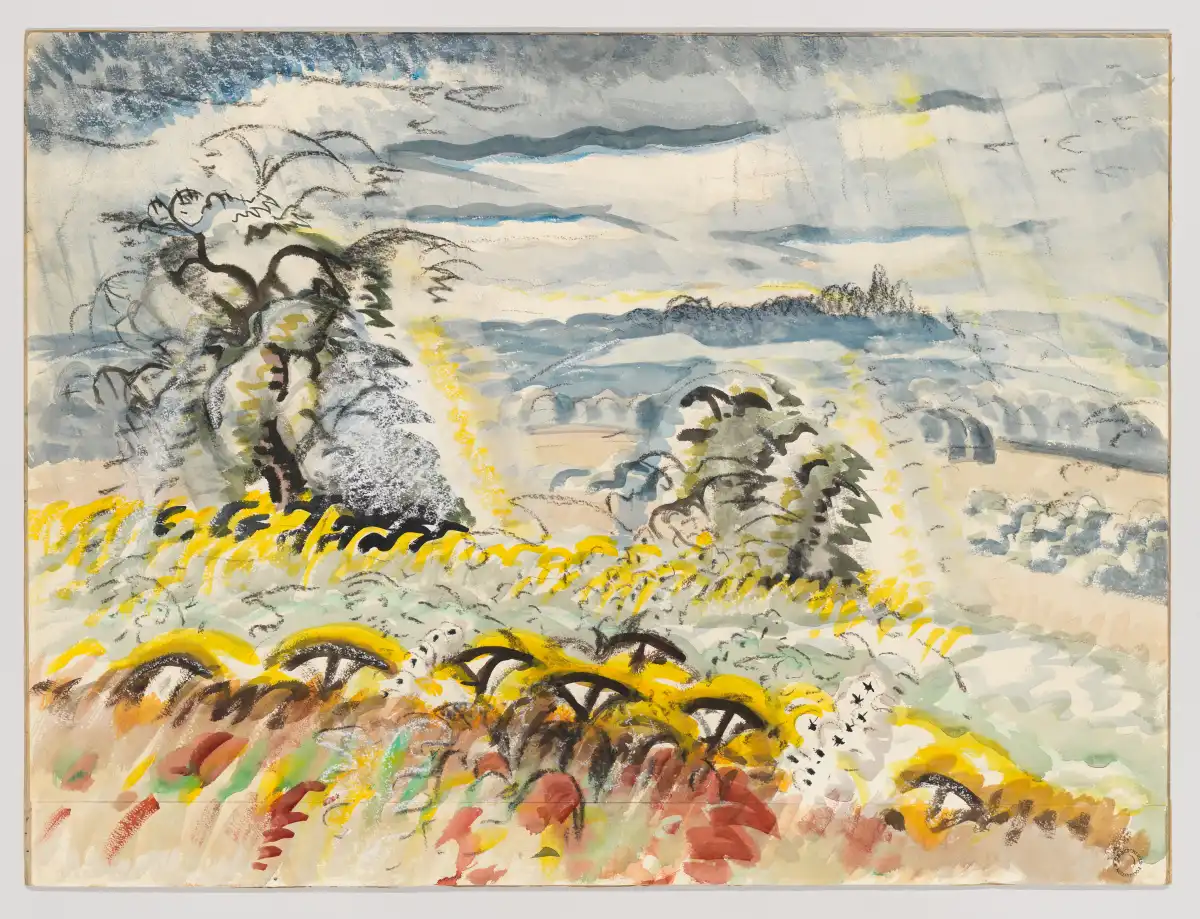
There is a more oblique pleasure in Cold September Rain (1957), in which curving rows and brilliant yellow grasses retain their warmth beneath a gathering gray. The color invites me into the field, although the lean of the trees makes me want to go in with my collar up. Years earlier, Burchfield had written in his journal of the September days he regretted losing to finishing and framing work for the New York fall season. The demands of one September, with its pictures to deliver, kept him from the other September, whose weather would go on without him.

Consider, too, how long he spent painting the swiftest things. Burchfield worked on Overhanging Cloud in July from 1947 to 1959. Yellow dashes fall in long shafts through a break in the clouds, while grasses and wildflowers all lean to the left. His use of relatively little water on the brush gave the strokes their jagged edges and the color its density, and he could return to passages, wet them again, and revise them. A summer squall might turn a field inside out in minutes. It took him twelve years to decide what those minutes could contain.
As winter approaches and New York starts going dark before I’m remotely ready to call it an evening, I can think of few exhibitions I’d rather see. Burchfield is very good company for anyone inclined to take a four-thirty sunset a little personally.
Webb sees an ecological urgency in these paintings, and I keep coming back to how much of a sheet of paper Burchfield gave to the sound of crickets. Somehow, he makes me miss them in advance. What troubles me is how ordinary their disappearance might look to anyone who had never learned to listen for them. A hedge can keep its shape for years after it has gone quiet.
Charles Burchfield: Elemental is on view through spring 2027 on the seventh floor of the Whitney Museum of American Art, 99 Gansevoort Street, New York.