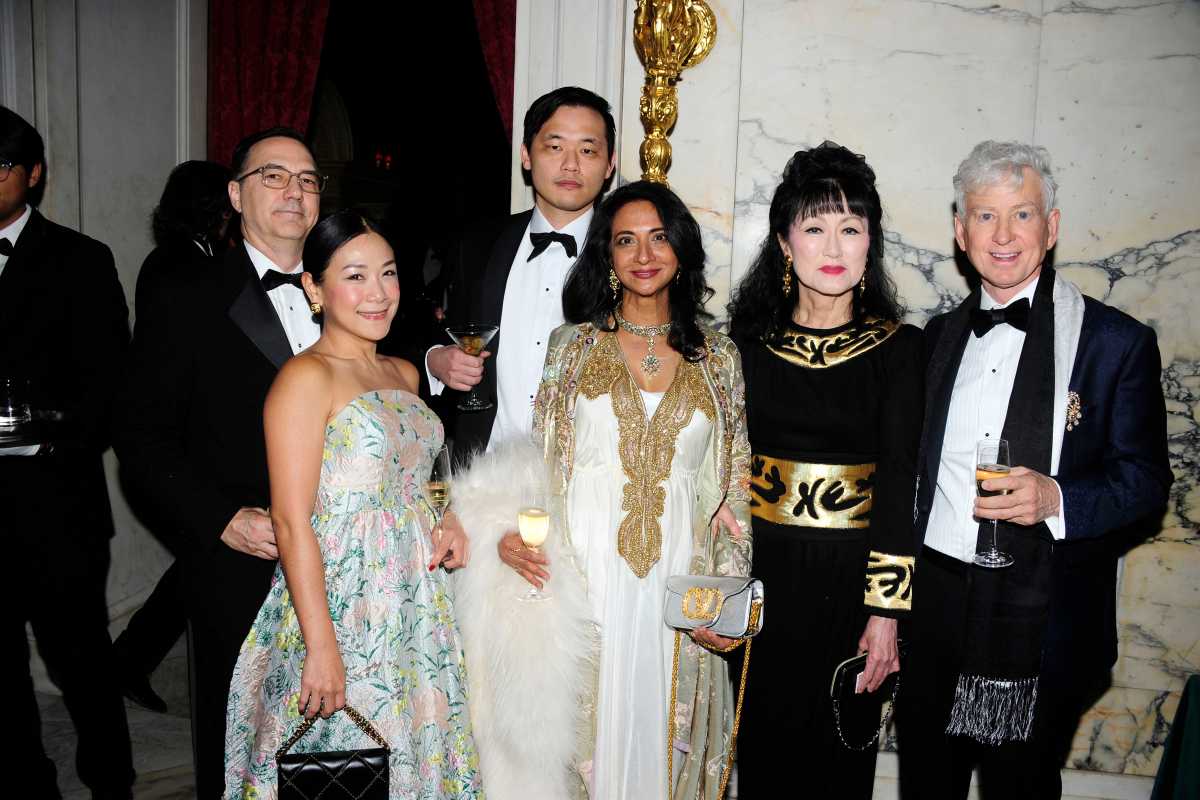
At French Heritage Society’s New York ball, couture and old-world hospitality helped raise money for historic places and the people who will care for them.
Jean Shafiroff’s pale pink train made rather handsome use of the floor. The flowers in her Malan Breton gown were faint enough to reward a second look, and the silver opera gloves made it seem perfectly proper to take one’s time about it. It was, after all, Le Bal Impérial, French Heritage Society’s annual black-tie dinner dance, held last week at a private club in Manhattan. The tricolore hung beside a marble staircase, and in the dining room, candlelight glanced off stemware set among roses and blue flowers, with crimson curtains and gilt moldings behind it all.
Lulu Sezercan Dalkanat had the delicious nerve to put purple gloves with yellow-gold satin, then softened the whole affair with a cream wrap and its dark collar. In Paul Bruinooge’s photograph, Derin Sezercan stands beside her in a gleaming black strapless gown with a cutout that makes a little bare skin go a long way. Ilona Velez held an open blue-and-white fan over ivory scattered with green rosettes, while CeCe Black, in white pleats and green drop earrings, kept hers folded. One can, of course, flirt with a fan in either position. Preston Wilson wore his black bow tie with a bottle-green velvet dinner jacket. As for Shafiroff, she said afterward that her gown had been easy to dance in, a rather important qualification for a train that promised that much drama.


The society took its colors and gilding from the Empire period, when a thing as exquisite as a court gown could also be a matter of economic policy. Napoleon required French-made cloth at court, to the benefit of the country’s silk manufacturers and designers. At one point, the Metropolitan Museum of Art records, even the border of a woman’s court train was limited to four inches. An emperor could, it seems, be quite particular about trim, and there were livelihoods in all that fuss.
Getting dressed for other people is among the more conspicuous courtesies a guest can offer. At table, much the same attention goes into an introduction that gives two strangers something to ask one another and, with any luck, a reason to want the conversation to last. A tactful host can bring a reticent guest into that exchange, too, and give them the lovely feeling of having been expected. Black, the society’s special events chair, welcomed guests with chairman Timothy Corrigan and co-presidents Jean-Guillaume and Stéphanie de Tocqueville. Shafiroff co-chaired the gala with Ann Van Ness and Rebecca Whyte. Myriam Gil, France’s deputy consul general in New York, and Stéphane Foin, deputy director of Villa Albertine, were among the guests.
Fauchon’s tower of pastel macarons stood among blue-and-white folding fans, two very good excuses to stay a little longer at the table. Bernardaud, Baccarat and Christofle were, fittingly, among the evening’s partners, alongside Maison Kébou, Trudon and Pol Roger. The pleasure of a well-made thing is reason enough to take an interest in who will learn to make the next one. In his remarks, Corrigan spoke of safeguarding “the extraordinary skills, the knowledge, the craftsmanship” behind historic buildings and of seeing those increasingly rare traditions passed on.


Brett Sherlock, an international consultant at Christie’s, led a live auction that the society described as record-breaking, with support from Boucheron and Le Bristol. There was also a paddle raise for the Education Program, and Bertille Hantraye, an FHS intern at The Museum at FIT, spoke about her experience there. The internship includes curatorial and archival research, an education, among other things, in how to read a garment closely. The inside of a dress can be surprisingly revealing. A practiced eye can see in the cut and stitching something of what an era expected from both the maker and the person who wore it.
In 44 years, French Heritage Society says it has awarded more than $17 million through over 700 restoration and cultural grants in France and the United States and supported nearly 600 students through transatlantic internships. In Paris, for instance, the society is supporting the conservation of seventeenth-century murals in the Salle de l’Europe at the Hôtel des Invalides. Water has seeped into the walls and loosened the paint, so conservators must stabilize the plaster and secure the fragile layers of color. The work depends, in part, on knowing just how much disturbance a centuries-old surface can bear.
Guests danced to the Bob Hardwick Sound after dinner, and DJ Olivier Meiji kept the afterparty going past midnight with Pol Roger champagne in the glasses. It was, surely, an evening to let oneself be persuaded into one more dance. Years from now, someone may walk into the Salle de l’Europe, look up, and have the innocent luxury of assuming that those paintings were always going to be there.