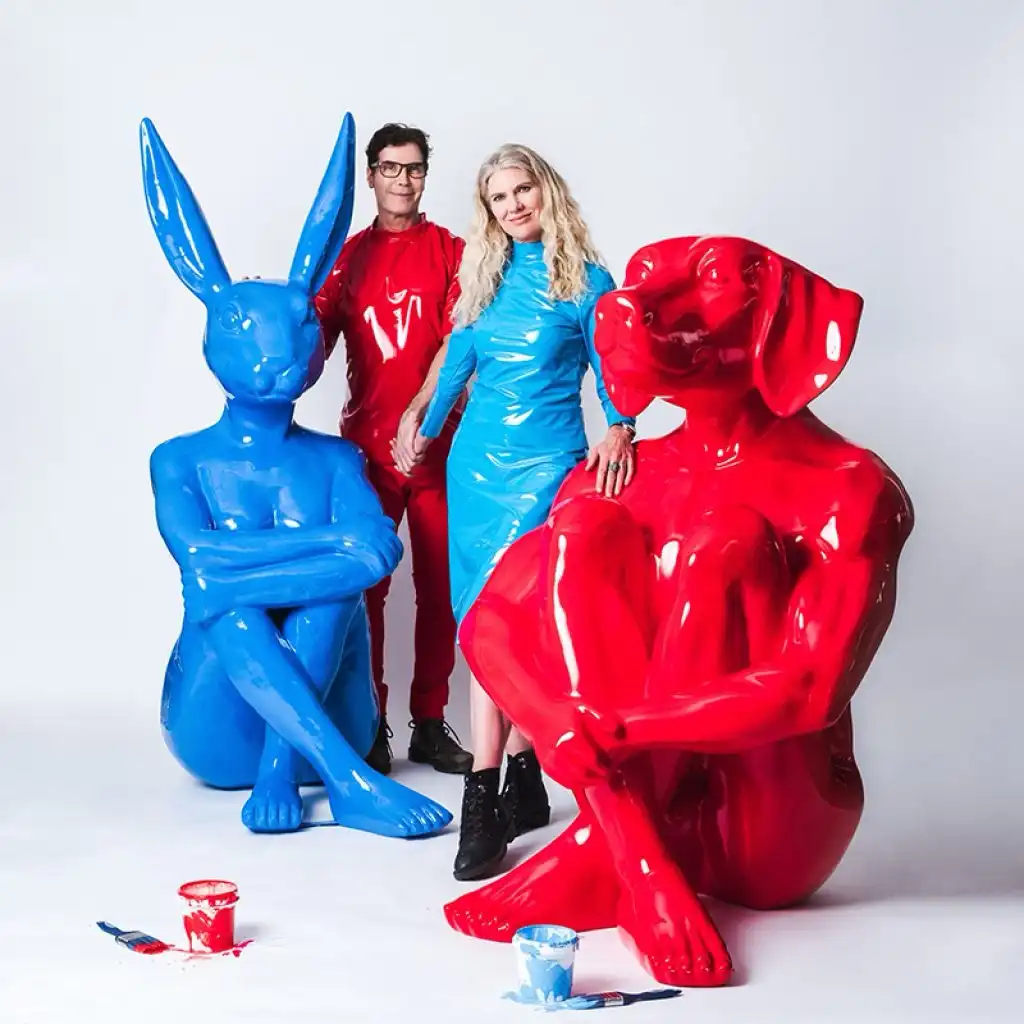
Through ancient hybrid forms, jubilant color and monumental bronze, Gillie and Marc transform a shared life into a deeply human fable about devotion, extinction and responsibility.
Art history has often indulged the romance of solitary genius: one studio, one imagination and one signature beneath the evidence. Gillie and Marc Schattner offer a far more convivial proposition. Their practice is created side by side, with painting, sculpture, marriage and advocacy folded into one sustained conversation. The result feels less like compromise than alchemy, shaped by two distinct histories that continually meet, challenge and enlarge one another.
Collaborative couples are hardly without precedent. Christo and Jeanne-Claude remade landscapes; Bernd and Hilla Becher altered photography through rigorous industrial typologies; Claes Oldenburg and Coosje van Bruggen enlarged ordinary objects into civic theater. Gillie and Marc enter that lineage, although their distinction is unusually personal. Their marriage supplies the recurring characters, emotional vocabulary and central question: what might become possible when difference is treated not as an obstacle, but as a source of invention?
The pair met during a photo shoot in Hong Kong in 1990 and married seven days later near the Himalayas. More than three decades on, that almost implausibly cinematic decision has developed into a body of work seen across more than 250 cities. Their best-known alter egos, Rabbitwoman and Dogman, wander through this universe drinking coffee, riding bicycles, sharing wine and, quite often, inviting others into the scene.

Those hybrid figures carry considerably more art-historical weight than their playful surfaces initially suggest. Gillie and Marc have spoken about encountering the ancient Egyptian tradition of human bodies joined with animal heads, where hybridity conveyed powers beyond the ordinary. Rabbitwoman and Dogman translate that visual grammar into a contemporary language of personality, attraction and partnership. The rabbit and dog, conventionally cast as prey and predator, become lovers and companions instead.
That reversal feels especially astute beside the nineteenth-century animalier tradition. Sculptors such as Antoine-Louis Barye often presented beasts through muscular combat and the drama of survival. Gillie and Marc preserve the physical authority of the animal while replacing violence with alliance. A rabbit and dog seated at a café table may appear charming, naturally, yet the image carries a quietly serious proposition: instinct does not have to become destiny.
Their separate histories lend that idea greater gravity. Gillie, born in London to a Dutch mother and Indian father, spent her childhood in Zambia, where extraordinary encounters with wildlife existed alongside poverty and the horror of poaching. Marc grew up in Australia carrying the legacy of the Holocaust through his Jewish father, the sole survivor of a 20-person family. Those experiences are not equivalent, of course, though both seem to have cultivated an acute awareness of vulnerability, disappearance and the terrible consequences of indifference.

Their paintings introduce another register. Saturated grounds, graphic contours and recurring figures place the canvases, perhaps, in conversation with Pop art’s immediate visual language and street art’s instinct for direct address. The emotional temperature, however, is much warmer than Pop’s celebrated coolness. A bicycle, coffee cup, kiss or animal becomes a private emblem repeated until everyday pleasure begins to feel almost ceremonial.
Bronze permits an even more pointed revision. Civic monuments have traditionally honored rulers, generals and men whose authority was intended to outlast the body. Gillie and Marc redirect that endurance toward endangered species, overlooked women and the improbable tenderness of their hybrid couple. Empty seats, open tables and room on monumental couches invite participation, replacing the distant pedestal with physical welcome.
In that sense, their sculpture recalls the medieval bestiary, where animals carried moral and spiritual meaning. Gillie and Marc create a contemporary version, although their creatures do not lecture from a symbolic remove. A gorilla holding coffee, a rhino beside a chessboard or an elephant gathered at a communal table draws viewers through wit before revealing the more difficult concern underneath. Accessibility is not a concession here; it is the means by which urgency enters consciousness.

Few projects express that tension more poignantly than The Last Three. The 2018 monumental sculpture portrayed Sudan, Najin and Fatu, then the final three northern white rhinos. Sudan, the last male, died only days after the New York installation opened, abruptly transforming a conservation effort into a memorial. Bronze acquires a painful irony in that context: the object may endure for centuries while the living creature stands at the edge of biological absence.
Their Statues for Equality initiative offered another correction to the public record, presenting larger-than-life bronzes of accomplished women, including Jane Goodall, Oprah Winfrey, Janet Mock, Gabby Douglas and Tererai Trent. Conceived in response to the scarcity of women represented across New York’s commemorative landscape, the series treated permanence itself as a medium. Equality was no longer an aspiration printed on a wall; it occupied physical space in the same material historically reserved for male achievement.
Gillie and Marc may ultimately be understood as authors of a new civic bestiary. Their figures alter the social choreography of parks, plazas and streets, encouraging strangers to pause, touch, sit and reconsider. The rhino raises a question about permanence, the elephant carries the shadow of the gunshot and Rabbitwoman and Dogman suggest, with disarming ease, that affection can become a form of public philosophy.
The imagery remains joyful, certainly, though never inconsequential. Beneath the polished metal and vivid color lies a sober conviction that devotion requires practice, visibility carries political force and conservation demands much more than admiration from a comfortable distance. Gillie and Marc make those responsibilities tactile, approachable and, perhaps most importantly, difficult to ignore.
parkwestgallery.com