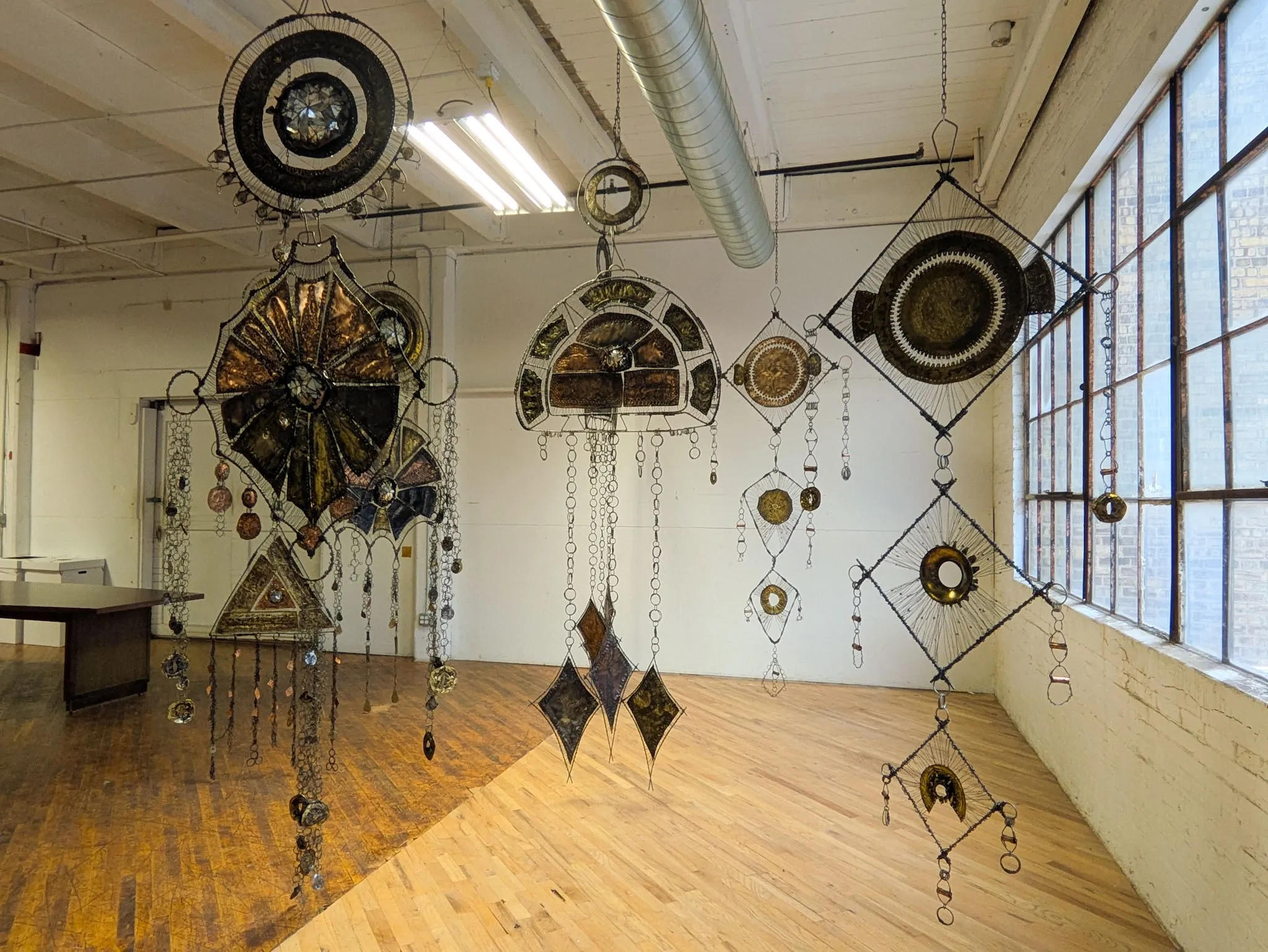
For just over two weeks every September, everyone in Grand Rapids, Michigan, is an art critic. That’s when ArtPrize—a competitive festival famously open to any artist with winners decided by public and juried votes—unfolds across the city, not only in galleries and artists’ studios but also in shops, squares, office spaces, restaurants and theaters. For 17 days, more than 900,000 people, locals and visitors, prowl the streets with catalogs in hand, assessing more than a thousand artworks and casting their votes.
I experienced it for myself this year over three days spent wandering between as many venues as I could before and after moderating a post-performance panel at artist Lora Robertson‘s 1111 Lady of The (boiler) House studio. And by as many as I could, I mean just a fraction of the 159 dotting several square miles of the city. What I saw everywhere I went, on top of art that ranged from the sublime to the bizarre, was huge levels of engagement. There were people on Reddit making and then sharing their own custom interactive ArtPrize maps. Families discussing the relative merits of found-objects-as-artwork in DeVos Place. Groups committed to seeing every work in every downtown space checking venues off in their ArtPrize Passport Guides.

The first entry I saw was See the Forest for the Sea (2024), a sculpture by Japanese-born, New York-based artist Moko Fukuyama installed outside the Amway Grand Plaza Hotel (which was much more compelling than the works displayed inside). I was on my way to the Grand Rapids Art Museum, where I’d see works by Robert Rauschenberg, Jenny Holzer, Richard Diebenkorn and David Hockney alongside pieces by artists of the American Regionalism movement and masters of design from the city’s furniture-making heyday. (“The market for Grand Rapids furniture died in less than a decade, but it took 125 years for all that infrastructure to rot its way through to being replaced,” artist Kevin Draper told me as we explored the art downtown. “And that was due mostly to all the other industries—Bissell, Amway, Herman Miller, Steelcase—that came in the 20th Century and generated dynastic wealth.”)

With a relatively small collection of just 7,000 works, GRAM is the city’s only major arts institution. ArtPrize, which recently concluded its 17th edition, does not have the infrastructure you’d expect from an event that attracts so many people and generates more than $80 million in economic impact. Beyond the museum, Ferris State University’s Kendall College of Art and Design has a network of four galleries. And there are artist studios and nonprofit spaces, but no commercial galleries and no real collector class to speak of, according to Draper, whose God Is An Atomic Bomb and Guns and Money hung outside of 1111 Lady of The (boiler) House.
“The creative industry is actually significant here, but it’s invisible… The dialogue is imported,” he quipped, not unkindly. Cultural criticism arrives in Grand Rapids in the form of the Detroit Free Press and another newspaper out of Ann Arbor, and they’re both owned by the same company. “The audience here is authentic, but it doesn’t grow the way it might elsewhere. There’s no professional audience, by which I mean the best artists in Grand Rapids are not necessarily functional commercially. I’m not sure you can say that about many other cities.”

And yet once a year, it punches so far above its weight class with a single event that artists from around the globe participate. ArtPrize, which bills itself as the world’s largest art competition, has inverted the usual order of operations. Instead of galleries and critics deciding what’s worth the public’s attention, it hands that decision to anyone willing to scan a QR code, for better or worse. And unlike, say, Denver’s Cherry Creek Arts Festival, which is curated by the organizers, the art at ArtPrize is chosen by the venues. “They get really intense about it,” executive director Tyler Loftis told me during a post-ArtPrize chat. “Some of them have been doing this every year—they have dossiers, they go through submissions. It becomes a mini side job.”
A Grand Rapids native and artist himself, Loftis moved to New York when he was 19 and still maintains a studio there. “New York and L.A. have taken on America’s crappy value system—money first, art second,” he reflected. “I come back here and, I’m a little embarrassed to say this, but I am sometimes surprised at the intensity and the depth and the ownership of it. That’s the power of art.”
ArtPrize arguably puts art first, but money talks as loudly in Grand Rapids as it does on the coasts, and the prize is roughly $500,000 divvied up between an artist chosen by a jury of critics, curators, educators and art industry professionals; an artist chosen by popular vote; and several artists who receive smaller prizes that can vary from year to year. The competition is, according to both Draper and Loftis, nothing if not mutable.

“The conversation about who gets to decide what the art should be and how artists are being rewarded has gone back and forth for the whole existence of this event; it’s been a big, ongoing public debate,” Draper said. “They started with only a public vote, and people were voting for what was essentially handicrafts, and there was a backlash from artists. Then the jury came in, and that was a big issue, too. It swung all the way toward private commissions one year, which didn’t turn out very well.” That tension—jury versus Joe Public—has never fully resolved itself, but the discourse around it arguably accounts for some of the grassroots engagement at the heart of the competition. “There’s been this really long, in-depth dialogue about who has the right to talk about art or decide what’s good. And frankly, that’s why ArtPrize was created, even if the original founders didn’t realize they would achieve that.”

The panel I moderated, which followed back-to-back performances of Currents Dance Theatre’s Glitch/Go (which received the 2026 Time-Based Public Award) and Robertson’s Lady Of The House and included Draper, Robertson, singer Ruby Duimstra, Scoob the Artist and several others involved with Satellite Collective’s program, focused on the power of collaborative creation. It’s something I saw in action that evening—Robertson’s powerful hanging heart sculpture complemented by song and dance with Amanda Reed’s 1308 displayed in the same space—as well as next door at stone sculptor Jason Quigno’s Asinaabe Studios and 1101 Godfrey, where some of the best works of ArtPrize were on view: SOMA: Archive of Breath by Merima Smajlovic, Lilly Adkins’s The Cloud Factory and The Wound is the Place by Cary Okoro.
Which isn’t to say that there wasn’t work equal in quality in neighborhoods closer to downtown—the pop-up gallery Cūra and Fountain Street Church each had stellar presentations. It’s just that, as Draper puts it, there can be a lot of noise because “people join ArtPrize for very, very personal reasons.” For his part, Loftis (who came on as executive director this year, succeeding Catlin Whitington) is glad he wasn’t involved in the early years of the competition because he would have tried to over-curate it. “The only thing that keeps it going is the authenticity,” he said, adding that the sincerity was a big draw for this year’s highest-profile attendee, actor Bryan Cranston. “Artists here may not have the studio practice or the time to develop ideas as far or as aggressively as artists in cities with more support, but they’ve found different ways to supplement themselves and be connected.”

The only problem is that once the voting ends and the crowds leave, the infrastructure that springs up around the competition effectively dissolves until the next edition. And yet, Loftis added, “Grand Rapids’s tradition in the arts goes back really far. It’s something we don’t think about or talk about, but we have art on our manhole covers and on the side of our buildings. It’s just part of our mentality and our everyday. Everyone loves the Eames chairs, everyone’s super proud of them, even though they don’t necessarily align themselves with that cultural identity.”
With that in mind, he has thoughts about the future of ArtPrize. He has no intention of pivoting away from the core concept; everything he’s contemplating is additive, from intimate salons to VIP experiences, performing arts weekends and an art fair component with big names but also a broad range of price points. “That’s what I’d like to build here: a new kind of art hub where people come and communicate ideas in an unbranded, art-forward environment,” he said. By not changing too much, “we’re telling the rest of the country that we’re not going to be judgmental, that we’re not going to try to over-architect it. We have this interesting, humble relationship with art. It’s that very Midwest sorry-excuse-me energy. And, yeah, it can be a little corny and overdone, but it really works.”

My trip ended at the Chihuly show at Frederik Meijer Gardens and Sculpture Park, a monument to the dynastic wealth that funded Grand Rapids’s recent development—old-family money moving at civic scale, built to outlast everyone currently alive to enjoy it. ArtPrize is the inverse of that—homespun, temporary, remade from scratch every fall by whoever happens to show up. Both support artists, albeit in different registers. By expanding ArtPrize, Loftis hopes to fill in the gaps and create a more visible and sustainable art scene in the city. But even now, Draper said, “there’s a level of joy here. It’s just fun.”

Art Travel Guides