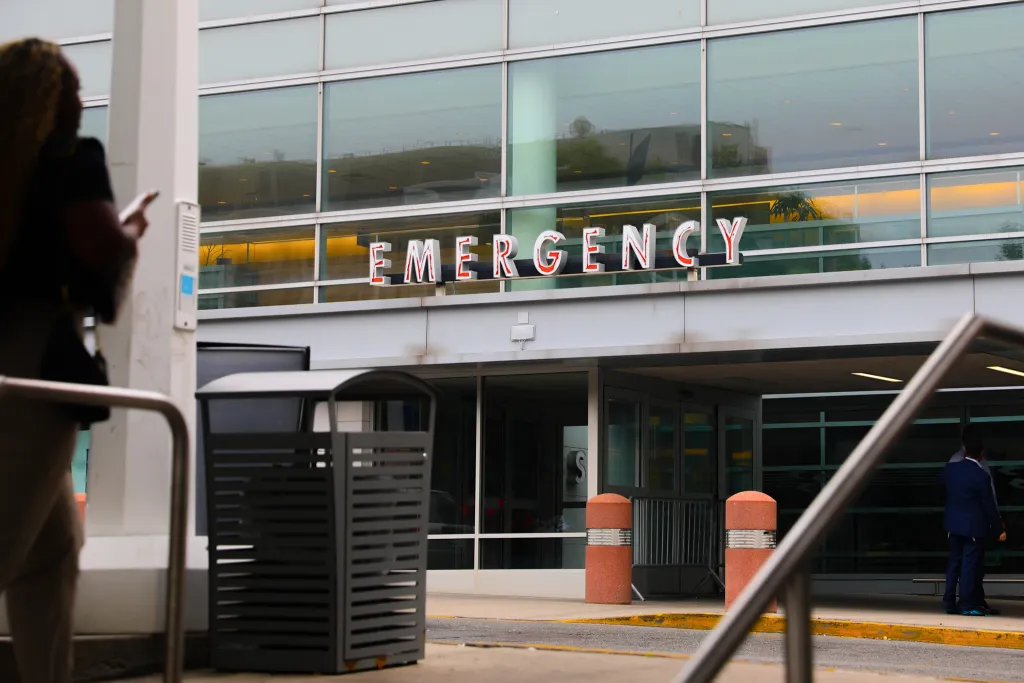
Did New York’s landmark program to give eviction help to low-income people cause a dip in emergency room visits? That’s what a new study points to, studying millions of ER visits in the first neighborhoods where the legal program rolled out.
The research, published Wednesday in the Journal of General Internal Medicine, found that emergency rooms visits dropped in the first 10 ZIP codes where New York began providing free attorneys to New Yorkers facing eviction in Housing Court, begun about a decade ago through its right-to-counsel program.
“Particularly for vulnerable neighborhoods, this program might help tenants avoid ED visits, and so we will be doing future research to try to dig into that a little bit more deeply,” Dr. Katherine Chen, lead author of the study and an assistant professor at UCLA’s David Geffen School of Medicine.
Simultaneously, the study found, emergency department visits related to mental health and substance use disorders actually increased in frequency after the right-to-counsel program rolled out.
New York City launched the nation’s first Right to Counsel program as a pilot in 2016 to provide low-income residents facing eviction with free legal representation. The program started in 10 ZIP codes, chosen based on factors like high rates of shelter entries and evictions, and over about three years expanded by five ZIP codes at a time. Those first 10 ZIP codes included neighborhoods such as Crown Heights and Bedford-Stuyvesant in Brooklyn, parts of Staten Island’s North Shore, Harlem and The Bronx’s Tremont and Kingsbridge, among others.
The program eventually went citywide in March 2020, two years ahead of schedule, in large part due to the COVID pandemic.
Chen and her team examined over 8 million emergency department visits between January 2016 and February 2020 and analyzed the data using statistical models. The study period ended before the citywide expansion of right to counsel and the COVID pandemic, which dramatically altered how New Yorkers sought healthcare.
The researchers looked at ER visits by only New York City residents who either lacked insurance or used Medicaid, not the entire universe of people who visited the emergency room. They did this because the people who have access to an attorney through the right-to-counsel program must earn below a certain income level; the researchers estimated that New Yorkers without insurance or using Medicaid would be more likely to overlap with that lower-income group.
In those first 10 ZIP codes, Chen and her team found there were at least 26 fewer visits to the emergency department per 10,000 residents. But as the program rolled out in future phases and expanded, the rate of emergency department visits didn’t change.
“It was specifically in the earliest phase where we saw this significant decrease in ED visits associated with right-to-counsel roll-out,” Chen said. “We can’t definitively say for sure it was definitely right to counsel that made people go to the ER less in those early ZIP codes, but that’s one leading, possible explanation.”
The study found that 30 months after right-to-counsel implementation, ZIP codes that had the program showed significantly lower rates of emergency room visits compared to ZIP codes that didn’t. The rates dropped most clearly among children, with a decrease of 32 visits per 10,0000.
Danya Keene, an associate professor at the Yale School of Public Health who studies housing policy’s effect on health, said the drop in emergency room visits aligned with previous research.
“Evictions are really harmful to health and are associated with increased ED visits, and so it makes sense that an intervention to mitigate evictions would have this effect,” said Keene, who was not affiliated with the UCLA study. “It’s consistent with what we know about right to counsel reducing evictions and what we know about evictions being harmful for health.”
A large body of research shows how housing security relates to health, and how eviction is associated with worsened health outcomes. Previous studies have shown that right to counsel is associated with improving health along a variety of lines, including a reduction in adverse birth outcomes for babies of Medicaid-insured parents.
“Evictions are obviously bad,” said Oksana Mironova, housing policy analyst with the Community Service Society, “but pulling out exactly the way this looks for people’s lived experiences beyond ‘Do you get to keep your apartment or not?’ is super helpful.”
Impact on Mental Health
One of the study findings was surprising to Chen and her colleagues: In all of the areas where the right-to-counsel program first began, there was an increase in emergency department visits specifically related to substance use disorders and mental health concerns in the five-year period studied.
“We thought that this program would help protect people from stress, and that those outcomes might go down,” Chen said.
Julia Fulton, a housing attorney in Brooklyn who represents clients through the right-to-counsel program, pointed out that people facing eviction experience uncertainty and stress whether or not they have legal representation.
“Even if we are able to stop an eviction or delay it or end the case entirely, being in the process alone is incredibly traumatic,” Fulton said. “Not knowing whether you’re going to stay in your home or not has a huge impact on mental health. And a lot of my clients are dealing with things beyond the housing case.”
The researchers contended with several limitations as they did their work. The team, for instance, did not have information on whether the New Yorkers making emergency department visits were actually being evicted or relying on the free lawyers through the right to counsel program. They also could not track whether a New Yorker who seeks emergency department services and becomes displaced from eviction might move into an area with right to counsel from an area without it (or vice versa), which could affect the analysis.
The city’s right-to-counsel program, which more than 25 other jurisdictions followed with their own versions, has shown to be effective at keeping tenants housed and overall better prepared for court. A 2025 report showed that between 2018 and 2023, about 81% of households facing eviction with lawyers were able to remain in their homes.
Before the program, it was customary for tenants to face off on their own in Housing Court against experienced lawyers well-versed in the nuances of tenant-landlord law. Still, in recent years a rising number of tenants facing eviction have gone to court on their own because of a lack of funding and high caseloads that make it hard for lawyers to meet demand. Housing attorneys providing the services have consistently called on the city to increase funding for the program.
The Mamdani administration, which has emphasized protecting tenants, committed to spending $14 million for right to counsel this fiscal year and $40 million annually in subsequent years.
Rosalind Black, Legal Services NYC’s citywide housing director, said the money was a good start, but the program should be approached as one that stabilizes clients’ lives beyond just eviction.
“It’s a step towards funding the program more appropriately and creating models for allowing some of these secondary benefits to be realized,” she said. “But we need a lot more if we want to have a program that has an impact through people’s lives.”
Our nonprofit newsroom relies on donations from readers to sustain our local reporting and keep it free for all New Yorkers. Donate to THE CITY today.
The post ER Visits Dropped Where NYC Provided Free Eviction Lawyers, New Research Shows appeared first on The City Reporter.