The first woman waiting inside Pen + Brush wears a crown and looks capable of biting the hand that bestowed it. Deborah Buck’s New Jewels had already seized me among the press images; quite fittingly, its namesake canvas is also the initial confrontation in this retrospective. Nothing about the introduction is polite. She crouches beneath enormous gold baubles, her expression suspended between curtsy, grimace and private joke. Sour violets, chalky white and brutal black contour beckon with the lurid magnetism of a circus sideshow. Bold, uncomfortable, oddly beautiful and almost guttural, these portraits carry Baltimore’s streetwise audacity into the supposedly civilized precincts of oil paint.
That jolt reaches the nervous system before the intellect can arrange a respectable interpretation. Curated by Summer Guthery, the survey spans four decades, widening from solitary “Bad Girls” imprisoned within velvety darkness to immense collaged civilizations. Gradually, a consequential question emerges: what happens when the subject stops surviving the role and starts redesigning the stage?
A jewel, after all, is never merely ornament. It commemorates engagements, births, anniversaries and survival; it may carry an ancestor’s touch across generations or provide portable wealth in societies that have often denied women financial autonomy. Yet its symbolism contains a crueler reduction. Women are not simply given gems; they are described, appraised and displayed as though they were gems themselves—precious when polished, coveted while youthful, valuable according to someone else’s desire to possess them. The compliment harbors confinement. Buck understands adornment’s emotional splendor without ignoring the bargain beneath its shimmer. Here, celebration and captivity meet at the clasp.


That double bind takes flesh in the pictures that follow. Runner Up turns the pageant body into a visual emergency: the crouched figure bends under a title defined by insufficiency, as though second place were not merely a result but an entire social condition. In Opera Night, binoculars should bestow the authority of the spectator; instead, they intensify the claustrophobia. She watches a performance while remaining trapped inside one herself, her livid features pressing upon cultured decorum.
New Jewels, meanwhile, drives the argument toward its most merciless conclusion. Laden with ceremonial gold and twisted into submission, its heroine appears conquered by the emblems meant to certify her value. Courtesy becomes a cramp; glamour begins to bruise. These protagonists are not distorted for failing at femininity. Their contortions record the psychic violence required to succeed at it.
Such pressure acquired particular urgency during the 1980s. Neo-Expressionism had returned painting to bodily scale, emotional extremity and conspicuous gesture, while the market again advertised aggression as masculine prerogative. Rather than borrow the era’s swagger, however, the artist redirected its force toward lives regulated by costume and approval. Clyfford Still encouraged her as a teenager and sponsored her attendance at Skowhegan; Grace Hartigan supplied a living model of irreverence and perpetual reinvention.
Baltimore, perhaps even more decisively, offered a rowdier academy. Wedding-shop windows overflowed with cheap veils; the wharf yielded characters with towering beehives, improbable outfits and sufficient bravura to make conventional elegance appear terribly timid. John Waters and his orbit belonged to that atmosphere. Here were people who never waited for good taste to authorize their existence. From them, Buck understood that whatever polite society dismisses as vulgar may contain fierce self-possession. Taste, one begins to suspect, is frequently hierarchy wearing perfume.


Consequently, the sideshow quality is not eccentric garnish. Historically, the grotesque emerged from fantastical Roman ornaments in which human, animal and vegetal shapes ignored the boundaries governing respectable bodies. Later, James Ensor turned masks and carnival performance into modern satire, while George Grosz exaggerated physiognomy until corruption became impossible to disguise. Buck advances that unruly lineage through distinctly feminist intelligence. In the traditional spectacle, the observer owns the stare; at Pen + Brush, the displayed creatures look back. Monstrosity resides not within them, but in standards demanding smaller, prettier and more compliant selves.
From that reversal, fairy tales become less an escape than another contested archive. Raised on a Maryland farm, Buck spent childhood hours among animals and stories in which frogs spoke, maidens slept through catastrophe and heroines became witches after conventional usefulness had expired. Such fables offered metamorphosis, although they also smuggled social order into the imagination.
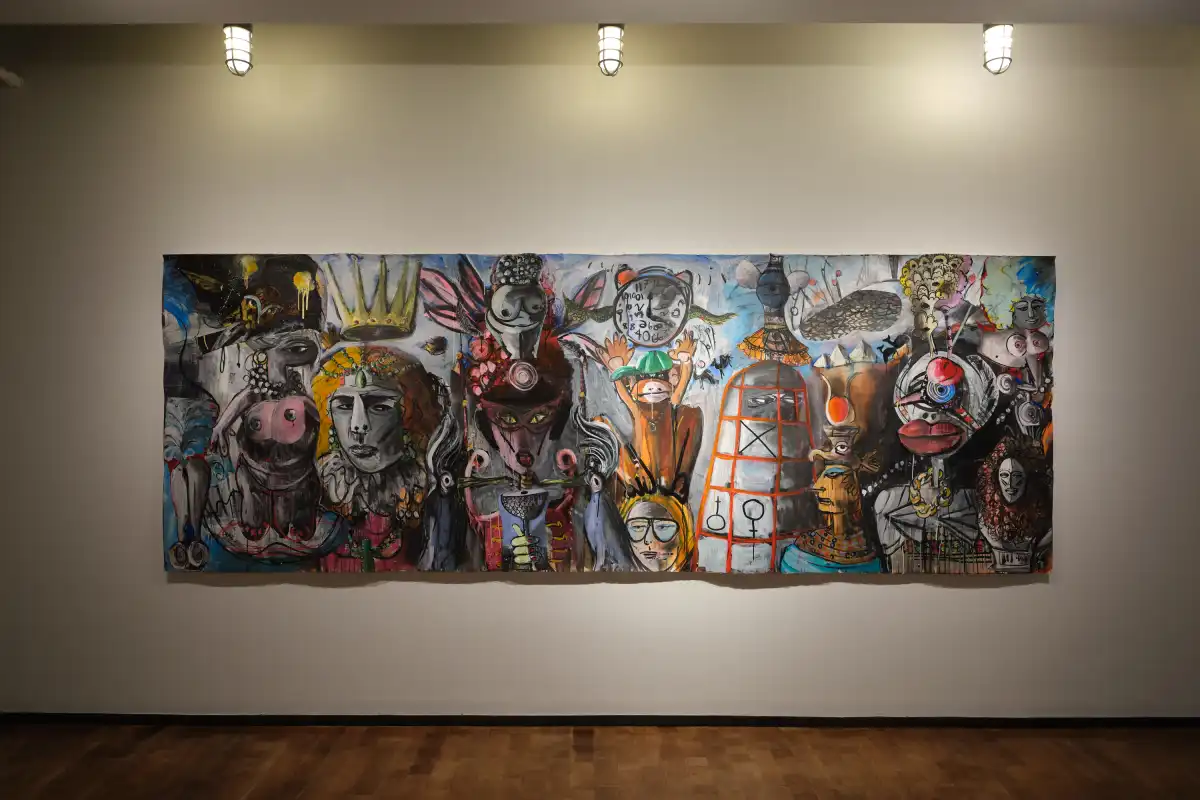
By the 1990s, accordingly, the tightly sealed psychological chamber splits open. Figures yield to eggs, cages, flowers, masks and anthropomorphic beings; objects assume bodily presence, while transformation carries equal measures of promise and menace. Gesture now operates as both structure and atmosphere. Faces tip toward disguises, backgrounds loosen into brushwork, and narrative approaches dissolution in pigment. This is not an abandonment of earlier concerns. The prison has expanded into myth.
Guthery’s sequencing allows that evolution to gather tremendous force. In The Eyes Have It, magnified gazes proliferate until the viewer loses anonymity. One Too Many sends faces, hands and monstrous blossoms surging from an overburdened chalice. Elsewhere, Shootout at Sunset stages a Western duel between an armed rabbit and pig, its absurdity shadowed by America’s devotion to guns. Laughter arrives, certainly, then catches in the throat.
Quite crucially, these recent large-scale collages incorporate sections cut from unresolved earlier canvases. Rejected passages return as indispensable material; previous selves are reorganized and granted renewed agency. Artistic development ceases to resemble a ladder and assumes the character of an excavation. What appeared ruined was merely awaiting a different future. Identity, likewise, is performed, dismantled, exaggerated and continually remade.
Her wider path follows a similarly independent logic. In 2019, Buck founded the Deborah Buck Foundation to support institutions confronting the marginalization of female practitioners. Pen + Brush could scarcely provide a more resonant setting. Established in 1894, it is New York’s longest-running nonprofit devoted to advancing gender equity across visual art and literature, championing women, trans women and gender-expansive creatives through exhibitions, mentorship and professional advocacy.
This presentation is therefore neither fashionable rediscovery nor belated rescue. Buck’s achievement did not suddenly acquire consequence when surveyed institutionally; the historical record has finally begun correcting its eyesight. Within a venue established to dismantle the very barriers her paintings expose, the dialogue feels less convenient than inevitable.
By the final gallery, the isolated protagonist formerly compressed against velvet has escaped into an entire unruly civilization. Watchful forms multiply, flowers develop appetites, animals acquire weapons and discarded remnants return with sharper purpose. More importantly, scrutiny has changed direction. We entered prepared to inspect these excessive beings, only to discover that they have been measuring us—our appetite for beauty, our obedience to rank and our habit of calling a female subject monstrous whenever she exceeds the frame prepared for her.
The indictment, remarkably, feels exhilarating. That crown still glitters, although its wearer is no longer the prize. She is the judge, and the carnival now belongs to her. Deborah Buck: New Jewels is on view at Pen + Brush, 29 East 22nd St., through Feb. 1, 2027. For further information, visit penandbrush.org.