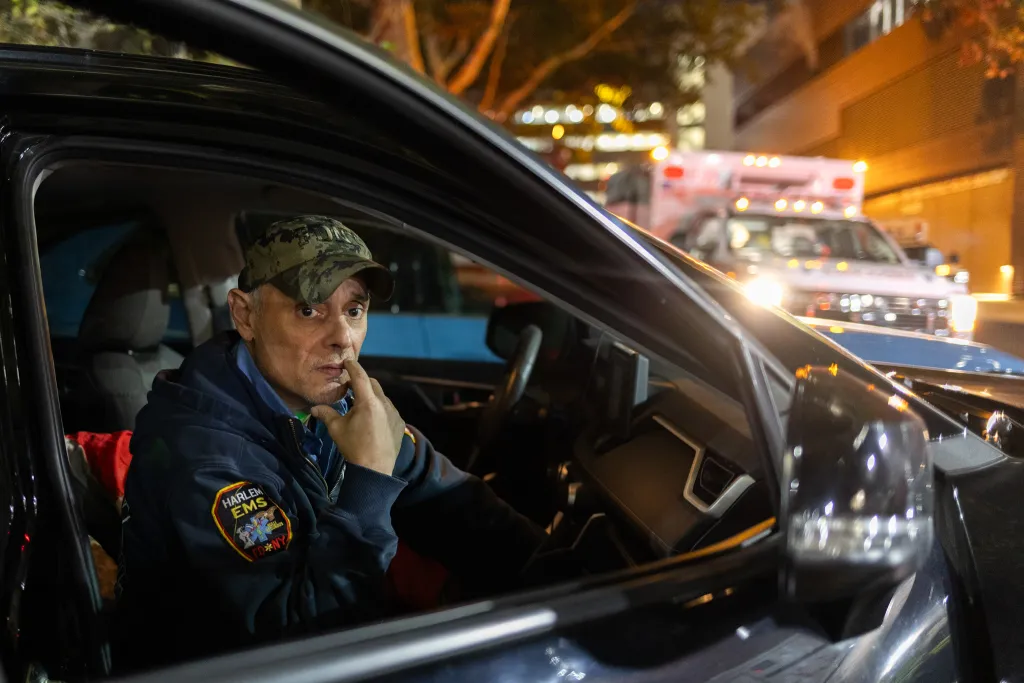
After a twelve-hour shift, most people would undergo a bleary-eyed commute home, enjoy whatever show they’re currently binging, and go to bed before doing it all over again the next day.
But not Alex Gomez.
Gomez, a 31-year veteran of the city’s Emergency Medical Services, lives in East Stroudsburg, Pennsylvania, a longtime landing strip for New Yorkers looking to buy a home that would otherwise be out of reach in an increasingly expensive city.
At the end of each work day, Gomez punches out of his station at Harlem Hospital and heads towards the parking lot to his SUV, lays the driver’s seat all the way down, cracks open the window and tucks in for the night. He has done some version of this routine three to four days a week since 1997, when he bought the Poconos home where he lives with his wife and raised their two children.
“Everybody at work jokes around,” says Gomez, a supervisor. “They call it ‘Hotel RAV4.’”
Westward Ho!
He is one of an untold number of workers who’ve chosen to make their lives two states away in the Pocono Mountains, where New York salaries stretch farther, and they’re surrounded by nature, peace, quiet and space for their children to roam.
In the approximately five decades since the migration began with the completion of Interstate 80 connecting New York to eastern Pennsylvania, these New Yorkers have transformed a cluster of towns, making them among the most diverse in that region.
In his election night victory speech last year, Mayor Zohran Mamdani invoked the Poconos commuter, describing an 1199SEIU member named Wesley as “a New Yorker who lives elsewhere, who commutes two hours each way from Pennsylvania because rent is too expensive in this city.” (Wesley, through his union, declined to speak with The City Reporter.)
The Poconos-to-New York commuter comes in many forms.
There’s the white-collar worker taking advantage of the work-from-home revolution to try exurban living. There’s the yawning immigrant day laborer arriving at the George Washington Bridge before dawn to start looking for a gig. And there’s the blue-collar worker — the civil servant, the medic, the union porter or electrician or laborer — who, priced out of the five boroughs and their immediate suburbs, is forced to venture westward for their slice of the American Dream.
A recently renovated 1,383 square-foot three-bed, two-bath ranch-style home on an acre of land in East Stroudsburg is currently listed for $315,000; a comparatively sized ranch on Staten Island — the borough with the largest concentration of civil servants — is going for more than twice as much, at $760,000.

Yes, there is the peace and quiet and bucolic scenery and the space. But for many former New Yorkers the decision boils down to economics: their New York City salaries stretch much farther two hours away.
It’s a dynamic that has long vexed New York’s labor leaders. New York City has residency requirements for most civil servant jobs, though they vary by job title, status and agency. Workers in some jobs designated as “hard-to-recruit,” like those in the Emergency Medical Services, are not required to live in the city.
Anthony Almojera, the president of Local 3621, which represents EMS officers, was unable to provide specifics, only that a considerable share of his members live in Pennsylvania — and even as far as Delaware.
“What kind of society are we that the people who are specifically here to help us in our time of need, cannot afford to live in New York City, the city that they work for?” he said. “The sacrifice that is made by these people is tremendous. The only place to afford to live as a New York City FDNY EMT is Pennsylvania? That’s crazy.”
Real estate companies make direct appeals to home buyers from New York and New Jersey. There have been talks for decades of reopening an abandoned passenger rail line connecting Scranton to New York City via East Stroudsburg. There is a cottage industry of bus and van companies connecting Poconos commuters via the George Washington Bridge bus terminal.
A Taste of the Old Neighborhood
Some former New Yorkers who moved to Monroe County in recent years say that, in some respects, it feels like they never left. One construction worker notes that all of his neighbors are New Yorkers — Puerto Rican, Dominican and Haitian families from The Bronx and Brooklyn; one is a cabbie. Gomez often meets with two fellow members of his union, Local 3621 of the Uniformed EMS Officers Union, to kill time at a local shooting range.
Today, nearly 40% of East Stroudsburg’s population is Black or Latino, according to the Census. The town’s share of Black residents (20%) is nearly identical to that of New York (21.9%). Over the decades, the schools went from being “90% white, to now they’re about 50/50,” according to Kelly Lewis, the town’s borough manager. Lewis, a Republican former state lawmaker and 12th-generation Stroudsburger, takes pride in his hometown’s transformation. “We have a very diverse population now.”
Despite the region’s growing diversity, several former New Yorkers shared shared stories depicting a mixed reception.
Dorothy Leconte, a yellow cab driver, recalled an incident 15 years ago at a Home Depot parking lot near her East Stroudsburg home. She went to the store to pick up a few things and when she returned to her parked cab, she found a handwritten note that read “Get your ass back to New York. There’s no place for you here.” Leconte, who is from Haiti, said her son also experienced racist bullying as a child in East Stroudsburg’s elementary schools in the early 2000s.
‘I Wanted to Cut My Wrists’
The commute to and from the Poconos has consistently ranked among the worst in the country — made worse, as was the case last year, when a series of massive sinkholes opened in sections located in Morris County, NJ, stretching commute times on I-80 by an hour in both directions for months as repairs were underway.
One worker at a NYC social services agency described the ensuing five-hour roundtrip traffic: “I wanted to cut my wrists and bleed out.”
But The City Reporter spoke to more than a dozen people who feel having peace, quiet and a home they can afford is still worth the long commute.

Gomez, the EMS lieutenant, grew up in Throggs Neck. He and his wife, a fellow Bronxite, tried buying a home in the borough in the mid 1990s but the newlyweds discovered they were priced out — not just from The Bronx, but from Long Island and Westchester, too. They bought their two-level East Stroudsburg home in 1997 for a fraction of an equivalent home in the New York metro area. He’s lived in Pennsylvania for nearly his entire three-decade career in New York City’s emergency medical services.
Gomez is just one of many New York EMS technicians and paramedics, who receive the lowest pay among the city’s first responders, to have made a home in Pennsylvania.
Winslow Luna Jr., a paramedic, moved to East Stroudsburg in 2019 following in the footsteps of his own parents, who made the jump a few years prior and still work in New York.
A New Life
Luna, 35, grew up in the Woodside Houses in Queens and said he wanted more for his young family.
“There was a bullet that missed my head when I was sleeping there, like about eight years old, and the hole was still on the wall when I left that apartment,” he said.

He married his high school sweetheart, a fellow FDNY paramedic, and they closed on their 2,700 square-foot two-story house in October 2019 for $198,000, he said.
“I remember I used to get jumped like every two weeks,” he said. “It wasn’t easy growing up over there. I didn’t want that for my daughter.”
New Yorkers arrived in the Poconos in three major waves. There was the COVID bump at the beginning of this decade, and a post-9/11 wave exacerbated by what became the subprime mortgage crisis. But the first New Yorkers arrived in the mid- to late-1970s, after the completion of Interstate 80, a period that coincided with the city’s near-bankruptcy and an exodus of white New Yorkers to the suburbs.
Lewis, the East Stroudsburg borough manager, remembers the sudden arrival of new kids around 1977, when he was in middle school. These kids spoke differently, wore trendier clothes and talked nonstop about basketball, while the town kids worshipped football.

“They started showing up in our seventh or eighth grade classes,” said Lewis. “They said they came from New York, but they definitely just dressed differently, brought the trends with them.” The accents and the last names — at the time, predominantly Italian — were another giveaway, he recalled.
The population exploded, such that there are now two public high schools — though football is still king, as it was in Lewis’ boyhood. The East Stroudsburg South Cavaliers were the division champs in 2024 and are hoping to come back this year after a disappointing 2025 season.
In the late 1990s and early 2000s, another crop of first-time home buyers — many of them Black and Latino — from New York looked to the Poconos to settle their roots. (Anecdotally, some locals and real-estate professionals say the 2001 attacks on the World Trade Center aided this second wave.) Flocks of New York City civil servants and blue-collar workers were duped into buying spacious houses for a bargain compared to city prices — only to later learn their home’s value had been wildly inflated, making them victims of a vast fraud described in a 2003 City Limits article as a “real-estate–scam hell.”
The result was devastating: Even before the national real estate bubble burst in 2008, one in five homes in Monroe County, at the heart of the Poconos, were in foreclosure, according to a 2004 study commissioned by two Pennsylvania state agencies.
“It was a desperate time,” said Lewis.
‘Everything’s Cheaper’
Slowly the region began to rebuild. Today, East Stroudsburg property values for the first time surpassed pre-2007 levels, according to Lewis. There is a flurry of new construction for the first time in decades: Pocono Township approved plans to build hundreds of new townhomes earlier this year, and East Stroudsburg has conversion proposals for 40 homes. Amid all the development, the biggest controversy is a plan to dot the region with data centers, including two 125,000 sq-ft facilities in East Stroudsburg.
East Stroudsburg’s main downtown strip is dotted with pubs, boutiques, brunchy cafés, and Dominican and Jamaican lunch counters. (On a recent afternoon, Gomez’s wife, a self-described foodie, regaled visitors with local restaurant recommendations and served Argentine alfajores and other cookies from a nearby bakery.)
COVID brought on another wave of home-buyers, says local realtor Cindy Lecht, and the region’s low inventory has caused home prices to surge. According to Redfin, the real estate firm, the median home price in Monroe County this summer rose 11.9% compared to last year, to $346,000.
Lecht, a second-generation realtor in the Poconos, has said that New Jerseyans and New Yorkers have long provided reliable clientele in the area.
“I think people come out here looking for the same things: everything’s cheaper, taxes-wise, car insurance is cheaper, and they are able to get a large home for a very reasonable price without having to think too much in terms of school or property tax,” says Lecht.

“We’re literally an hour and a half from Manhattan, so we’re not that bad of a drive,” she adds. “For people who have a family that is growing, I can imagine these are all reasons why they come to our area.”
A proposed Amtrak extension that would restore passenger rail service between East Stroudsburg and New York City has been a political hot potato for decades. The administration of Pennsylvania Gov. Josh Shapiro, a Democrat, is in the early stages of determining the proposal’s feasibility after receiving millions in federal funds for rail expansion across the state in 2023.
In the meantime, commuters find creative ways to get to and from their jobs in the city. There’s Gomez, who sleeps in his car. Luna drives a motorcycle to his three to four weekly shifts to save on tolls on the George Washington Bridge and Manhattan’s congestion pricing.
Leconte obtained her taxi medallion in 1989 and lived in Queens Village until 2004, when she closed on her house in an East Stroudsburg gated community after seeing a real estate ad in the Daily News.
Whatever skepticism Leconte felt about moving two states away evaporated when she toured the neighborhood.
“I just fell in love: it’s quiet, the house was so big, there was a lake. I had space for my car,” she said. “There was no crime; there were no drugs. And I thought to myself, ‘Well, 90 minutes from New York is not that bad.’”
For years Leconte, a single mom, would make the roundtrip to New York up to seven days a week – rising at 3:30 in the morning — but now she stays with relatives in Hicksville, Long Island, a few days a week.
Escape From Old Bed-Stuy
Derrick Jones, a mason tender with Laborers Local 79 for 17 years, drove from his home in Henryville five days a week, rising at 3:15 in the morning to start his commute. One morning three years ago, he endured a bad accident about 40 minutes from the city. There was heavy rain and low visibility, he said, and he struck the median on Route 280 in New Jersey, totaling his car. Now he stays with his sisters in Brooklyn a few nights a week to save on trips.
The traffic, they all admit, is awful, especially in the evening rush. But to hear people like Jones and Gomez describe it, the trade-off makes sense: After all that driving, they arrive home, sit on their porches overlooking spacious, forested land and enjoy that one amenity that is hard to find anywhere in New York: Some peace and quiet.
“Besides,” Jones offers, “with traffic, it takes two hours to get to Long Island, too.”
Jones, 54, grew up in Bedford-Stuyvesant, Brooklyn, and took an anywhere-but-New York approach to his home search. He couldn’t afford to stay in the city, and at the end of the day he said he wanted more for his young son, who is now 15.
He picked Henryville, a Monroe County village of 3,500, because of the quality of its school district. As much as he loves his home borough, he has zero regrets about his decision to move to Pennsylvania in 2019, where he owns a newly-built home with nearly an acre of land.
“I wanted a better life, I didn’t have the money and I wanted to get out of the environment that I came from,” he says. “If my son’s happy then I’m happy. I want him to have things that I never grew up with myself.”
‘New York Was My First Choice’
Ashley Alejo, an EMS lieutenant who came up in the service alongside Gomez, lived in Morristown, New Jersey, early in his career where rent was cheaper than in Astoria, where he grew up. But when was ready to buy a house, he found that he was priced out of North Jersey, too.
After years of diligent saving, and working punishing overtime shifts, the search left him feeling dispirited: “New York was my first choice.”
Gomez and others convinced him to take a look at the Poconos. The commute, they assured him, wasn’t so bad. He closed on his Long Pond, Pa. home, about 30 minutes west of East Stroudsburg, for around $200,000 in 2005.
Naturally, after working for 60 hours a week, and dedicating at least 25 more to drive to and fro, there is little time for rest and leisure. Life in Monroe County is quiet, and that’s just fine for the long-haul commuters. The taxes are low. After the busy summer settles and the weekenders go away, they’re left with the beauty of the Delaware Water Gap all to themselves.
Still, with so many ex-New Yorkers around, one wonders where they hang out. Is there a Knicks bar where they all saw the team’s miracle playoff run? Do the guys from the local ever get together for poker, or a family barbecue?
“No, but that’s actually not a bad idea,” offers Alejo. “Maybe I should start that up.”
Our nonprofit newsroom relies on donations from readers to sustain our local reporting and keep it free for all New Yorkers. Donate to THE CITY today.
The post Welcome to Hotel RAV4: The Brutal Commute of New Yorkers Priced Out to the Poconos appeared first on The City Reporter.