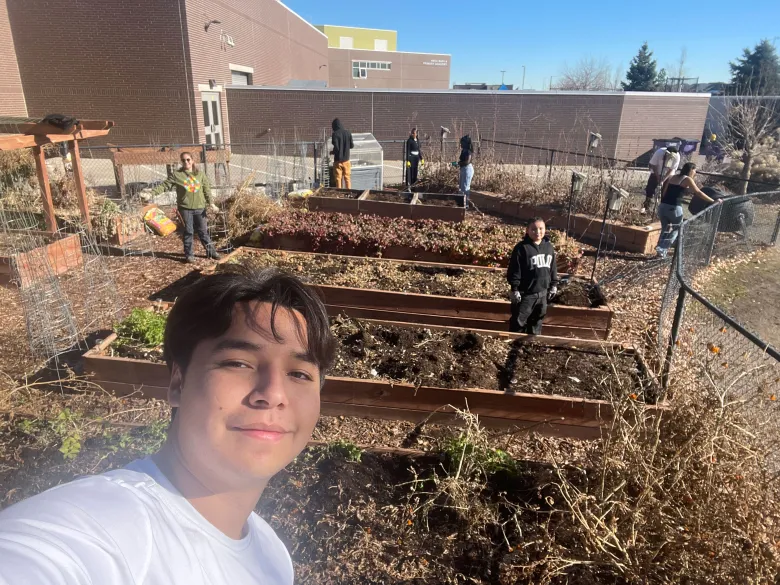

As a student at a high school not far from Denver’s main airport, Anthony Muñoz wondered whether the jet fuel from airplanes flying above his campus was harming living things.
An avid gardener, Muñoz partnered with a local university to create a garden on the campus of his charter school, Vista Academy, filling it with native plants that could detect ground-level ozone pollution. He also worked with climate scientists from the National Center for Atmospheric Research, a federal office in nearby Boulder, who directed Muñoz on what data to collect, what the condition of leaves reveals about air quality and why milkweed matters for monarch butterfly migration.
“One garden’s a very good data source,” said Muñoz. “Colorado’s so beautiful, and I would hate to see it wilt away.”
Muñoz built the “ozone garden” for his capstone project as part of Colorado’s seal of climate literacy, a statewide initiative that pairs climate-focused coursework with hands-on community service. To earn the seal — an endorsement on high school diplomas and transcripts — students must complete at least two advanced courses that cover the Earth’s climate systems and an approved project that tackles a climate issue in their community.
Since 2024, when Colorado lawmakers approved the seal, 26 of the state’s 179 school districts have adopted it, according to Lyra Colorado, an education nonprofit that advocates for the seal. Now, the model is spreading to other states. Maine adopted its own climate seal earlier this year, and California just signed into law a bill to establish the seal for graduates there. Youth coalitions have pushed for the policy in Hawaii and Minnesota, with varying success.
Proponents of the seal argue that young people must understand and combat climate change, without waiting for political leaders to reach consensus on how it should be taught in schools. They also hope the endorsement will connect students to a rapidly expanding green workforce, preparing them to work on solar grids and climate-resilient farms or in water resource management and urban heat mitigation. And, as climate change begins to alter almost every aspect of human life, the seal could offer anxious teenagers a sense of agency and ability to make some difference.
“Where we can make the most difference is often in our local community,” said Laura Schifter, a senior fellow with the Aspen Institute’s This is Planet Ed, a climate education group. She said the seal offers students a chance to learn about climate change, a topic rarely covered in depth in K-12 classrooms, and called it “a really promising policy.”
Still, the seal has faced hurdles, including tight school district budgets, concern about new burdens on schools and the federal government’s attempts to refute climate science.
Lance Izumi, senior director of education studies with the free market think tank Pacific Research Institute in California, which has been criticized in the past for sharing disinformation about climate change, said he’d rather see students focusing on the fundamentals of science rather than what he considers activist community projects. He noted only a third of students in the Golden State test as proficient in science.
“Diverting focus away from foundational science learning could worsen California’s already abysmal performance levels,” he wrote in an email.
Related: Interested in climate change and education? Sign up for our newsletter.
The idea for the seal originated with Lyra Colorado, the nonprofit in Denver that supports community-based education programs. Rural students and educators the group was working with on another climate-related project said they wanted a way to explore climate change as a reality in their daily lives, not just through a dense unit in a textbook, according to Mary Seawell, Lyra’s CEO.
To earn the seal, students need to complete two classes that promote “climate literacy,” or basic principles of climate change such as its causes and how to mitigate it. One of them must be a science class, such as environmental studies, biology or earth science. The other course can be in any discipline, including the humanities or fine arts. For example, this year Denver Public Schools will build lessons about climate change into its state-mandated civics course, Seawell said. Students also must complete a school-approved capstone project in their local community; a running list of student projects includes ones related to beaver dams, building trails, snow science and forestry management.
The program is voluntary; districts can choose whether to offer the seal on diplomas, and individual students in those districts can decide to pursue it or not. An estimated 1,200 students have received it so far, said Seawell.
Funding, though, has been a challenge: State lawmakers provided less than $20,000 for the seal’s rollout. Many students fund their projects out of pocket or, like Muñoz, secure grants. He cowrote a $1 million grant proposal to the city to pay for the gardens at his school. Lyra created its own grant program to help local schools pay for teachers’ time, student projects and even graduation cords.

Muñoz, now a sophomore studying mechanical engineering at the Colorado School of Mines, said the seal allowed him to learn climate leadership skills. He’s now vice president of the college’s environmental club and tries to inspire his peers to take action.
“Are you going to think beyond yourself and help not only those in need but the environment, or will you sit back and wait for someone else to change the world for you?” he said.
As more students like Muñoz graduate with the seal, many have started to work on climate issues at their colleges and in new states.
Rylan Neumann graduated last year from the Boulder Valley School District, enrolling that fall at the University of California, Berkeley, to study environmental economics. Almost immediately, she joined an eco-club and boarded a train to Sacramento, where she lobbied state lawmakers in support of the state’s pending climate seal bill.
“Getting more students involved in climate action and how they’ll be impacted in the future is essential,” she said. “Students are the future. We’re the ones growing up in this world.”
Young people have pushed for the seal in other states too. In Hawaii, a student member of the state board of education championed the endorsement for high schools on the islands. The Minnesota Youth Council, a state advisory board with representatives from middle and high schools, recommended the seal during this year’s legislative session.
Related: Education that convinces kids the world isn’t doomed
State education officials in Maine, meanwhile, adopted the seal directly to avoid legislative debate.
“Students want to be involved in climate action, in environmental literacy, in green careers,” said Teddy Lyman, the K-12 climate education specialist in Maine. “They’re often doing the work already but don’t have the recognition. They didn’t see a sort of pathway to continue that work and embark on that as a potential career.”
Maine already offers a seal of biliteracy, which recognizes students for proficiency in two or more languages. That made it easier to adopt the new seal, Lyman said.
The seal also complements existing state guidelines that require schools to incorporate traditional ecological knowledge, or Indigenous studies, into all classes, said Lyman. He added that grounding the seal in local capstone projects also could lower climate distress among youth.
“No more global doom and gloom,” Lyman said. “Students can feel empowered to make a difference in their community. They’re not trying to solve something for the U.N. They’re advocating at their town committee instead.”
During a spring pilot across nine high schools, Lyman expected roughly a dozen students to apply for the seal. Instead, he said, 57 seniors did.
Melissa Luetje teaches science at Freeport High School, which enrolls about 600 students, many of whom earn money on lobster boats and aquaculture farms growing oysters or seaweed. Warming and rising sea levels have hit nearby Casco Bay hard, eroding coastal infrastructure and flooding surface streets.
The Gulf of Maine is warming faster than almost any other body of water on the planet, Luetje said. “That means all eyes are on us. There’s so much good science happening in our backyard.”
For a seal-approved class she teaches on research, students will monitor woodlands for insect damage, develop new ways to compost or commodify an invasive crab species, and work on a sustainable fishery.
“How climate impacts the coastal community is very different from the interior or a city,” Luetje said. “It’s up to each community to figure out what they value and how they want to roll this out.”
Related: The greening of career education: Students learn new skills they’ll need as climate change advances
As the seal expands, proponents have tried to connect the high school endorsement directly to career and technical education and green workforce pipelines.
Lyra Colorado has started working with higher education institutions like Colorado Mountain College to align the seal with certification in the skilled trades, such as heat pump installation, solar grid maintenance or sustainable agriculture. She hopes universities will offer a partial minor or a course credit for incoming first-year students who have the climate endorsement.
At the same time, President Donald Trump has attacked climate change as a “hoax,” and new federal scrutiny of renewable energy projects threatens philanthropic support for such initiatives. The Treasury Department and Republicans in Congress have targeted the tax-exempt status of nonprofits that support climate causes, which Seawell said created a noticeable chilling effect among potential donors.
“Funders are worried,” she said.
The Trump administration has also tried to pull funding from and dismantle the National Center for Atmospheric Research, the climate research center that helped Muñoz with his school garden. He called the proposed cuts “devastating.”
Still, Muñoz, who plans to pursue biomedicine and one day become a professor, remains focused on climate issues.
He met virtually with students pushing for the seal in Minnesota. And he spent his first college break back at Vista Academy, assisting younger kids in the garden. They recently put the final touches on an elevated box designed for gardeners in wheelchairs.
And he’s writing code to make it easier for Vista students to continue collecting data in the ozone garden — even if it’s not clear when, or if, NCAR scientists will get to use the data.
Contact staff writer Neal Morton at 212-678-8247, on Signal at nealmorton.99, or via email at morton@hechingerreport.org.
This story about climate literacy was produced by The Hechinger Report, a nonprofit, independent news organization focused on inequality and innovation in education. Sign up for Hechinger’s climate change newsletter.
The post In an age of climate disaster, more states offer students a way to show they are ‘climate literate’ appeared first on The Hechinger Report.
